
How WNBA Player Development Differs from the NBA
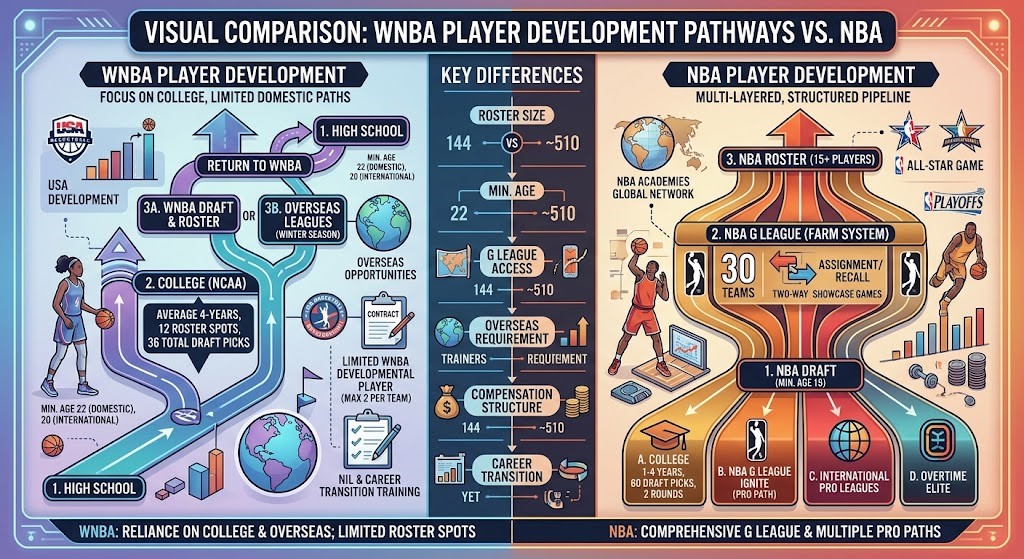
How WNBA Player Development Differs from the NBA
Basketball players at the professional level have already reached an extraordinary standard of athletic ability and skill. However, reaching a professional league is not the end of player development. It is the beginning of another stage in an athlete’s career.
The development process in the Women’s National Basketball Association and the National Basketball Association shares many fundamental principles. Players in both leagues work with coaches, trainers, strength and conditioning specialists, nutrition professionals, and performance staffs. They study film, refine individual skills, learn team systems, and adapt to increasingly sophisticated competition.
However, the development environments are not identical.
The WNBA and NBA operate within different schedules, roster structures, competitive histories, international ecosystems, financial realities, and player pathways. Those differences influence how athletes develop once they reach the professional level.
WNBA players may arrive from college with significant experience but face a particularly compressed professional season. Many also develop through overseas competition, offseason training, and international leagues. NBA players have historically benefited from a longer professional calendar and deeper organizational resources, while also facing their own unique challenges related to workload, competition, and roster management.
Understanding how WNBA player development differs from the NBA provides a fascinating look at how professional basketball players evolve after reaching the highest levels of the sport.
Professional Development Does Not End With the Draft
Being drafted does not mean a player has finished developing.
In many ways, the draft marks the beginning of the most demanding phase of an athlete’s development.
Professional players must improve while simultaneously competing against athletes who have already mastered the game at an elite level.
A rookie must learn:
- Professional offensive systems
- Defensive schemes
- Scouting responsibilities
- Film-study habits
- Recovery techniques
- Advanced terminology
- Professional expectations
The transition requires tremendous adaptability.
Both WNBA and NBA rookies must learn how to turn their existing abilities into professional-level production.
The College-to-Professional Transition
For many WNBA players, the transition from college basketball to the professional game is particularly significant.
College basketball can provide extensive experience with team concepts, but the professional game introduces new levels of speed, physicality, spacing, scouting, and tactical complexity.
Players must adjust quickly.
A college star who dominated through athleticism may discover that professional opponents can neutralize that advantage.
A player who was primarily a scorer may need to become a more effective facilitator.
A strong defender may be asked to guard several positions.
Professional development therefore involves identifying which college skills translate directly and which need significant refinement.
The WNBA’s Shorter Season Creates Unique Challenges
One of the most important differences between the WNBA and NBA development environments is the structure of the professional calendar.
The WNBA season is considerably shorter than the NBA regular season.
That creates both advantages and challenges.
Players have less time to establish themselves within a team.
Coaches have fewer games in which to evaluate young players.
Rookies must often become productive quickly.
There is less room for a long adjustment period.
This places tremendous importance on preparation before the season begins.
A player who arrives at training camp already understanding professional concepts can have a significant advantage.
The NBA Offers More Games for Development
NBA players have a much longer regular-season schedule.
That provides more opportunities to experience different situations.
Young players can learn through:
- Repeated matchups
- Extended road trips
- Back-to-back games
- Different defensive schemes
- High-pressure situations
- Long-term adjustments
A larger schedule provides more repetitions.
However, it also creates greater physical demands.
NBA development therefore involves learning how to improve while managing an extremely demanding workload.
WNBA Players Often Have International Opportunities
International basketball plays an important role in the development of many WNBA players.
Because the WNBA season is relatively short, numerous players compete overseas during other parts of the year.
International leagues can provide valuable opportunities to:
- Take on larger roles
- Develop new skills
- Face different styles
- Gain leadership experience
- Play against international competition
A player who receives limited opportunities in the WNBA may become a primary scorer or playmaker overseas.
That expanded responsibility can accelerate development.
Overseas Basketball Can Expand a Player’s Skill Set
Playing internationally exposes athletes to different basketball philosophies.
European basketball, for example, may emphasize different offensive structures and tactical approaches than American basketball.
Players may encounter:
- Different spacing concepts
- Different defensive schemes
- Different coaching philosophies
- Different styles of ball movement
Adapting to those environments forces players to become more versatile.
International competition can therefore serve as an important development laboratory.
NBA Players Also Develop Internationally
International basketball is not exclusive to women’s basketball.
Many NBA players compete overseas before entering the league, while others participate in international competitions during their careers.
The difference is that NBA players generally have more opportunities to develop within their domestic professional environment because of the length and structure of the NBA ecosystem.
The international route remains valuable, but it represents a different piece of the overall development pathway.
Role Development Can Be Especially Important in the WNBA
Professional teams need players who understand their specific roles.
A college star may have been the primary offensive option.
At the professional level, she may initially become a secondary scorer, defensive specialist, rebounder, or floor spacer.
Learning to contribute without dominating the ball is a major developmental challenge.
Players who embrace their roles can earn additional opportunities.
Over time, those roles may expand as coaches gain confidence in their abilities.
NBA Players Face Similar Role Adjustments
NBA prospects encounter the same basic challenge.
A college star accustomed to having the ball constantly may become a role player during his first professional season.
The transition can be difficult psychologically.
Successful players learn that professional development does not always mean immediately reproducing their college statistics.
Sometimes development means learning how to become extremely effective in a smaller role.
That foundation can eventually lead to greater responsibility.
Shooting Has Become Essential in Both Leagues
Modern basketball places tremendous value on shooting.
Spacing allows offenses to operate more effectively.
Players who can reliably shoot from outside the paint create opportunities for teammates.
WNBA and NBA players therefore spend considerable time developing:
- Catch-and-shoot ability
- Pull-up shooting
- Free throws
- Shooting off movement
- Three-point range
Shooting development often determines whether a player can remain on the court consistently.
Ball Handling Creates Versatility
Ball-handling development is another important component of professional basketball.
Players increasingly need to create opportunities rather than simply finish plays.
A forward who can handle the ball can initiate offense.
A guard who can operate off the ball becomes more difficult to defend.
Modern development programs therefore encourage players to become more versatile.
Position labels are becoming less restrictive.
Defensive Versatility Is Highly Valuable
Professional offenses are designed to attack weaknesses.
Defenders who can guard multiple positions therefore become extremely valuable.
WNBA and NBA players increasingly work on:
- Lateral movement
- Pick-and-roll defense
- Closeouts
- Help defense
- Switching
- Communication
Young players must understand that defense is not simply about individual effort.
It requires anticipation and team awareness.
Strength and Conditioning Differ by Individual Need
Professional development also includes physical preparation.
Players work with performance staffs to improve:
- Strength
- Speed
- Explosiveness
- Mobility
- Conditioning
- Recovery
The goal is not simply to become stronger.
Athletes need physical development that supports their playing style.
A guard may emphasize quickness and change of direction.
A post player may emphasize strength and positioning.
Individualized development has become increasingly important in both leagues.
Recovery Is Part of Development
Training does not end when practice does.
Recovery has become an essential part of professional player development.
Teams use various methods to help players manage workloads and maintain performance.
These may include:
- Sleep optimization
- Nutrition
- Mobility work
- Physical therapy
- Massage
- Recovery monitoring
A player who cannot consistently recover cannot consistently improve.
Professional development therefore involves learning how to take care of the body.
Film Study Is a Major Development Tool
Basketball players improve by watching basketball.
Film study allows athletes to see details that may be difficult to recognize during live competition.
Young players learn to identify:
- Defensive tendencies
- Offensive spacing
- Opponent weaknesses
- Rotational mistakes
- Passing opportunities
Film also helps players understand their own performances.
Coaches can show a rookie exactly where a decision could have been better.
This accelerates learning.
Analytics Influence Player Development
Modern professional basketball is increasingly data-driven.
Teams track enormous amounts of information.
Player development departments can evaluate shooting locations, defensive positioning, efficiency, movement, and lineup performance.
Data helps coaches identify strengths and weaknesses.
For example, a player might discover that she shoots extremely well from one area of the floor but struggles from another.
That information can shape training priorities.
Analytics therefore complement traditional coaching rather than replacing it.
The Mental Side of Development
Professional basketball is psychologically demanding.
Players must deal with:
- Limited playing time
- Criticism
- Injuries
- Travel
- Competition
- Performance pressure
Mental preparation helps athletes maintain confidence while adapting.
A rookie who struggles early must avoid allowing temporary setbacks to define her career.
The ability to remain patient is one of the most important developmental qualities a professional athlete can possess.
Confidence Must Be Built Carefully
Young players often enter professional basketball with tremendous confidence.
That confidence can be challenged immediately.
Experienced opponents may expose weaknesses that were rarely punished in college.
Good development programs help players respond constructively.
The goal is not to eliminate confidence.
It is to build realistic confidence based on preparation and improvement.
Leadership Development Matters
Professional teams need leaders.
Leadership does not always come from the team’s biggest star.
Young players can develop leadership through:
- Communication
- Preparation
- Accountability
- Defensive effort
- Teamwork
WNBA players often have opportunities to develop leadership through international competition, where they may take on expanded responsibilities.
That experience can benefit them when they return to the WNBA.
The WNBA’s International Identity Is Important
The WNBA features players from around the world.
International teammates bring different experiences and basketball backgrounds into locker rooms.
This creates opportunities for cultural exchange and tactical learning.
Players can learn new approaches simply by working alongside teammates from different basketball systems.
The global nature of the women’s game has become a valuable part of player development.
The NBA Has a Massive Development Ecosystem
The NBA benefits from an extensive professional development structure.
The G League provides another level of competition for developing players.
Athletes can receive playing time while remaining within NBA organizational systems.
This creates a bridge between developmental competition and the NBA.
Teams can monitor progress while players gain valuable experience.
G League Opportunities Serve a Different Purpose
The G League can allow NBA organizations to develop players without immediately relying on them for major NBA minutes.
A young player may work on specific skills in a competitive environment.
That controlled development pathway can be extremely valuable.
The WNBA’s smaller league structure means its developmental ecosystem operates differently.
That difference affects how young players accumulate professional repetitions.
WNBA Players May Need to Maximize Every Opportunity
Because roster sizes and seasons are different, WNBA players may have fewer opportunities to gradually develop within a single organization.
Training camp performance can become particularly important.
Every practice matters.
Every preseason game matters.
Every rotation opportunity matters.
Players must demonstrate quickly that they can contribute at the professional level.
That environment can accelerate development while also increasing pressure.
Coaching Relationships Matter
Player development depends heavily on trust between athletes and coaches.
Young players need honest feedback.
They need to understand why they are receiving certain roles.
They also need clear development goals.
Strong coaches create environments where players can make mistakes while learning from them.
This relationship is important in both the WNBA and NBA.
Player Development Is Becoming More Individualized
Modern professional basketball increasingly recognizes that no two players develop in exactly the same way.
A rookie’s training plan may be built around her specific strengths and weaknesses.
Coaches can use data, film, medical information, and performance testing to create individualized programs.
This approach helps athletes maximize their unique abilities.
The future of player development will likely become even more personalized.
The Two Leagues Are Becoming More Similar in Some Areas
Although significant differences remain, WNBA and NBA development systems increasingly share the same fundamental principles.
Both leagues emphasize:
- Skill development
- Shooting
- Defensive versatility
- Analytics
- Film study
- Physical preparation
- Recovery
- Mental performance
The differences often involve structure and opportunity rather than the basic philosophy of improvement.
Both leagues are committed to producing more complete professional basketball players.
The Future of WNBA Player Development
As women’s basketball continues to grow, player development will likely become even more sophisticated.
More investment can support:
- Expanded training staffs
- Improved facilities
- Advanced analytics
- Sports science
- Recovery technology
- Player-specific development programs
The growing popularity of women’s basketball should create additional opportunities for young athletes.
As the professional ecosystem expands, development pathways will likely become more comprehensive.
Final Thoughts
WNBA player development differs from NBA player development primarily because the two leagues operate within different structures, schedules, resources, and competitive pathways. The WNBA’s shorter season, international playing opportunities, roster environment, and growing professional infrastructure create a development model that is distinct from the NBA’s longer schedule and extensive domestic development ecosystem.
Yet the fundamental goal remains the same: help elite athletes become better basketball players.
WNBA players must refine their skills, understand professional systems, develop physically, manage recovery, study opponents, and build the mental toughness necessary to compete against the best players in the world. Many also use international basketball as an important part of their professional development.
Ultimately, the differences between WNBA and NBA player development highlight an important truth about professional basketball: reaching the league is only the beginning. The athletes who build lasting careers are the ones who continue learning, adapting, and expanding their games long after their draft day.
The future of basketball development will likely bring the two leagues even closer together in technology, sports science, analytics, and training methodology while preserving the unique pathways that make each league distinct. As women’s basketball continues its remarkable growth, the development of WNBA players will become an increasingly important part of the sport’s evolution.