
The Ultimate Cornhole Beginner’s Guide to Mastery
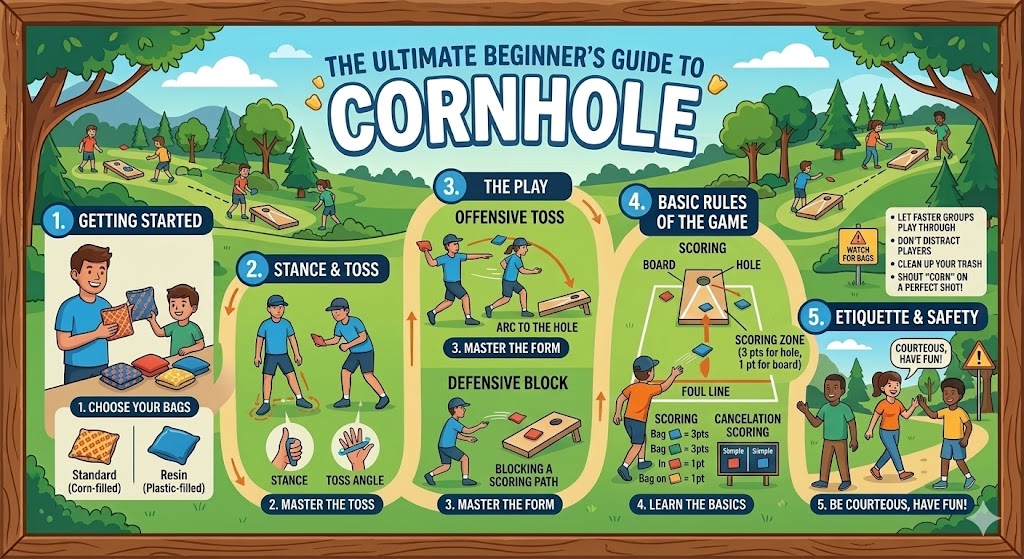
The Ultimate Cornhole Beginner’s Guide to Mastery
Cornhole has become one of the fastest-growing backyard sports in America. The Ultimate Cornhole Beginner’s Guide to Mastery notes its growth. Families cook out, fans toss bags, and competitors travel to tournaments.
At first glance, the game looks simple. Two boards sit across from each other while players throw bean bags toward a hole. However, the sport quickly becomes more strategic than many beginners expect.
This guide explains everything you need to know before you step up to the board. You will learn the history of the game, the official rules, the equipment used by professionals, scoring methods, and beginner strategies that help you win more games.
By the end of this guide, you will understand why cornhole has evolved from a backyard pastime into a nationally organized competitive sport.
What Is Cornhole?
Cornhole is a lawn game where players toss fabric bags toward a raised board with a circular hole. The Ultimate Beginner’s Guide to Cornhole explains the objective is simple. Land bags on the board or sink them through the hole to score points.
While the rules appear basic, the game requires accuracy, touch, and strategy. Players must control distance, arc, and spin with every throw.
Most games involve two players competing head-to-head or two teams of two players each. The teams stand on opposite sides of the playing area and alternate throws until each player has tossed four bags.
Then the round ends and the score is calculated.
Because the game is easy to learn and inexpensive to set up, it has exploded in popularity over the last two decades.
The History of Cornhole
The origins of cornhole remain debated. Several stories claim credit for the invention of the game.
One popular legend traces the concept back to 14th-century Germany. According to the story, a cabinet maker created a board game where players tossed small bags into a hole to entertain children. The idea supposedly spread through Europe before eventually reaching the United States.
Another story claims the game originated in Kentucky during the 1800s. Farmers used dried corn kernels inside small cloth bags and tossed them at wooden boards during social gatherings.
However, modern cornhole did not become widely recognized until the Midwest embraced the game in the late 20th century.
Cities across Ohio, Indiana, and Kentucky began hosting organized tournaments. As a result, the game spread rapidly through tailgating culture and backyard events.
Today, cornhole has become a nationally recognized sport, as highlighted in The Ultimate Beginner’s Guide to Cornhole.
Why Cornhole Became So Popular
Cornhole’s growth did not happen by accident. Several factors helped the game explode across the country.
First, the sport is incredibly easy to learn. New players understand the objective within minutes.
Second, almost anyone can play. Age, strength, and athletic ability matter far less than accuracy and touch.
Third, cornhole fits perfectly into social environments. Backyard parties, weddings, breweries, tailgates, and family reunions often include boards set up for friendly competition.
Another reason involves accessibility. Equipment is relatively inexpensive, and the playing area requires minimal space.
Finally, the professional side of the sport continues to expand. Televised tournaments and national championships have introduced cornhole to millions of viewers.
As a result, casual players increasingly become competitive players.
Cornhole Equipment Explained
Before playing your first game, you must understand the equipment used in cornhole.
Fortunately, the equipment list remains simple.
Cornhole Boards
Cornhole boards form the foundation of the game.
Official boards measure:
- 48 inches long
- 24 inches wide
- 6 inches high at the front
- 12 inches high at the back
The circular hole sits 9 inches from the top edge and measures 6 inches in diameter.
Professional boards use smooth plywood surfaces that allow bags to slide easily.
Many backyard sets use painted or laminated finishes to improve durability.
Cornhole Bags
Each team uses four bags.
Official bags measure:
- 6 inches by 6 inches
- 15–16 ounces in weight
Traditional bags contain dried corn kernels. However, many modern bags use resin pellets instead.
Resin bags last longer because moisture cannot damage them.
Professional bags also feature two different fabric sides.
One side slides easily across the board, while the other grips the surface for better control.
Playing Distance
Regulation cornhole courts place the front edges of the boards 27 feet apart.
Younger players sometimes shorten the distance to make the game easier.
However, official tournaments always use the full regulation distance.
Official Cornhole Rules
Although casual players often create house rules, official cornhole tournaments follow standardized guidelines.
Understanding these rules improves fairness and competitive play.
Starting the Game
Players begin by deciding which team throws first.
This decision often comes from a coin toss or random draw.
The player who wins the toss chooses either:
- Throwing first
- Selecting the pitching lane
Once the first round begins, players alternate throws until each competitor has tossed four bags.
Throwing the Bags
Players must remain within the designated pitching box while throwing.
A legal throw occurs when the player releases the bag before stepping beyond the foul line.
If a player crosses the line during a throw, the bag does not count.
Each team throws from the same side of the court during a round.
Then players walk to the opposite boards for the next frame.
Cornhole Scoring System
Cornhole uses a cancellation scoring system.
That means both teams earn points during the round, but only the difference between scores counts.
Scoring works like this:
- Bag through the hole = 3 points
- Bag on the board = 1 point
- Bag off the board = 0 points
For example:
If Team A scores 7 points and Team B scores 5 points during the same round, Team A receives 2 points.
This system keeps games competitive and prevents runaway scoring.
Winning the Game
Standard games play to 21 points.
However, some tournaments require teams to win by at least two points.
The team that scores last in the previous round throws first in the next round.
Games usually last between 10 and 20 minutes depending on player skill.
Basic Cornhole Throwing Techniques
Beginners often assume cornhole involves simply tossing a bag toward the board.
In reality, experienced players rely on specific throwing techniques.
Developing consistent mechanics dramatically improves accuracy.
The Flat Bag Throw
Most professionals prefer a flat spinning throw.
The player releases the bag with slight wrist rotation so the bag spins like a frisbee.
This spin stabilizes the bag in the air and increases accuracy.
Flat throws also help bags slide across the board toward the hole.
The Arc Throw
Arc refers to the height of the throw.
Some players prefer a high arc that drops the bag softly onto the board.
Others use a lower, faster trajectory.
Beginners should experiment to discover which style produces better consistency.
The Slide Shot
The slide shot aims for the lower portion of the board.
When executed properly, the bag slides upward toward the hole.
This shot works best on slick board surfaces.
The Airmail Shot
The airmail shot sends the bag directly into the hole without touching the board.
Although difficult, the shot becomes valuable when opponents block the hole with other bags.
Professional players practice this technique frequently.
Beginner Strategies That Improve Winning Chances
While accuracy remains essential, strategy separates average players from strong competitors.
Several simple approaches dramatically improve results.
Aim for the Center of the Board
Beginners often aim directly for the hole.
However, this tactic leads to more missed throws.
Instead, target the center of the board.
Bags that land in this area often slide naturally toward the hole.
Block the Hole
Defensive play can disrupt opponents.
If your bag lands in front of the hole, it blocks the opponent’s direct path.
Now they must throw around your bag or attempt a more difficult airmail shot.
Push Shots
Advanced players sometimes use existing bags on the board.
A push shot lands on another bag and drives both bags toward the hole.
This technique can produce multiple points in a single throw.
Control Your Speed
Fast throws bounce off the board.
Instead, focus on soft landings and controlled slides.
Smooth throws create more consistent scoring opportunities.
Cornhole for Backyard Fun vs Competitive Play
Many people enjoy cornhole casually with friends.
However, competitive cornhole differs in several ways.
Backyard games often use relaxed rules. Players may shorten the board distance, ignore foul lines, or allow unlimited practice throws.
Competitive leagues require strict rule enforcement.
Players must follow official distances, bag specifications, and scoring guidelines.
Serious players also train regularly. They practice throwing mechanics, bag placement, and strategic shot selection.
This dedication transforms a casual lawn game into a legitimate competitive sport.
Cornhole Tournaments and Professional Play
Cornhole now features a growing professional scene.
Major organizations host tournaments throughout the year.
These events attract hundreds of players and large prize pools.
Professional tournaments use standardized courts, certified equipment, and experienced referees.
Top players travel nationally and compete for ranking points and sponsorship opportunities.
Televised championships have also introduced the sport to new audiences.
As a result, more amateur players now aspire to compete at higher levels.
How Beginners Can Improve Quickly
Every new cornhole player wants to improve faster.
Fortunately, a few simple habits accelerate progress.
First, practice regularly. Even 20 minutes of focused throwing helps build muscle memory.
Second, develop a consistent stance and release point.
Third, observe experienced players. Watching skilled competitors teaches valuable strategies.
Finally, focus on accuracy before power.
Controlled throws win far more games than aggressive attempts.
Setting Up Your Own Cornhole Court
Creating a backyard cornhole setup requires minimal effort.
Start by placing two boards 27 feet apart.
Next, ensure the playing surface remains flat and stable.
Grass works well for casual play. However, many competitive players prefer concrete or packed gravel surfaces.
Lighting also matters if you plan to play in the evening.
Portable LED lights allow games to continue long after sunset.
Once the boards are positioned, gather friends and start playing.
The Social Side of Cornhole
One reason cornhole thrives involves its social atmosphere.
The game encourages conversation and friendly competition.
Players stand relatively close together, which creates a relaxed environment where spectators often join the fun.
Because rounds move quickly, new participants can rotate into games without long delays.
Cornhole also adapts easily to many environments.
You see it at beaches, parks, breweries, weddings, and college tailgates.
Few sports blend competition and social interaction as effectively.
Common Beginner Mistakes
Most new players make several predictable mistakes.
Recognizing these issues helps you improve faster.
One common mistake involves throwing too hard. Beginners often try to force the bag into the hole.
Another problem occurs when players constantly change their throwing style.
Consistency matters far more than experimentation during a game.
Finally, many beginners ignore strategy.
Simply tossing bags without thinking about blocking or positioning limits scoring potential.
Avoiding these errors leads to quicker improvement.
The Future of Cornhole
Cornhole’s popularity continues rising each year.
More communities now organize local leagues and recreational tournaments.
Schools and colleges have also embraced the sport as a social activity.
Meanwhile, professional organizations expand their schedules and prize pools.
Television coverage introduces new fans to the game, while social media highlights incredible trick shots and dramatic tournament moments.
Because the game remains simple, accessible, and social, its growth shows no signs of slowing.
Why Cornhole Is the Perfect Beginner Sport
Cornhole offers something rare in the sports world.
It combines simplicity with skill.
Anyone can learn the basic rules within minutes. However, mastering strategy and shot control requires dedication.
This balance keeps players engaged for years.
Families enjoy it together. Friends compete during parties. Serious athletes train for tournaments.
Few games provide such broad appeal.
For beginners looking for a fun, competitive activity that works in almost any setting, cornhole delivers the perfect solution.
Additional Cornhole Articles
- Official Cornhole Rules Explained: A Complete Guide for Beginners
- Cornhole Scoring Rules: How Points Work and How to Win Games Faster
- Cornhole Equipment Guide: Boards, Bags, and Court Setup Explained
- How to Throw a Cornhole Bag Like a Pro: Techniques and Form Tips
- Winning Cornhole Strategies: Offensive and Defensive Tactics That Work
- Common Cornhole Mistakes Beginners Make and How to Fix Them
- How to Build a Backyard Cornhole Court: Layout, Distance, and Setup
- Cornhole Tournaments and Leagues: How Competitive Cornhole Works