
Official Padel Rules Explained
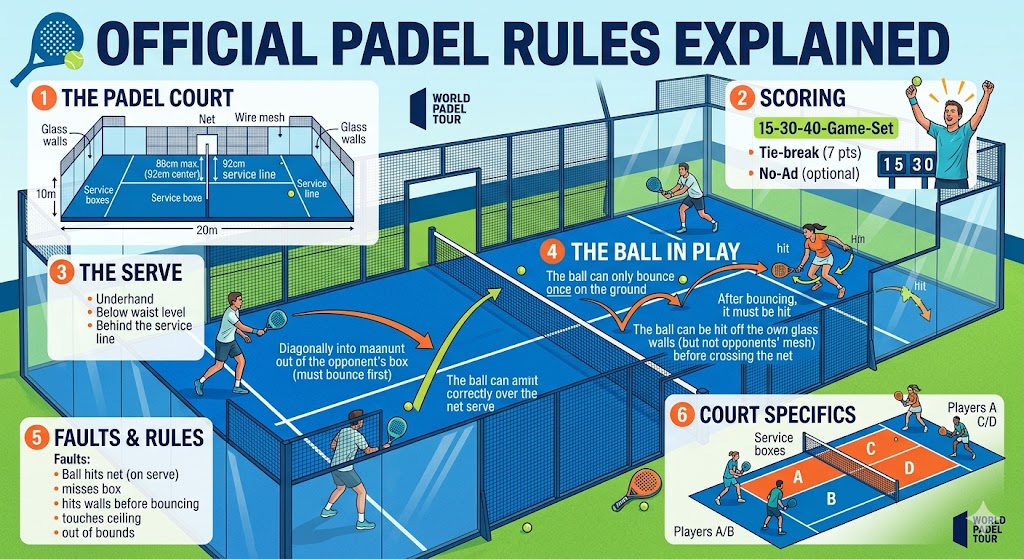
Official Padel Rules Explained: Court Dimensions, Serving, and Gameplay
Padel has become one of the fastest-growing racket sports in the world. Millions of players across Europe, Latin America, and the Middle East now enjoy the game regularly. The sport continues to expand into North America as new courts and clubs appear each year.
Although padel looks similar to tennis, the rules include several unique features that give the sport its distinctive style. Players use solid rackets instead of strung ones. The court is smaller and surrounded by walls. Additionally, players can use those walls during rallies to create strategic rebounds.
Because of these differences, beginners often need a little time to understand how padel works.
Fortunately, the basic rules are simple and easy to learn.
If you are new to the sport, start with The Ultimate Beginner’s Guide to Padel: Rules, Equipment, Strategy, and How to Start Playing. That article explains the sport’s history, basic gameplay, and why it has become so popular.
This guide focuses specifically on the official rules of padel, including court dimensions, serving rules, scoring, and gameplay structure.
Once you understand these rules, you will feel much more confident stepping onto the court for your first match.
Understanding the Padel Court
Before learning the gameplay rules, it helps to understand the court where padel is played.
Padel courts are smaller than tennis courts and completely enclosed by walls and fencing.
These walls play an important role in the game because players can use them to return shots.
A standard padel court measures:
- 20 meters long
- 10 meters wide
A net divides the court into two equal halves.
Glass walls form the back boundaries and parts of the side boundaries. Metal fencing completes the enclosure along the remaining sections.
Because of these walls, padel rallies often continue longer than tennis rallies.
The ball may bounce off the walls before players return it.
You can explore the court design in greater detail by reading Padel Court Layout and Dimensions: Understanding the Walls, Net, and Service Boxes.
Understanding court structure helps players anticipate rebounds and position themselves more effectively.
The Padel Net
The net divides the court into two equal sides.
Like tennis, the net sits slightly lower in the center than at the edges.
The net height measures:
- 88 centimeters in the center
- 92 centimeters at the posts
This height encourages players to use controlled shots and careful placement rather than simply hitting the ball as hard as possible.
Because the court is smaller, many rallies occur near the net where volleys play an important role.
Padel Scoring System
Padel uses the same scoring system as tennis.
Each game follows this sequence:
- 15
- 30
- 40
- Game
If both teams reach 40 points, the score becomes deuce.
From deuce, one team must win two consecutive points to win the game.
Matches typically follow a best-of-three sets format.
A team must win six games to win a set, and they must lead by at least two games.
If the score reaches 6–6, most matches use a tiebreaker to determine the winner of the set.
Understanding scoring is essential because strategy often changes depending on the score.
To learn how scoring decisions affect tactics, read Winning Padel Strategies: Positioning, Teamwork, and Shot Selection.
Starting a Match
A padel match usually begins with a coin toss or racket spin.
The winning team chooses either:
- which side of the court to start on
- or whether to serve first
Once the choice is made, the opposing team receives the remaining option.
Players then take their positions on the court.
Because padel is primarily played in doubles, each team has two players.
Teammates stand on opposite sides of their half of the court.
Padel Serving Rules
Serving in padel differs from tennis in several important ways.
The serve must always be underhand.
Additionally, the player must strike the ball below waist height.
These requirements reduce the advantage of powerful serves and emphasize rally play instead.
To serve correctly, players must follow several steps.
First, the server stands behind the service line.
Next, the player bounces the ball once on the ground.
Then the player strikes the ball underhand so that it travels diagonally into the opponent’s service box.
The ball must bounce inside the service box before touching the wall.
If the ball hits the wall before bouncing, the serve is considered a fault.
Service Boxes
Each side of the padel court contains two service boxes.
These boxes divide the court into four sections near the net.
The server must aim the ball diagonally into the opponent’s service box.
This rule ensures that serves travel across the court rather than straight ahead.
Once the serve lands inside the correct box and bounces, the receiving team can return the ball.
Understanding the location of these boxes becomes much easier after studying Padel Court Layout and Dimensions: Understanding the Walls, Net, and Service Boxes.
Faults and Second Serves
Padel allows two serve attempts.
If the first serve fails, the player receives a second chance.
A serve counts as a fault if:
- the ball misses the service box
- the ball hits the wall before bouncing
- the server strikes the ball above waist height
- the server steps on or over the service line before contact
If the server commits two faults in a row, the receiving team wins the point.
Returning the Serve
Once the ball bounces in the service box, the receiving team must return it before the second bounce.
The return can be hit directly or after rebounding off the back wall.
However, the ball must bounce once on the ground before contacting the wall.
After the return, the rally begins.
Both teams may now use the walls strategically during the rally.
Rally Rules
During a rally, players attempt to hit the ball over the net so that it lands inside the opponent’s court.
The ball must bounce once on the receiving side before contacting the walls.
After the bounce, the ball may strike the walls and remain in play.
Players may also hit the ball against their own wall before sending it back over the net.
This technique often helps players defend difficult shots.
Rallies continue until one team commits an error.
Winning a Point
A team wins a point when the opponent fails to return the ball legally.
Common ways to win a point include:
- the opponent misses the ball
- the ball bounces twice before being returned
- the ball hits the fence directly without bouncing
- the opponent hits the ball out of bounds
Additionally, a team may win a point if their opponent commits a rule violation.
The Role of the Walls
The walls make padel unique compared to other racket sports.
Players may use the walls in several ways.
For example, a defensive player may allow the ball to bounce off the back wall before returning it.
This technique helps players handle deep shots.
Players may also hit angled shots that rebound off the walls and confuse opponents.
Mastering these rebounds takes practice.
Understanding how the walls affect gameplay becomes easier once you study Essential Padel Shots Every Beginner Should Learn.
Player Positioning During Play
Positioning plays a major role in padel strategy.
Most successful teams try to control the net area.
Players standing near the net can hit volleys and pressure their opponents.
Meanwhile, players near the baseline focus on defense and lobs.
A well-placed lob can push opponents away from the net and give the defensive team time to advance.
These positional battles often determine the outcome of rallies.
Strategic movement and teamwork become extremely important as players improve.
Common Rule Mistakes Beginners Make
New padel players sometimes misunderstand certain rules.
For example, beginners may accidentally hit an overhand serve instead of an underhand serve.
Others may return the ball before it bounces when receiving a serve.
These mistakes are common during early matches.
Fortunately, they are easy to correct with practice.
Understanding these errors can help beginners improve faster.
For additional tips, review Common Padel Mistakes Beginners Make and How to Fix Them.
Equipment Requirements for Official Matches
Official padel matches require regulation equipment.
Players must use approved padel rackets and balls.
Padel balls look similar to tennis balls but usually have slightly lower pressure.
This difference helps maintain control during rallies.
Shoes designed for court sports also improve traction and movement.
Choosing the right gear can significantly improve your playing experience.
You can learn more about equipment in Padel Equipment Guide: Choosing the Right Racket, Balls, and Shoes.
Competitive Padel Rules
Professional tournaments follow the same basic rules described above.
However, competitive matches may include additional regulations regarding time limits, player conduct, and officiating.
Referees oversee many matches and ensure that players follow the rules.
Professional tournaments also use advanced scoring systems and rankings to determine champions.
If you are interested in organized play, explore Padel Tournaments and Leagues: How Competitive Padel Works.
Competitive environments introduce new challenges and opportunities for improvement.
Final Thoughts on Padel Rules
Padel combines simple rules with unique gameplay features.
The enclosed court, underhand serves, and use of walls create a sport that is both strategic and exciting.
Fortunately, beginners can learn the rules quickly.
Once players understand court layout, serving rules, and rally mechanics, they can start enjoying competitive matches almost immediately.
With practice, players also learn how to use the walls and positioning to their advantage.
These skills make padel a dynamic and rewarding sport for players of all skill levels.
Continue Learning About Padel
Explore the rest of the padel learning series:
The Ultimate Beginner’s Guide to Padel: Rules, Equipment, Strategy, and How to Start Playing
Padel Court Layout and Dimensions: Understanding the Walls, Net, and Service Boxes
Padel Equipment Guide: Choosing the Right Racket, Balls, and Shoes
Essential Padel Shots Every Beginner Should Learn
Winning Padel Strategies: Positioning, Teamwork, and Shot Selection
Common Padel Mistakes Beginners Make and How to Fix Them
How to Build or Find a Padel Court Near You
Padel Tournaments and Leagues: How Competitive Padel Works



2 Responses
[…] If you want to understand the official regulations in detail, read Official Padel Rules Explained: Court Dimensions, Serving, and Gameplay. […]
[…] Understanding these measurements becomes even more helpful when combined with the rules described in Official Padel Rules Explained: Court Dimensions, Serving, and Gameplay. […]