
Padel Court Layout and Dimenions
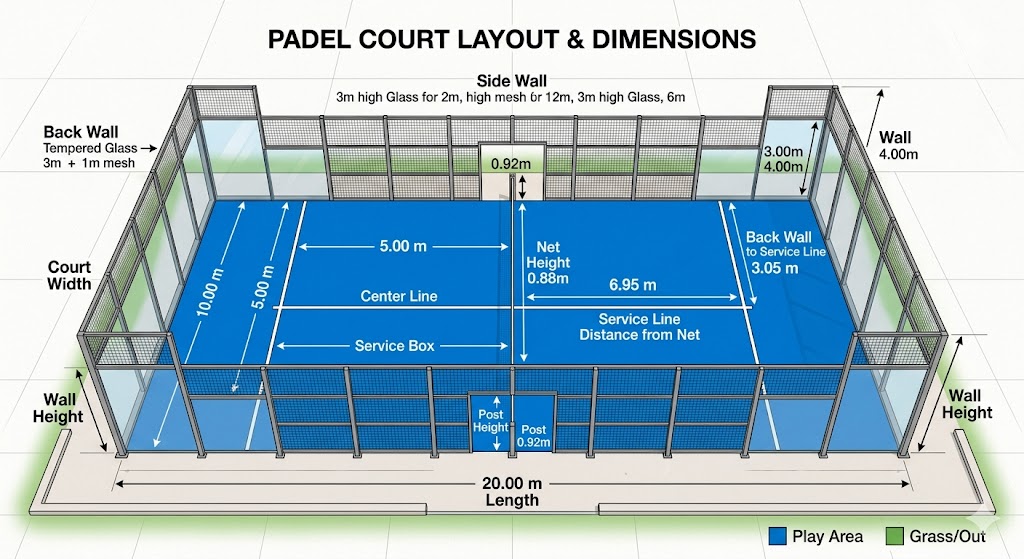
Padel Court Layout and Dimensions: Understanding the Walls, Net, and Service Boxes
Padel courts have a distinctive design that sets the sport apart from other racket games. At first glance, the court looks similar to a tennis court. However, a closer look reveals several important differences.
The playing area is smaller. Glass walls surround the court. Metal fencing completes the enclosure. These features allow the ball to rebound during rallies, which creates longer points and exciting strategic possibilities.
Because the court design plays such an important role in gameplay, every padel player should understand its layout and dimensions.
Knowing where the walls, service boxes, and net are located helps players anticipate rebounds, position themselves correctly, and execute more effective shots.
If you are new to the sport, start with The Ultimate Beginner’s Guide to Padel: Rules, Equipment, Strategy, and How to Start Playing. That guide explains the basics of the sport and how beginners can begin playing.
This article focuses specifically on padel court design, including official measurements, wall construction, and the purpose of each section of the court.
Understanding these details will help you feel much more comfortable when stepping onto a padel court for the first time.
The Standard Size of a Padel Court
A regulation padel court has a fixed size used in professional competitions and most recreational facilities.
The official dimensions are:
- 20 meters long
- 10 meters wide
These measurements create a compact playing area compared with tennis courts.
The smaller court size encourages quick reactions and strategic shot placement. Players often rely on positioning and angles rather than powerful swings.
Because the court is enclosed, the ball rarely leaves the playing area. This feature keeps rallies alive and makes the game more dynamic.
Understanding these measurements becomes even more helpful when combined with the rules described in Official Padel Rules Explained: Court Dimensions, Serving, and Gameplay.
The Padel Net
The net divides the court into two equal halves.
Each half measures 10 meters by 10 meters.
The net height follows the same general principle used in tennis, with the center slightly lower than the sides.
Official net measurements are:
- 88 centimeters at the center
- 92 centimeters at the posts
This height creates a balance between offensive and defensive play.
Players standing near the net can apply pressure with volleys. Meanwhile, players at the baseline can defend by using lobs and wall rebounds.
Because the net is lower than a tennis net, players often use angled shots and controlled volleys rather than powerful smashes.
These dynamics play a major role in strategy, which you can explore further in Winning Padel Strategies: Positioning, Teamwork, and Shot Selection.
The Back Walls
The back walls are one of the most recognizable features of a padel court.
These walls usually consist of tempered glass panels.
The glass allows spectators to watch the match clearly while also providing a consistent surface for ball rebounds.
Each back wall measures:
- 3 meters high
The lower portion of the wall is solid glass. Above that, metal fencing may extend upward.
Players frequently use the back wall when defending deep shots. Instead of attempting a difficult return immediately, a player may allow the ball to bounce off the back wall before hitting it.
This technique provides extra time to react and reposition.
Learning how to use the back wall effectively becomes much easier once players practice the techniques explained in Essential Padel Shots Every Beginner Should Learn.
The Side Walls
The side boundaries combine glass panels and metal fencing.
The glass sections near the back corners allow rebounds similar to the back wall.
Closer to the net, the fencing allows the ball to exit the court if struck directly.
This design creates interesting gameplay situations.
Players may intentionally hit angled shots that rebound off the side walls to confuse their opponents.
These rebounds can produce unpredictable angles that make defensive returns difficult.
As players gain experience, they begin to anticipate these rebounds and position themselves accordingly.
The Metal Fencing
Metal fencing surrounds the upper sections of the court.
Unlike the glass walls, the fencing does not allow clean rebounds.
If the ball strikes the fence directly before bouncing, the point usually ends.
However, if the ball bounces first and then touches the fence, it may remain in play depending on the situation.
The fencing serves two important purposes.
First, it keeps the ball within the playing area.
Second, it allows spectators to watch matches from outside the court.
Understanding how the fence affects play helps players avoid costly mistakes during rallies.
The Service Boxes
Each half of the court contains two service boxes.
These boxes resemble the service areas found on tennis courts.
The service boxes determine where serves must land to begin a rally.
A center service line divides each half of the court vertically.
Meanwhile, the service line runs parallel to the net several meters away.
Together, these lines create the two service boxes on each side.
When serving, the ball must travel diagonally across the net and land in the opponent’s service box.
If the serve misses the box, it counts as a fault.
Learning the location of these boxes helps players serve more accurately.
These rules are explained in greater detail in Official Padel Rules Explained: Court Dimensions, Serving, and Gameplay.
The Service Line
The service line runs parallel to the net and marks the front boundary of the service boxes.
Servers must stand behind this line when hitting the ball.
Stepping on or over the line before striking the ball results in a fault.
Because padel serves are underhand, players usually stand close to the line to improve accuracy.
Maintaining proper positioning during the serve ensures that the ball travels into the correct service box.
Court Entrances
Padel courts include one or two entry points along the side fences.
These openings allow players to enter and exit the court safely.
During most recreational matches, players simply walk through the gate between points.
However, in some competitive environments, players may even chase balls outside the court through these openings.
This situation creates spectacular rallies where players run outside the court to return a ball that bounced off the wall.
Although this advanced play is rare for beginners, it highlights the unique design of padel courts.
Court Surfaces
Padel courts use several different surface materials.
Each surface affects how the ball bounces and how players move.
Common court surfaces include:
- artificial turf
- textured concrete
- synthetic sports flooring
Artificial turf is the most common surface used in modern padel courts.
This surface provides consistent ball bounce and good traction for players.
The surface also allows players to slide slightly when changing direction.
Proper footwear improves performance and safety on these surfaces.
You can learn more about selecting the right gear in Padel Equipment Guide: Choosing the Right Racket, Balls, and Shoes.
Lighting for Padel Courts
Many padel courts include overhead lighting systems.
These lights allow players to continue playing after sunset.
Lighting systems typically mount on tall poles at the corners of the court.
Proper lighting ensures that players can see the ball clearly during night matches.
Many clubs host evening leagues and tournaments, so lighting plays an important role in maintaining consistent gameplay conditions.
How Court Design Influences Strategy
The layout of a padel court strongly influences strategy.
Because the court is enclosed, players can use walls to extend rallies and create new angles.
For example, defensive players often rely on back-wall rebounds to return deep shots.
Meanwhile, offensive players attempt to control the net area where volleys are most effective.
Understanding how the court affects gameplay helps players choose smarter shots.
Strategic positioning becomes even more important as players gain experience.
To explore these tactics further, read Winning Padel Strategies: Positioning, Teamwork, and Shot Selection.
Common Court-Related Mistakes Beginners Make
New players sometimes struggle with court awareness.
For example, beginners may forget that the ball can rebound off the wall after bouncing.
They might also stand too close to the wall when defending deep shots.
Another common mistake involves misjudging angles off the side walls.
Fortunately, these issues improve with practice.
Spending time observing how the ball reacts to different surfaces can accelerate the learning process.
To avoid additional beginner errors, review Common Padel Mistakes Beginners Make and How to Fix Them.
Practicing Court Awareness
Improving court awareness requires practice and observation.
Players should spend time watching how the ball behaves after hitting the walls.
Practicing defensive shots that involve back-wall rebounds can also build confidence.
Additionally, players should learn how to position themselves when opponents hit lobs or angled shots.
Over time, these habits help players anticipate rebounds more accurately.
Developing this awareness makes padel rallies far more enjoyable.
Finding or Building a Padel Court
As padel continues growing in popularity, more facilities are building courts.
Many sports clubs and recreation centers now offer padel courts alongside tennis courts.
Some communities are even constructing dedicated padel facilities.
If you want to locate a court near you or learn how courts are built, explore How to Build or Find a Padel Court Near You.
Access to a proper court makes it much easier to practice and improve your skills.
Final Thoughts on Padel Court Layout
The unique design of a padel court plays a major role in the sport’s excitement and strategy.
Its compact size encourages fast reactions and teamwork.
Meanwhile, the glass walls create dynamic rebounds that keep rallies alive.
Understanding the layout of the court helps players anticipate shots and move more effectively during matches.
Once beginners become comfortable with court dimensions, service boxes, and wall rebounds, they can focus more on strategy and technique.
With practice and experience, the court becomes a powerful tool for creative gameplay.
Continue Learning About Padel
Explore the rest of the padel learning series:
The Ultimate Beginner’s Guide to Padel: Rules, Equipment, Strategy, and How to Start Playing
Official Padel Rules Explained: Court Dimensions, Serving, and Gameplay
Padel Equipment Guide: Choosing the Right Racket, Balls, and Shoes
Essential Padel Shots Every Beginner Should Learn
Winning Padel Strategies: Positioning, Teamwork, and Shot Selection
Common Padel Mistakes Beginners Make and How to Fix Them
How to Build or Find a Padel Court Near You
Padel Tournaments and Leagues: How Competitive Padel Works



4 Responses
[…] You can learn more about these features in Padel Court Layout and Dimensions: Understanding the Walls, Net, and Service Boxes. […]
[…] Understanding how the court influences these strategies is essential. You can learn more about the court structure in Padel Court Layout and Dimensions: Understanding the Walls, Net, and Service Boxes. […]
[…] You can explore the court design in greater detail by reading Padel Court Layout and Dimensions: Understanding the Walls, Net, and Service Boxes. […]
[…] Before buying gear, it also helps to understand how equipment interacts with the court itself. You can learn more about the court structure in Padel Court Layout and Dimensions: Understanding the Walls, Net, and Service Boxes. […]