
How VAR Decisions Impact Match Outcomes in Soccer
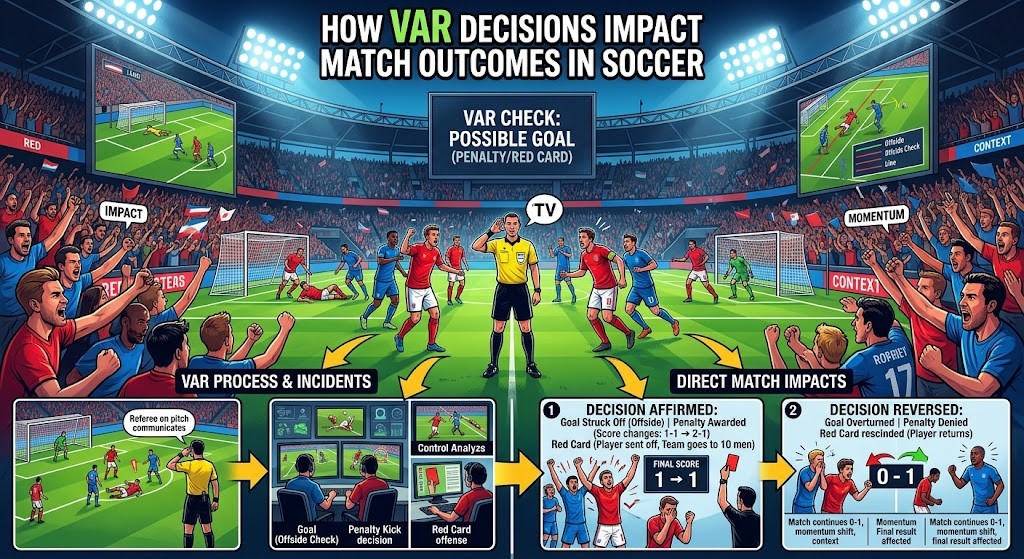
How VAR Decisions Impact Match Outcomes in Soccer
Few developments have changed modern soccer as dramatically as Video Assistant Referee technology. Better known simply as VAR, the system was introduced to help officials correct clear and important mistakes while preserving the flow and character of the sport.
Soccer has always involved difficult decisions. A goal can depend on whether a player’s shoulder was slightly beyond a defender. A penalty can hinge on a split-second challenge. A red card can change the direction of an entire match.
Before VAR, many of those decisions were final once the referee made them.
Now, controversial incidents can be reviewed using video.
That has changed more than refereeing. VAR can influence goals, penalties, red cards, player behavior, tactical decisions, momentum, substitutions, stoppage time, and ultimately the result of a match.
The technology has created greater accuracy in some situations while generating new debates about consistency, interpretation, delays, and the role of human judgment.
Understanding how VAR decisions impact match outcomes provides an important look at one of the biggest changes in modern soccer.
What Is VAR?
VAR stands for Video Assistant Referee.
The system uses video footage to assist the on-field referee with specific categories of potentially decisive incidents.
VAR is not intended to replace the referee.
Instead, it provides another layer of review.
A video assistant referee and supporting officials examine relevant footage and communicate with the referee when an incident may require further consideration.
The referee remains responsible for the final decision when an on-field review is required.
This distinction is important because VAR is ultimately a tool for decision-making rather than an independent referee.
Why Was VAR Introduced?
The primary argument for VAR is straightforward: important decisions should be as accurate as reasonably possible.
Soccer matches can be decided by extremely small moments.
A missed penalty.
An incorrectly awarded goal.
A mistaken red card.
An offside decision.
Before video review, officials had to make those decisions in real time.
Even the best referee can miss an incident.
Players move quickly, multiple bodies may block the referee’s view, and some incidents occur in fractions of a second.
VAR gives officials an opportunity to examine those moments more carefully.
VAR Focuses on Specific Types of Decisions
VAR is not designed to review every decision during a match.
Its use is generally concentrated on major incidents involving:
- Goals and offenses leading to goals
- Penalty decisions
- Direct red cards
- Mistaken identity
This limited scope is important.
If every foul, throw-in, corner, and tactical decision were reviewed, matches could become extremely slow.
The system therefore attempts to balance accuracy with the traditional flow of soccer.
Goals Can Be Changed by VAR
Goals are among the most significant events affected by VAR.
When a goal is scored, officials can review whether an infringement occurred during the attacking sequence.
Potential issues may include:
- Offside
- Handball
- Fouls
- Ball going out of play
- Other offenses during the attacking phase
If a goal is determined to have resulted from an offense, it can be overturned.
That can completely change a match.
A team that appears to have taken a lead may suddenly return to a tied score.
Offside Decisions Became More Precise
Offside has become one of the most visible applications of VAR.
Video review can identify extremely close offside positions that would have been difficult or impossible to detect with certainty in real time.
This has increased the accuracy of many decisions.
It has also created controversy.
Players and fans sometimes question whether tiny positional advantages should determine whether a goal counts.
The debate highlights a fundamental challenge: technological precision does not automatically eliminate disagreement about how rules should be interpreted.
The Difference Between Accuracy and Perfection
VAR can improve decision-making without making refereeing perfect.
Video footage provides additional information, but officials still have to interpret what they see.
A camera angle may show one aspect of an incident while hiding another.
Slow motion can make ordinary contact appear more dramatic.
Different people may interpret the same challenge differently.
VAR therefore reduces certain errors but does not eliminate subjective judgment.
Penalty Decisions Can Change Entire Matches
Penalty decisions may have an even greater impact than many other VAR interventions.
A penalty creates an enormous scoring opportunity.
Awarding or overturning one can shift:
- The score
- Momentum
- Tactical strategy
- Player confidence
- Time management
A team that trails by one goal may suddenly have a chance to equalize.
A team that appears to have conceded a penalty may instead escape with possession.
The consequences can be enormous.
VAR Can Overturn a Penalty
A referee may initially award a penalty after believing a defender committed an offense.
VAR can review the incident.
If the video indicates that the challenge did not meet the required criteria, the referee can overturn the decision.
The opposite can also happen.
A referee may initially allow play to continue, only for VAR to identify an incident that warrants a penalty review.
This can dramatically alter the match.
Red Cards Can Change the Competitive Balance
A sending-off can transform a soccer match.
A team playing with eleven players against ten has a major tactical advantage.
VAR can influence red-card decisions when a serious incident may have been missed or incorrectly identified.
A review can therefore change the number of players on the field.
That affects:
- Defensive shape
- Possession
- Substitutions
- Tactical formation
- Physical workload
A red-card decision can influence the outcome long after the original incident has disappeared from view.
Mistaken Identity Matters
Soccer can involve chaotic situations.
Multiple players may be involved in an incident, making it difficult for a referee to identify the correct offender.
VAR can help determine which player committed the offense.
This prevents a player from receiving a card intended for someone else.
Although mistaken identity may seem like a narrow issue, it can become extremely important when a potential red card is involved.
VAR Can Change Momentum
Momentum is one of soccer’s most discussed concepts.
A team can build confidence after scoring.
A defensive mistake can create anxiety.
A controversial call can energize one side and frustrate the other.
VAR introduces another potential momentum swing.
Imagine a team celebrating a late goal.
The players believe they have won.
Seconds or minutes later, the goal is overturned.
The emotional impact can be enormous.
The opposing team receives renewed energy while the team that lost the goal must recover mentally.
Emotional Responses Affect Performance
Players are not machines.
VAR decisions can influence their emotional state.
A team may become frustrated after a goal is overturned.
Players may lose concentration after a controversial penalty.
Defenders may become more cautious after seeing a teammate sent off.
Managing emotions becomes especially important after lengthy reviews.
Strong teams learn to reset quickly.
Tactical Plans Can Change After VAR
Coaches prepare tactical plans based on the expected match situation.
VAR can suddenly change that situation.
If a team goes from leading to drawing, the coach may become more aggressive.
If a penalty creates a lead, the team may become more defensive.
If a red card occurs, the entire tactical structure may change.
The ability to adapt quickly has therefore become even more important in the VAR era.
Coaches Must Prepare Players for Uncertainty
Modern teams understand that decisions can be reviewed.
Players need to remain mentally engaged during stoppages.
They also need to avoid assuming that a decision is final.
Coaches can prepare players by emphasizing concentration and emotional control.
The best teams respond to what the match becomes rather than what they expected it to be.
VAR Has Changed Goal Celebrations
One of the more subtle effects of VAR involves goal celebrations.
Players and fans sometimes hesitate before fully celebrating because a review may still be underway.
A goal that appears obvious may be examined for:
- Offside
- Handball
- Fouls
- Attacking violations
This has changed the emotional rhythm of scoring.
The celebration may not feel completely secure until the referee confirms the goal.
Delays Can Influence Match Flow
One of the most common criticisms of VAR involves delays.
Reviews can interrupt the natural rhythm of a match.
Players may stand waiting.
Fans may not know what is happening.
Momentum can disappear.
The longer the review takes, the more disruptive it can feel.
Finding the right balance between accuracy and speed remains one of the central challenges of VAR implementation.
Communication Matters
The way VAR decisions are communicated can affect how fans and players perceive the process.
If supporters do not understand why a decision changed, frustration can increase.
Clear explanations help establish confidence.
Refereeing organizations have increasingly recognized that transparency is important.
The technology is only as effective as the communication surrounding it.
Fans Experience VAR Differently
Supporters inside a stadium may have less information than viewers watching television.
Broadcast audiences often see multiple replays and graphics.
Stadium spectators may simply watch players waiting.
That can create confusion.
Clear stadium communication is therefore important.
Fans need to understand why play has stopped and what decision is being reviewed.
Broadcasters Influence Public Perception
Television coverage has a major influence on how VAR decisions are understood.
Broadcasters can show:
- Slow-motion replays
- Different camera angles
- Offside lines
- Contact points
- Referee explanations
These images can help viewers understand the decision.
However, repeated replays can also intensify controversy.
A single incident may be shown dozens of times.
That can make a marginal decision seem even more significant.
VAR Can Improve Competitive Fairness
One of VAR’s strongest arguments is fairness.
If an obvious error could determine the result, correcting that mistake can protect competitive integrity.
A wrongly disallowed goal could cost a team points.
A missed penalty could eliminate a team from a tournament.
A mistaken red card could influence an entire knockout tie.
Correcting major errors can therefore provide meaningful benefits.
But Greater Accuracy Creates New Expectations
Once technology is introduced, expectations change.
Fans may begin expecting every decision to be perfect.
That is unrealistic.
Soccer still contains subjective judgments.
VAR can determine where a player was standing.
It cannot always determine precisely how much contact should constitute a foul.
Technology may therefore increase accuracy while simultaneously increasing expectations.
Subjective Decisions Remain Difficult
Some of soccer’s most controversial decisions involve interpretation.
Consider a potential handball.
Video can show where the ball struck the player.
But officials must still determine whether the contact constitutes an offense under the applicable rules.
The same applies to physical challenges.
Was the contact careless?
Reckless?
Serious?
Video provides evidence.
The referee provides judgment.
That distinction explains why disagreements remain even after VAR review.
Referees Must Manage the Technology
VAR has not eliminated the importance of referees.
Instead, it has added another dimension to their responsibilities.
Officials must know:
- When intervention is appropriate
- When to trust the original decision
- How to communicate with VAR officials
- How to conduct an on-field review
- How to manage players during delays
The modern referee must therefore combine traditional officiating skills with technological understanding.
VAR Can Influence Tournament Outcomes
The consequences become even greater in major competitions.
In a league season, one decision can influence standings.
In a knockout tournament, one decision can determine who advances.
A single penalty or overturned goal can change the entire tournament path.
This makes VAR particularly important during high-pressure matches.
Small Decisions Can Have Huge Consequences
Soccer’s scoring environment makes individual decisions unusually important.
A sport can produce only a handful of goals in a match.
Therefore, a single goal-related decision can represent a substantial percentage of the final result.
If a match ends 1–0, an overturned goal may have completely changed the outcome.
That is why VAR decisions receive so much attention.
Teams Have Adapted Strategically
Professional clubs have adjusted to the VAR environment.
Defenders have become increasingly conscious of:
- Offside positioning
- Challenges inside the penalty area
- Handball risks
- Reckless tackles
Attackers also understand that goals may be reviewed.
The technology has therefore influenced player behavior.
Players are learning where the boundaries of acceptable risk have changed.
Training Has Changed
Coaches can use video review to teach players about situations that might trigger VAR intervention.
Training sessions may include examples of:
- Offside positioning
- Penalty-area challenges
- Handball situations
- Red-card offenses
Players can learn to avoid unnecessary risks.
VAR has therefore become part of tactical education.
The Technology Continues to Evolve
VAR itself is not a finished product.
Technology continues improving.
Better camera systems can provide more accurate information.
Automated offside technology can speed up certain decisions.
Communication systems can make reviews more efficient.
The goal is to maintain the benefits of video review while reducing interruptions.
Future versions of VAR may therefore become faster and less intrusive.
The Future of VAR in Soccer
The long-term future of VAR will likely involve greater automation and better communication.
Technology may increasingly assist officials with objective elements of decisions.
Human judgment will remain important for subjective incidents.
The challenge will be determining which parts of refereeing should rely on technology and which should remain primarily human decisions.
Soccer has always valued its human character.
VAR must fit into that tradition rather than overwhelm it.
Final Thoughts
VAR has changed soccer because it changed the consequences of officiating decisions. Goals can be overturned, penalties can be awarded or canceled, red cards can be reviewed, and incidents that once disappeared into the flow of a match can now receive detailed examination.
The technology has improved accuracy in many important situations, but it has not eliminated controversy. Some decisions remain subjective, and the introduction of video review has created new debates about delays, consistency, transparency, and the proper role of technology in the sport.
Ultimately, VAR demonstrates that technology can change the way a sport is played without completely removing the human element. Referees still interpret the laws. Players still make split-second decisions. Coaches still adjust tactics. Fans still react emotionally.
The biggest difference is that some of the game’s most important moments are no longer necessarily final when they happen.
In modern soccer, the whistle may start the decision—but sometimes, the video has the final say.