
How the Bills’ “Alien” Offense Is Breaking Modern Defenses
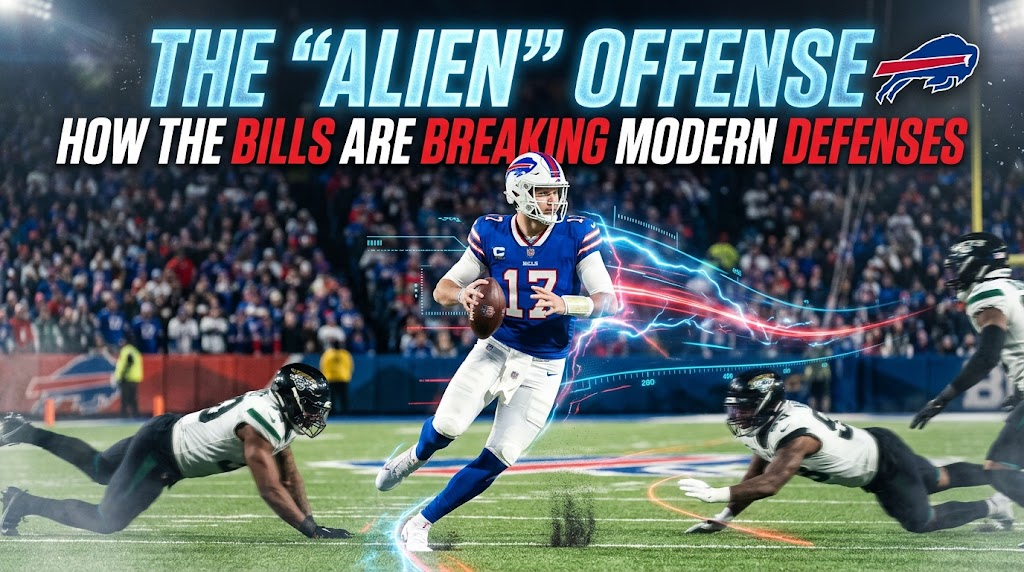
How the Bills’ “Alien” Offense Is Breaking Modern Defenses
Josh Allen has always possessed the physical tools that make NFL defensive coordinators lose sleep.
The arm strength is obvious. The mobility is rare. The size is unusual for a quarterback who can move the way he does. His ability to turn a broken play into a 30-yard gain has been part of his identity for years.
But what Buffalo showed against the Detroit Lions in Week 2 of the 2026 NFL season suggested something different.
This wasn’t simply Josh Allen being Josh Allen.
The Buffalo Bills appeared to have found an offensive structure that makes all of Allen’s unique talents even more difficult to defend.
In Buffalo’s 41-31 victory over Detroit, Allen accounted for five touchdowns — three through the air and two on the ground — while completing 20 of 31 passes for 248 yards. He added 69 rushing yards on 14 carries. Running back James Cook contributed 135 rushing yards and another touchdown, while tight end Dalton Kincaid caught seven passes for 95 yards and a score.
More importantly, Buffalo scored touchdowns on five of its first six possessions and accumulated 446 total yards and 34 first downs.
The Bills weren’t merely throwing the ball around.
They were attacking defenses horizontally, vertically, physically and psychologically.
And when Detroit responded by blitzing, Allen punished them.
The Lions blitzed Allen on 55.3% of his dropbacks, according to Next Gen Stats. Against those blitzes, Allen completed 12 of 17 passes for 137 yards and two touchdowns while also producing rushing yards with his legs.
That is the central problem facing modern defenses.
If you sit back, Buffalo can run the football, attack intermediate zones and create explosive plays.
If you blitz, Allen can beat the pressure with his arm or legs.
If you play man coverage, Buffalo can create matchups with its tight ends and receivers.
If you load the box, Allen can exploit the space behind it.
And if you try to play physically with Buffalo’s personnel packages, the Bills can simply run directly at you.
That’s what makes the new-look Bills offense so fascinating.
It isn’t necessarily unstoppable.
It is becoming increasingly difficult to force it into an uncomfortable choice.
The Biggest Change: Buffalo Is Making Defenses Defend More Players
For years, NFL defenses have been built around the idea of identifying the primary threat.
Where is the quarterback?
Where is the star receiver?
Where is the running back?
Which player must be double-teamed?
Buffalo’s current offensive structure complicates that process.
The Bills have legitimate threats at quarterback, running back, tight end and wide receiver.
That matters because modern defenses frequently depend upon creating favorable numbers.
Defenses want to dictate terms.
They want to force an offense into predictable personnel groupings and predictable formations.
Buffalo’s offense is increasingly designed to do the opposite.
The Bills are using personnel groupings that force defenses to declare their intentions before the snap.
Then Allen gets to attack whatever the defense has given him.
That is one of the most important developments in Buffalo’s offensive evolution.
Buffalo’s Heavy Personnel Wasn’t Old-School Football
One of the biggest statistical revelations from the Detroit game was Buffalo’s use of multiple-tight-end formations.
The Bills used 12 and 13 personnel — formations featuring two or three tight ends — on 59.4% of their offensive snaps, according to TruMedia.
At first glance, that might sound like Buffalo was simply trying to establish the running game.
But that’s too simplistic.
The tight ends weren’t merely blockers.
They became part of the deception.
When Buffalo puts multiple tight ends on the field, Detroit has to consider the possibility of a run.
But those same players can release into routes.
They can block.
They can chip an edge rusher.
They can line up in different positions.
They can shift before the snap.
And they can create mismatches against linebackers.
That gives Buffalo an enormous amount of flexibility.
The modern NFL defense has to solve the problem of whether Buffalo’s heavy personnel is actually a running formation.
Often, it isn’t.
And that hesitation is exactly what an offense wants.
The Tight Ends Are the Engine of the Mismatch
Dalton Kincaid’s performance against Detroit was particularly important.
He finished with seven receptions for 95 yards and a touchdown.
But the bigger story is what Kincaid represents within the offensive structure.
A defense doesn’t necessarily want a linebacker covering a talented receiving tight end in space.
But removing the linebacker from the field creates other problems.
If Detroit responds with additional defensive backs, Buffalo can attack the run.
If Detroit keeps bigger personnel on the field, Buffalo can throw to its tight ends.
That is the matchup dilemma.
Buffalo’s tight ends allow the Bills to maintain a physical running identity without sacrificing their passing-game flexibility.
That’s a dangerous combination.
A traditional spread offense can create passing opportunities by putting four or five receivers on the field.
Buffalo can create similar spacing advantages without abandoning its ability to run the football.
That is a major distinction.
James Cook Makes the Quarterback Problem Worse
Josh Allen’s presence already creates a numbers problem.
Now add James Cook.
Cook rushed for 135 yards and a touchdown against Detroit, while Buffalo finished with 203 rushing yards as a team.
That means defenses cannot simply treat the Bills’ running game as an accessory to Allen’s passing attack.
It has become a legitimate weapon.
And that changes the defensive equation.
If a defense commits an extra defender to Allen, Cook can exploit the resulting blocking numbers.
If the defense commits additional resources to Cook, Allen can attack the perimeter or throw behind the pressure.
If defenders hesitate because they are worried about Allen keeping the ball, Cook gets another advantage.
The Bills are forcing defenses to account for both quarterback-run mathematics and running-back-run mathematics on the same play.
That’s a nightmare.
The Offensive Line Is Making Everything Easier
There is another part of Buffalo’s transformation that doesn’t receive nearly as much attention.
The offensive line is giving the scheme time to work.
Buffalo’s running game generated 203 yards against Detroit, while Allen was sacked only twice for a total loss of five yards.
That means the offense wasn’t surviving exclusively through Allen improvisation.
There was structure underneath the chaos.
The offensive line created running lanes.
It protected Allen.
It allowed Buffalo to use heavier formations without becoming predictable.
And it helped make play-action and misdirection credible.
That last part is crucial.
A fake only works if the defense believes the run is real.
Buffalo’s commitment to physicality forces defenders to respect the run.
Once they do that, Allen gets opportunities to exploit the resulting hesitation.
Why Detroit’s Blitzing Didn’t Work
This may have been the most revealing element of the entire game.
Detroit blitzed Allen on 55.3% of his dropbacks.
That was the highest blitz rate the Lions had used under defensive coordinator Kelvin Sheppard.
It was also exactly the kind of approach that could have theoretically disrupted Buffalo.
The problem?
Allen destroyed it.
Against the blitz, he completed 12 of 17 passes for 137 yards and two touchdowns.
He also added rushing production.
That creates a fundamental problem for defensive coordinators.
Blitzing is supposed to create an advantage.
You sacrifice coverage numbers in exchange for additional pressure.
But if Allen recognizes the pressure and gets the ball out quickly, the defense may have sacrificed coverage without getting the pressure it wanted.
And if the rush lanes aren’t disciplined, Allen can escape.
The blitz becomes an invitation for Josh Allen to attack the space created by the extra pass rusher.
That is why Buffalo’s heavy formations are so interesting.
The Bills can use additional blockers to neutralize pressure.
Then they can release enough receivers into the remaining coverage structure to attack the defense.
Allen’s Legs Change the Geometry of the Field
The quarterback run has become one of the most difficult concepts for modern defenses to handle.
Most defenses are designed around five-man offensive line structures and a quarterback who is assumed to be a passer.
Josh Allen doesn’t fit that assumption.
Against Detroit, he rushed 14 times for 69 yards and two touchdowns.
His legs aren’t simply a scrambling tool.
They are part of Buffalo’s offensive mathematics.
Consider a conventional defensive front.
Seven defenders might be responsible for seven gaps or specific coverage responsibilities.
But if the quarterback becomes an actual running threat, one of those defenders may have to account for Allen.
That changes the numbers.
Josh Allen’s rushing ability effectively creates an additional offensive player that defenses have to account for.
And unlike a running back, Allen can throw the ball after forcing a defender to commit.
That makes the conflict particularly difficult.
Buffalo Doesn’t Need Allen to Throw 40 Times
Another major adjustment is philosophical.
The Bills don’t appear to need Allen to throw the ball 40 or 45 times for the offense to dominate.
Against Detroit, he attempted 31 passes.
That’s important.
Buffalo generated 446 yards without turning the game into a quarterback-volume contest.
The Bills ran for 203 yards.
They converted 9 of 12 third downs.
They scored touchdowns on five of their first six possessions.
They controlled the football.
And Allen still produced five touchdowns.
The new Buffalo offense is not asking Josh Allen to carry every snap; it is creating conditions where he can decide which weapon should carry each possession.
That’s a subtle but significant distinction.
The First Drive Set the Tone
Buffalo won the coin toss and chose to receive.
That decision immediately put the offense on the attack.
The Bills drove 85 yards on 10 plays, with Allen accounting for 62 yards of offense and scoring on a one-yard touchdown run.
The importance wasn’t simply the touchdown.
It was the message.
Buffalo wasn’t going to spend the opening quarter trying to figure out what Detroit wanted to do.
The Bills were going to force Detroit to respond.
That distinction became increasingly important as the game progressed.
Buffalo Attacked the Defense in Different Ways
One of the most impressive aspects of the performance was the variety.
The Bills scored through the running game.
They scored through the tight ends.
They scored vertically.
They scored with Allen’s legs.
And they repeatedly created opportunities when Detroit brought pressure.
That diversity makes an offense difficult to game-plan against.
A defense can prepare for an offense that has one overwhelming strength.
It’s much harder to prepare for an offense that can win through multiple mechanisms.
Buffalo’s greatest offensive adjustment may be that it no longer needs to win the same way on every possession.
The Joshua Palmer Touchdown Shows the Value of Motion and Formation
One of Buffalo’s early touchdowns demonstrated another critical part of modern offense: forcing defensive communication.
Joshua Palmer scored on a 43-yard touchdown after Detroit experienced a coverage communication breakdown.
The result was a wide-open receiver.
From the offense’s perspective, that’s the dream.
Buffalo doesn’t need every receiver to beat a defensive back one-on-one for 40 yards.
Sometimes the objective is simply to make the defense communicate perfectly for 60 minutes.
The more formations, shifts, personnel packages and motion a defense has to process, the greater the chance that someone eventually makes a mistake.
Modern offenses aren’t always trying to physically beat every defender; sometimes they’re trying to make defenders solve too many problems simultaneously.
Buffalo is becoming very good at doing that.
The Bills Are Creating Conflict Before the Snap
Pre-snap conflict is one of the most important elements of modern NFL offense.
Quarterbacks want to know:
Is the defense playing man or zone?
Where is the pressure coming from?
Who is responsible for the quarterback?
Which defender is responsible for the running back?
Can the offense identify a mismatch?
Buffalo’s formations make those questions harder to answer.
Multiple tight ends can align in different places.
Receivers can move.
Allen can change the protection.
The running back can shift.
And the entire formation can create uncertainty about where the attack is coming.
The objective isn’t necessarily to confuse the defense completely.
The objective is to create one small hesitation.
Against Josh Allen, one hesitation can become a touchdown.
The “Alien” Label Actually Makes Sense
Calling Allen an “alien” is obviously hyperbole.
But there is a football reason the description resonates.
Allen doesn’t fit neatly into one quarterback category.
He’s not simply a traditional pocket passer.
He’s not simply a running quarterback.
He’s not merely an improviser.
He’s a powerful passer who can make every throw while also possessing the size and athleticism to function as a short-yardage runner, designed runner and scramble threat.
That combination forces defenses to account for an unusually large range of outcomes.
Josh Allen’s physical skill set expands the number of answers Buffalo can have for the same defensive problem.
That’s what makes the offense feel different.
Joe Brady Has More Freedom Than Previous Buffalo Offenses
Another important element is the coaching structure.
Joe Brady is now Buffalo’s head coach, and the early results suggest an offense that is willing to lean into Allen’s strengths rather than restrict them.
The Bills scored 36 points against Houston in Week 1.
They followed that with 41 against Detroit.
Through two games, Buffalo has scored 77 points.
That’s not enough to declare a season-long offensive revolution, especially this early in the year.
But it is enough to identify a clear pattern.
Buffalo is playing fast.
Buffalo is using multiple personnel groupings.
Buffalo is running the football.
Buffalo is giving Allen opportunities to attack pressure.
And Buffalo is allowing its quarterback to remain a central part of the rushing threat.
Why the Offense Is So Difficult to Blitz
Let’s simplify the problem from the perspective of a defensive coordinator.
Option One: Don’t Blitz
If you rush four, Allen has more time.
That gives him opportunities to work through multiple reads.
It also gives the offensive line a better chance to maintain its protection.
Meanwhile, Cook can run against a lighter box.
Option Two: Blitz
Now you have additional pressure.
But you have fewer defenders in coverage.
Allen has historically been extremely dangerous when he can identify pressure and attack it.
He can throw hot.
He can find the open receiver.
He can scramble.
He can break the pocket entirely.
Option Three: Play Man Coverage
Now the defense must survive individual matchups.
That’s dangerous against Buffalo’s collection of tight ends, receivers and Allen’s ability to escape man coverage situations.
Option Four: Play Zone
Now Allen gets opportunities to identify soft spots.
He can manipulate defenders with his eyes.
He can extend plays.
He can use his legs.
None of these choices is automatically doomed.
But every choice gives Buffalo something it wants.
That’s the real problem.
The Offensive Identity Is Becoming Less Predictable
The best offenses aren’t necessarily those with the most plays.
They are the offenses that make the same formation look different.
Buffalo can line up in heavy personnel and run.
It can line up in heavy personnel and pass.
It can use play-action.
It can attack the middle.
It can attack the perimeter.
It can keep Allen in the pocket.
It can let Allen escape.
It can use Cook as the primary runner.
It can use Allen as the runner.
That’s multiplicity.
Buffalo is building an offense where defensive personnel does not automatically tell the defense what play is coming.
That’s one of the most important characteristics of modern offensive football.
The Eight-Minute Drive May Have Been More Important Than the Five Touchdowns
The most revealing Buffalo possession of the game may have come after Detroit had begun fighting its way back.
The Lions had cut into Buffalo’s lead.
Instead of panicking, the Bills produced a 15-play drive that lasted more than eight minutes.
Allen eventually finished the possession with his fifth touchdown, a one-yard rushing score.
That drive demonstrated something different from explosive-play football.
It demonstrated control.
Buffalo didn’t need a 60-yard touchdown.
It didn’t need Allen to throw a bomb.
It simply moved the chains.
First down.
Second down.
Third down.
Another first down.
Then another.
Eventually, Detroit ran out of time and opportunities.
That is what a dangerous offense looks like when it can change speeds.
It can play explosive football.
It can play physical football.
It can play possession football.
And Allen can operate within all three styles.
The Lions Also Helped Expose the Formula
It’s important not to overstate what happened.
Detroit’s defense had serious problems.
The Lions struggled with communication.
There were poor run fits.
There were missed opportunities to contain Allen.
There were penalties.
And Detroit’s secondary experienced a major breakdown on the Palmer touchdown.
NFL.com reported that Detroit allowed 446 yards and 41 points, while Buffalo achieved a 59.5% offensive success rate — the highest single-game success rate against the Lions since Dan Campbell became head coach in 2021.
So Buffalo’s performance shouldn’t automatically be interpreted as proof that every NFL defense is incapable of stopping this offense.
The more interesting question is what happens when a better-prepared defense attempts to force Buffalo into a different game.
That’s where the rest of the 2026 season becomes fascinating.
What Defenses Will Try Next
The blueprint against Buffalo will likely involve several objectives.
First, defenses will attempt to prevent Allen from escaping.
Second, they will try to create interior pressure without constantly sending extra rushers.
Third, they will challenge Buffalo’s receivers to win isolated matchups.
Fourth, they will attempt to disguise coverage until after the snap.
Fifth, they will try to force long-yardage situations.
And sixth, they will attempt to make Buffalo sustain long drives rather than allowing explosive plays.
That’s easier said than done.
Because Buffalo now has multiple ways to respond.
If opponents play light boxes, Cook can run.
If they crowd the box, Allen can throw.
If they blitz, Allen can attack the vacated space.
If they play man, Allen can scramble.
If they play zone, Allen can work through coverage.
If they use heavier personnel, Buffalo can spread them out.
If they use smaller personnel, Buffalo can run at them.
That is the chess match.
The Real Evolution Is Not Josh Allen
This may be the most important conclusion.
Josh Allen isn’t suddenly a different quarterback.
The physical tools have been there for years.
The difference is how Buffalo is surrounding him.
The Bills are giving defenses more personnel problems.
They’re creating better run-pass conflicts.
They’re using tight ends as legitimate offensive weapons.
They’re establishing the running game.
They’re protecting Allen.
They’re using Allen’s legs strategically.
And they’re allowing him to attack defensive pressure rather than simply survive it.
The biggest evolution in Buffalo may be the offense built around Josh Allen rather than Josh Allen himself.
That’s a crucial distinction.
A quarterback can only attack what the scheme gives him.
Buffalo’s current scheme is giving Allen a remarkable menu of choices.
Is This Really an “Unstoppable” Offense?
No NFL offense is literally unstoppable.
Eventually, a defense will find something.
Weather can change the equation.
Injuries can change the equation.
Turnovers can change the equation.
Protection breakdowns can change the equation.
And eventually Buffalo will face defensive coordinators who spend an entire offseason studying these concepts.
The word “unstoppable” is therefore better understood as a description of what the offense looked like against Detroit rather than a permanent prediction.
But there is a legitimate reason for the excitement.
Buffalo isn’t relying on one trick.
It isn’t simply throwing deep.
It isn’t simply running Allen.
It isn’t simply feeding Cook.
It isn’t simply attacking with tight ends.
It’s combining all of those elements.
And that’s considerably harder to defend.
Why the Bills Could Force a Defensive Revolution
NFL defenses are constantly adapting.
When offenses become too effective at one concept, defenses develop counters.
The spread offense changed defensive personnel.
Mobile quarterbacks changed pass-rush responsibilities.
Run-pass options changed linebacker behavior.
Motion changed how defenses communicate.
Now Buffalo is combining several of those ideas with an unusually physical quarterback.
That creates another evolution.
The Bills are demonstrating what happens when a modern passing offense also has the personnel to play old-school power football.
That’s the contradiction that makes them dangerous.
Defenses want to spread out to stop the passing game.
Buffalo can run at that.
Defenses want to load the box to stop the run.
Buffalo can throw over it.
Defenses want to blitz Allen.
Buffalo can attack the pressure.
Defenses want to contain Allen.
That can create space for Cook and the tight ends.
There is no simple answer.
What the Bills Must Prove Going Forward
The Detroit game was spectacular.
But two games don’t establish a season-long offensive dynasty.
Buffalo still has to prove that this system works against defenses capable of disguising coverages, winning one-on-one matchups and generating pressure without excessive blitzing.
The Bills also have to prove that they can maintain their efficiency when the game doesn’t begin with a four-touchdown avalanche.
That’s where the eight-minute drive matters.
If Buffalo can win both ways — explosively and methodically — then the offense becomes much more difficult to game-plan.
The Early MVP Conversation
Allen’s performance inevitably puts him into the early MVP conversation.
Through two games, he has been responsible for an extraordinary amount of Buffalo’s production, including nine total touchdowns.
But an MVP race is a season-long discussion, and September performances don’t determine the eventual outcome.
What can be said right now is simpler:
Josh Allen has started the 2026 season playing at an extraordinary level, and Buffalo’s offensive structure is giving him an environment in which that level of play can become even more damaging to opposing defenses.
The distinction matters.
The offense isn’t asking Allen to perform miracles on every snap.
It’s giving him multiple answers.
Final Thoughts: Buffalo Has Created a Defensive Nightmare
The Buffalo Bills didn’t beat the Detroit Lions simply because Josh Allen played out of his mind.
They beat Detroit because the entire offense created problems that eventually overwhelmed the defense.
The Bills ran for 203 yards.
They passed for 248.
They converted 75% of their third downs.
They scored touchdowns on five of their first six possessions.
They used heavy personnel.
They incorporated tight ends.
They created running lanes.
They attacked blitzes.
They used Allen’s legs.
They controlled possession when necessary.
And they constantly forced Detroit to decide which threat it was willing to leave exposed.
That’s the real story behind the so-called “Alien” offense.
Josh Allen is the engine, but Buffalo has built an entire machine around him.
And when that machine is functioning properly, defenses aren’t simply trying to stop Josh Allen.
They’re trying to stop Josh Allen, James Cook, Dalton Kincaid, the tight ends, the receivers, the offensive line and the quarterback-run game — sometimes on the same play.
That’s an enormous assignment.
The Lions discovered just how difficult it can be.
The rest of the NFL now gets the opportunity to figure out how to solve it.
Because if Buffalo’s first two weeks are any indication, the Bills aren’t simply trying to build another high-scoring offense.
They’re trying to create an offense where the defense’s answer to one problem automatically creates another problem somewhere else.
And that’s the real reason Buffalo’s new-look attack is so fascinating.
The “Alien” isn’t just Josh Allen anymore.
It’s the entire offensive system surrounding him.