
Common Ping Pong Mistakes Beginners Make and How to Fix Them
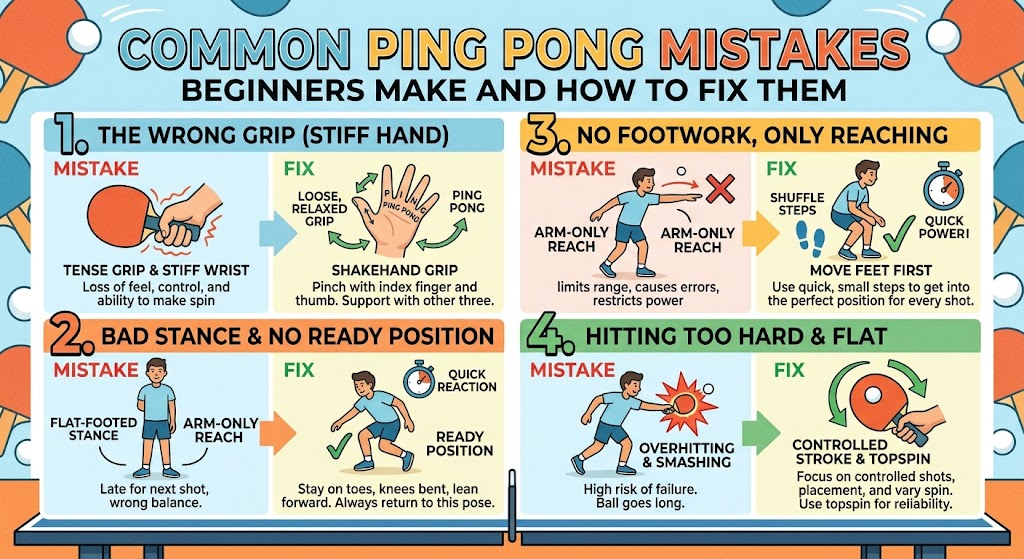
Common Ping Pong Mistakes Beginners Make and How to Fix Them
Every ping pong player makes mistakes.
That includes beginners, recreational players, competitive players, and even the best table tennis players in the world.
The difference isn’t whether you make mistakes. The difference is whether you understand why you’re making them and what you can do to correct them.
For beginners, some mistakes are particularly common. Players stand too upright, grip the paddle too tightly, swing too hard, watch the ball incorrectly, reach instead of moving their feet, ignore spin, attack balls they shouldn’t attack, and become so focused on winning that they forget to develop their technique.
None of these problems means you are a bad ping pong player.
They’re simply part of the learning process.
The key is recognizing them early.
Ping pong is a sport where small technical adjustments can make a surprisingly large difference. Changing your paddle angle slightly can improve a return. Moving your feet before swinging can dramatically improve your forehand. Relaxing your grip can give you better control. Learning to recognize backspin can eliminate a frustrating source of errors.
This guide covers the most common ping pong mistakes beginners make, explains what causes them, and provides practical solutions you can use during practice and matches.
If you’re new to the sport, this article works especially well alongside The Ultimate Beginner’s Guide to Ping Pong (Table Tennis): Rules, Equipment, Skills, and How to Play and Ping Pong Tips for Beginners: How to Improve Your Forehand, Backhand, and Footwork.
Why Beginners Make So Many Ping Pong Mistakes
Ping pong looks deceptively simple.
The table is small.
The ball is lightweight.
The paddle is relatively small.
You don’t have to run around a giant field.
Yet the game demands an unusual combination of skills.
You need:
- Hand-eye coordination
- Timing
- Balance
- Footwork
- Reaction speed
- Stroke technique
- Spin recognition
- Ball control
- Tactical awareness
- Mental discipline
Beginners are trying to learn all of these simultaneously.
That’s why mistakes are inevitable.
The objective isn’t to eliminate every mistake immediately.
Instead, focus on identifying the mistakes that are holding your game back the most.
Mistake #1: Holding the Paddle Too Tightly
One of the most common beginner mistakes is gripping the paddle like you’re trying to prevent someone from taking it away.
A tight grip creates unnecessary tension.
That tension can make your stroke:
- Stiff
- Slow
- Inconsistent
- Difficult to adjust
It can also interfere with touch and control.
How to Fix It
Hold the paddle securely but comfortably.
Your grip should provide enough control that the paddle doesn’t move unpredictably, but it shouldn’t leave your hand tense.
During practice, periodically check your hand.
Ask yourself:
“Am I squeezing harder than I need to?”
Relax your hand and continue.
As your skill improves, you’ll develop a better sense of when you need additional pressure and when you don’t.
Mistake #2: Standing Too Upright
A beginner may stand at the table almost like they’re waiting in line.
Their legs are straight.
Their upper body is upright.
Their weight is on their heels.
This makes movement difficult.
Ping pong requires you to react quickly in multiple directions.
How to Fix It
Start from an athletic ready position.
Keep:
- Knees slightly bent
- Feet roughly shoulder-width apart
- Weight balanced toward the balls of your feet
- Paddle in front
- Upper body slightly forward
You don’t need to crouch extremely low.
The goal is simply to remain ready to move.
Mistake #3: Standing Too Still
Some beginners believe that good players barely move.
The opposite is usually true.
Good players make lots of small adjustments.
If you remain planted in one location, you will eventually find yourself reaching for the ball.
How to Fix It
Stay active.
Use small adjustment steps.
Move toward the ball rather than stretching your arm whenever possible.
After every shot, recover into a position that prepares you for the next one.
This connects directly to one of the most important principles in Ping Pong Tips for Beginners: How to Improve Your Forehand, Backhand, and Footwork:
Feet first, paddle second.
Mistake #4: Reaching Instead of Moving
This is one of the defining beginner habits.
The ball goes toward the forehand.
Instead of moving the body, the player stretches their arm.
They might successfully return the ball.
But they’re usually off balance.
Then the opponent hits the next shot somewhere else.
Now they’re completely out of position.
How to Fix It
Move your body into position before swinging.
Your goal should be to create a comfortable contact zone.
Don’t make your paddle responsible for rescuing your body from poor positioning.
Good footwork gives your stroke room to work.
Mistake #5: Swinging Too Hard
Beginners often assume that hitting harder means playing better.
It doesn’t.
A hard shot that lands outside the table is still a lost point.
A controlled shot that lands exactly where you intended can be far more valuable.
How to Fix It
Start with controlled power.
Try hitting the ball at approximately 60–70% of your maximum effort.
Focus on:
- Timing
- Contact
- Placement
- Balance
- Recovery
Once your technique becomes reliable, increase your speed gradually.
Power should come from good mechanics rather than simply trying harder.
Mistake #6: Using Only the Arm
Another common problem is trying to hit every forehand with the arm alone.
This produces a stroke that may be fast but lacks consistency and control.
How to Fix It
Learn to involve your entire body.
A forehand can include:
- Leg positioning
- Hip rotation
- Torso rotation
- Shoulder movement
- Arm movement
- Forearm movement
You don’t need to exaggerate any of these.
The objective is to develop a coordinated movement rather than an isolated arm swing.
Mistake #7: Taking Too Big a Backswing
Beginners sometimes believe a bigger backswing creates more power.
In ping pong, a huge backswing can actually create problems.
The ball moves quickly.
You may not have enough time to complete a large motion.
How to Fix It
Use compact preparation.
Get your paddle into position early.
Then make a controlled forward swing.
As your technique improves, you’ll learn how much preparation you need for different types of shots.
Mistake #8: Contacting the Ball Too Late
Timing problems are extremely common.
A player waits for the ball to come toward them instead of meeting it at a comfortable contact point.
By the time they swing, the ball is too close to their body.
How to Fix It
Watch the ball closely.
Prepare earlier.
Move into position.
Try to make contact in front of your body rather than letting the ball get jammed beside you.
Good timing often starts with good preparation.
Mistake #9: Watching the Ball Only After It Bounces
Some beginners track the ball toward the table but stop paying attention to it after the bounce.
That’s too late.
How to Fix It
Watch the entire sequence:
Opponent contact → Ball flight → Bounce → Your contact
Also watch your opponent’s paddle.
Their contact can provide clues about:
- Speed
- Direction
- Spin
- Placement
The earlier you recognize what’s happening, the more time you have to react.
Mistake #10: Watching Your Own Paddle
Beginners sometimes look down at their paddle while hitting.
This usually happens because they’re consciously thinking about technique.
But your eyes should remain focused on the ball and your opponent.
How to Fix It
Trust your stroke.
Your paddle should eventually become an extension of your body.
Keep your visual attention on the incoming ball.
Mistake #11: Forgetting to Recover After a Shot
This is a huge problem.
A beginner hits a good shot.
Then they watch it.
Meanwhile, their opponent has already returned the ball.
Now they’re still standing in the position they used for the previous shot.
How to Fix It
Make recovery part of every stroke.
Think:
Hit → Recover → Prepare
Don’t admire your shot.
The rally isn’t over until the point is over.
Mistake #12: Having Poor Ready Position
Your ready position affects almost everything else.
If you’re standing too far back, too close, too upright, or with your paddle down by your side, your reaction time suffers.
How to Fix It
Before every rally, establish a comfortable ready position.
Keep your:
- Paddle in front
- Knees slightly bent
- Feet balanced
- Body relaxed
- Weight ready to move
This should eventually become automatic.
Mistake #13: Ignoring Footwork
Some beginners believe ping pong is mostly about the hands.
It’s not.
Your feet determine where your body is when you hit the ball.
How to Fix It
Practice footwork separately.
Try:
- Side-to-side shuffles
- Forehand/backhand movement
- Short-ball movement
- Recovery drills
- Random placement drills
Even five or ten minutes of focused footwork practice can improve your overall game.
Mistake #14: Treating Every Ball the Same
This is a major tactical error.
A fast topspin ball isn’t the same as a slow backspin ball.
A short ball isn’t the same as a deep ball.
A high ball isn’t the same as a low ball.
Yet beginners often use the same stroke for everything.
How to Fix It
Before hitting, ask:
What is this ball doing?
Consider:
- Spin
- Speed
- Height
- Length
- Direction
Then choose your response.
Mistake #15: Ignoring Spin
Spin is one of the biggest sources of beginner frustration.
You hit the ball the way you normally do.
Suddenly it goes into the net.
Or it flies long.
Or it shoots sideways.
You may wonder what happened.
The answer could be your opponent’s spin.
How to Fix It
Learn the basic types:
- Topspin
- Backspin
- Sidespin
- No-spin
Then learn how each affects your paddle.
Our detailed guide How to Put Spin on a Ping Pong Ball: Topspin, Backspin, Sidespin, and More covers both producing and reading spin.
Mistake #16: Trying to Attack Heavy Backspin With a Flat Stroke
This is one of the most common examples of misunderstanding spin.
A player sees a ball coming toward them and tries to hit it aggressively.
The ball goes straight into the net.
Heavy backspin can cause this reaction if the player doesn’t adjust.
How to Fix It
Recognize the backspin.
Adjust your paddle angle.
Use an appropriate upward component in your stroke when attacking.
If you’re still learning, a controlled push may be a better choice than attempting a difficult attack.
Mistake #17: Assuming More Spin Is Always Better
Beginners sometimes become obsessed with producing maximum spin.
But spin is a tool.
More isn’t automatically better.
How to Fix It
Learn to vary spin.
Practice:
- Heavy spin
- Medium spin
- Light spin
- No-spin
Being able to change the amount of spin can be more useful than simply producing maximum rotation.
Mistake #18: Trying to Learn Too Many Serves
Beginners often see advanced players performing complicated serves and immediately try to copy them.
The result is usually a collection of unreliable serves.
How to Fix It
Master a few reliable serves first.
Develop:
- One dependable backspin serve
- One sidespin variation
- One no-spin variation
- One longer serve
Once these become reliable, expand your serving toolbox.
For a complete serving breakdown, see How to Improve Your Ping Pong Serve: Techniques, Spin, and Placement.
Mistake #19: Serving Without a Plan
A serve isn’t simply something you do to start a rally.
It should have a purpose.
How to Fix It
Before serving, ask:
Where do I want the return?
Then:
What do I want to do with that return?
For example:
Short backspin serve → expected push → forehand topspin attack.
This turns your serve into the beginning of a strategy.
Mistake #20: Serving the Same Ball Every Time
Even a good serve becomes less effective if your opponent knows exactly what’s coming.
How to Fix It
Use variation.
Change:
- Placement
- Spin
- Speed
- Length
You don’t need dozens of different serves.
You need enough variation to prevent easy anticipation.
Mistake #21: Returning Every Serve the Same Way
Some players automatically push every serve.
Others try to attack every serve.
Neither approach is ideal.
How to Fix It
Read the serve first.
Ask:
- How much spin?
- What type?
- How long?
- Where is it going?
Then decide whether to:
- Push
- Flick
- Block
- Attack
- Control
Your return should match the ball you’re receiving.
Mistake #22: Trying to Win Every Point With a Winner
This is perhaps the biggest tactical mistake beginners make.
They believe every ball is an opportunity to hit a spectacular winner.
It isn’t.
How to Fix It
Wait for the right ball.
Build the point.
Use placement.
Force movement.
Create a weak return.
Then attack.
Our guide Ping Pong Strategies and Tactics: How to Outsmart Your Opponent explains how to construct points instead of constantly chasing winners.
Mistake #23: Playing Too Fast
Some beginners think fast rallies mean they’re playing better.
Sometimes speed is appropriate.
Sometimes it isn’t.
How to Fix It
Learn to control tempo.
Practice:
- Slow balls
- Medium-speed balls
- Fast attacks
Changing pace can be a tactical weapon.
A slower ball may actually cause more problems for an opponent who expects speed.
Mistake #24: Playing Too Far From the Table
Beginners sometimes retreat after a fast shot because they believe they need more time.
But moving too far back can create problems.
The ball has more distance to travel.
You may lose control of the short game.
You may also make your opponent’s placement easier.
How to Fix It
Learn to play at an appropriate distance for your style and skill level.
Stay relatively close when practicing basic control.
As you improve, you’ll learn when backing away makes tactical sense.
Mistake #25: Standing Too Close to the Table
The opposite problem is also common.
If you’re too close, you may not have enough time to react to fast balls.
How to Fix It
Find a comfortable position that allows you to:
- React
- Move
- Reach short balls
- Handle deeper balls
Your ideal distance will change depending on the type of shot you’re playing.
Mistake #26: Ignoring the Middle of the Table
Beginners often think only about forehand and backhand corners.
The middle can be a powerful target.
How to Fix It
Practice directing balls toward the opponent’s crossover area.
This can create hesitation between forehand and backhand.
The middle becomes especially useful when combined with side-to-side placement.
Mistake #27: Always Hitting to the Opponent’s Backhand
The backhand is a common target because many beginners struggle with it.
But constantly hitting there can make you predictable.
How to Fix It
Test the opponent.
Then use patterns such as:
Backhand → middle → forehand
or:
Backhand → forehand → backhand
Make the opponent move.
Mistake #28: Not Watching Your Opponent
Ping pong is not played against an empty table.
Your opponent is giving you information constantly.
How to Fix It
Watch:
- Their paddle
- Their body position
- Their feet
- Their recovery
- Their preferred shots
Look for patterns.
Do they always move toward the forehand?
Do they struggle with short balls?
Do they stand too far back?
Do they attack every long serve?
These observations can become tactical advantages.
Mistake #29: Refusing to Exploit a Weakness
Some beginners feel like targeting a weakness is somehow unfair.
It isn’t.
That’s part of competitive sports.
How to Fix It
If your opponent consistently struggles with a particular shot, use that information.
You don’t have to be rude or disrespectful.
You’re simply playing intelligently.
Mistake #30: Becoming Too Predictable
The opposite problem is also common.
You may have one favorite serve, one favorite placement, and one favorite attack.
Eventually, opponents figure you out.
How to Fix It
Develop variation.
Change one thing at a time:
- Direction
- Spin
- Speed
- Depth
- Placement
You don’t have to completely reinvent your game.
Mistake #31: Trying to Copy Advanced Players Too Soon
Watching excellent table tennis players is inspiring.
But their techniques may be far beyond what a beginner needs.
Trying to copy every movement can create confusion.
How to Fix It
Build your fundamentals first.
Develop:
- Balance
- Grip
- Ready position
- Forehand
- Backhand
- Footwork
- Basic serve
- Basic spin
Then gradually introduce advanced techniques.
Mistake #32: Changing Equipment Constantly
Beginners sometimes believe a new paddle will solve every problem.
It usually won’t.
How to Fix It
Use equipment that fits your skill level and then spend time learning how it behaves.
Changing equipment constantly makes it harder to develop consistent touch and control.
For guidance on selecting and maintaining equipment, see Ping Pong Equipment Guide: Choosing the Right Paddle, Balls, Table, and Gear.
Mistake #33: Using Equipment That Is Too Fast
Extremely fast equipment can be difficult for beginners to control.
You may find that the ball flies long before you’ve developed the technique needed to control it.
How to Fix It
Prioritize control.
As your skills improve, you can experiment with equipment designed for greater speed or spin.
Equipment should support your development rather than compensate for missing technique.
Mistake #34: Practicing Only by Playing Matches
Playing matches is fun.
But matches aren’t always the best environment for learning a new skill.
If you’re trying to improve your backhand, you might only get a few opportunities during a normal game.
How to Fix It
Use dedicated drills.
Practice:
- Forehand repetitions
- Backhand repetitions
- Serve repetitions
- Footwork
- Spin recognition
- Placement
Then use matches to test those skills.
Mistake #35: Practicing Without a Goal
Random practice can become mindless.
You hit the ball.
The ball comes back.
You hit it again.
But what are you improving?
How to Fix It
Choose one goal.
For example:
Today’s goal: Improve backhand consistency.
Or:
Today’s goal: Recover after every forehand.
Or:
Today’s goal: Practice short backspin serves.
Focused practice produces better results.
Mistake #36: Practicing Only What You’re Good At
This is a very human tendency.
We enjoy doing things we’re already good at.
But improvement often comes from working on weaknesses.
How to Fix It
Spend part of every practice session on your weaker areas.
If your forehand is excellent but your backhand is unreliable, give the backhand attention.
If your strokes are good but your footwork is poor, work on movement.
Mistake #37: Getting Frustrated by Errors
Mistakes are inevitable.
Getting angry after every mistake can make your technique worse.
You may grip the paddle tighter.
Rush.
Swing harder.
Stop moving your feet.
How to Fix It
Treat mistakes as information.
Instead of:
“I’m terrible.”
Ask:
“Why did that ball go into the net?”
Maybe you misread the spin.
Maybe your paddle angle was wrong.
Maybe you contacted the ball too late.
That’s useful information.
Mistake #38: Trying to Fix Everything at Once
This can overwhelm beginners.
One minute you’re thinking about grip.
Then footwork.
Then paddle angle.
Then spin.
Then strategy.
Then your serve.
Your brain becomes overloaded.
How to Fix It
Pick one technical priority.
Work on it until it becomes more natural.
Then move to the next.
You can still play normally while focusing on one specific improvement.
Mistake #39: Ignoring the Mental Side of Ping Pong
Ping pong is a mental game as well as a physical one.
Players can become:
- Nervous
- Impatient
- Overconfident
- Frustrated
- Distracted
These emotions affect decision-making.
How to Fix It
Develop a simple routine.
Before important points:
- Take a breath.
- Relax your grip.
- Choose your plan.
- Commit to the shot.
- Play the point.
Don’t let one bad point control the next one.
Mistake #40: Letting the Score Control Your Game
You’re winning 9–5.
You become nervous.
You stop attacking.
You play scared.
Or you’re losing 8–4 and start trying to hit impossible winners.
Both reactions can hurt you.
How to Fix It
Focus on the next point.
Ask:
What is the best decision right now?
Not:
How do I win the entire match immediately?
Mistake #41: Not Practicing Under Pressure
A player may look great during relaxed practice but struggle badly when the score matters.
How to Fix It
Create pressure situations during practice.
Start games at:
- 8–8
- 9–9
- 10–10
Practice serving when you need the point.
Practice returning when one mistake could cost the game.
Pressure becomes less intimidating when you’ve experienced it repeatedly.
Mistake #42: Focusing Only on Your Own Game
You need technique.
But you also need to understand the opponent.
How to Fix It
During matches, gather information.
Look for:
- Weaknesses
- Patterns
- Favorite serves
- Preferred returns
- Movement problems
- Reactions to spin
Then adjust.
This is the foundation of intelligent strategy.
Mistake #43: Forgetting That Placement Beats Power
A moderately fast ball in the perfect location can be more effective than a hard shot directly at your opponent.
How to Fix It
Practice targeting:
- Corners
- Middle
- Body
- Short areas
- Wide angles
Develop control.
Then add speed.
Mistake #44: Trying to Hit the Perfect Shot
Beginners sometimes wait for the perfect ball.
They want to make an amazing shot.
Meanwhile, they miss the easy opportunity.
How to Fix It
Play the ball you actually received.
Don’t imagine the ball you wish you had received.
If it’s low and short, control it.
If it’s high, attack it.
If it’s heavily spinning, adjust.
Adaptation is a major part of ping pong.
Mistake #45: Not Understanding the Rules
Technical skill isn’t enough if you don’t understand how the game works.
Serving, scoring, doubles rotation, lets, edge balls, and other rules matter.
How to Fix It
Learn the fundamentals of legal play.
Our guide Ping Pong Rules Explained: How to Play, Score Points, and Win Games provides a detailed breakdown of the rules beginners need to know.
Understanding the rules also helps you understand strategy.
Mistake #46: Forgetting Basic Ping Pong Etiquette
Good sportsmanship matters.
Beginners sometimes get so focused on winning that they forget they’re playing with another person.
How to Fix It
Practice good etiquette:
- Respect your opponent.
- Don’t intentionally distract them.
- Retrieve stray balls safely.
- Congratulate good shots.
- Avoid unnecessary arguing.
- Follow the rules.
- Keep the playing area safe.
Competitive intensity and good sportsmanship can coexist.
Mistake #47: Not Warming Up
Walking directly to a table and immediately trying to hit maximum-speed shots isn’t ideal.
How to Fix It
Spend a few minutes warming up.
Start with:
- Easy forehands
- Easy backhands
- Controlled movement
- Gradually increasing speed
This also gives you an opportunity to get a feel for the table and ball.
Mistake #48: Expecting Instant Improvement
Ping pong rewards repetition.
You may practice a new technique and feel worse before you feel better.
That’s normal.
How to Fix It
Give yourself time.
Track small improvements.
Maybe you hit five consecutive topspin shots this week and 15 next week.
That’s progress.
Mistake #49: Comparing Yourself to Experienced Players
A beginner watching an advanced player may think:
“I’ll never be able to do that.”
Don’t make that comparison.
That experienced player has probably spent years developing those skills.
How to Fix It
Compare yourself to your previous performance.
Can you do something today that you couldn’t do last month?
That’s what matters.
Mistake #50: Forgetting to Have Fun
This may be the most important mistake of all.
Ping pong is supposed to be enjoyable.
If every practice session feels like a punishment, you’re less likely to keep playing.
How to Fix It
Mix structured practice with recreational games.
Try new shots.
Play different opponents.
Set fun challenges.
Laugh at ridiculous misses.
Celebrate improvement.
Enjoy the game.
The Five Mistakes That Usually Matter Most
We’ve covered a lot of potential problems.
But beginners don’t need to fix all 50 simultaneously.
Start with these five:
1. Poor Footwork
Move your body into position.
2. Excessive Power
Prioritize control.
3. Poor Timing
Prepare early and contact the ball comfortably.
4. Ignoring Spin
Learn to recognize how the ball is rotating.
5. Poor Decision-Making
Stop trying to win every point with one spectacular shot.
Fixing these five areas can dramatically improve a beginner’s game.
A Simple Mistake-Correction System
When you make an error, use this four-step process.
Step 1: Identify the Error
What happened?
Step 2: Find the Cause
Why did it happen?
Step 3: Choose One Adjustment
What can you change?
Step 4: Test It
Try again.
For example:
Problem: Forehand went long.
Possible cause: Paddle angle too open.
Adjustment: Close the paddle slightly.
Test: Hit another controlled forehand.
This is much more productive than simply thinking:
“Don’t hit it long!”
How to Turn Mistakes Into Practice Drills
Your mistakes can tell you what to practice.
If you repeatedly:
Miss backhands → practice backhand consistency.
Miss against backspin → practice spin recognition and pushing.
Get caught out of position → practice footwork.
Lose serve points → practice serving and returning.
Overhit easy balls → practice controlled placement.
Your match is essentially giving you a practice plan for free.
A 30-Minute Mistake-Correction Practice Session
Try this routine.
Minutes 1–5: Warm-Up
Easy forehands and backhands.
Minutes 6–12: Weak Stroke
Practice whichever stroke causes you the most trouble.
Minutes 13–18: Footwork
Alternate between forehand and backhand.
Minutes 19–24: Spin
Practice identifying and responding to different spins.
Minutes 25–30: Controlled Games
Play points while focusing on your biggest weakness.
Don’t worry about the score.
Focus on correcting the problem.
Keep a Mistake Journal
This can be surprisingly useful.
After each practice or match, write down:
Three things that went well
This prevents you from focusing only on mistakes.
Three things that went wrong
Be specific.
One thing to practice next time
Keep the next goal manageable.
For example:
Problem: I kept reaching for wide forehands.
Next practice goal: Move my feet before swinging.
Over time, you’ll see patterns.
When Should You Get Coaching?
You don’t need formal coaching to enjoy ping pong or improve.
But instruction can accelerate progress, particularly if you’re repeatedly making the same technical mistake.
A coach can identify things you may not notice yourself.
For example:
- Paddle angle
- Foot positioning
- Stroke path
- Timing
- Recovery
- Serve mechanics
If coaching isn’t available, video can also be useful.
Record yourself from a safe location and watch your movement afterward.
You may notice habits that aren’t obvious while you’re playing.
Don’t Become Obsessed With Perfect Technique
There is another trap worth mentioning.
Some beginners become so focused on technique that they stop enjoying the game.
Technique matters.
But there is no single perfect-looking stroke for every player.
Body type, grip, playing style, equipment, and tactical preferences all influence technique.
The goal is functional, repeatable technique.
How Mistakes Change as You Improve
Interestingly, the mistakes don’t disappear.
They change.
Beginners may struggle with:
- Grip
- Stance
- Timing
- Basic contact
Intermediate players may struggle with:
- Spin
- Placement
- Transitions
- Serve returns
- Tactical decisions
Advanced players may focus on:
- Fine margins
- Deception
- Variation
- Pressure
- Tactical adaptation
Improvement doesn’t mean making no mistakes.
It means making better mistakes and learning faster from them.
Frequently Asked Questions About Beginner Ping Pong Mistakes
What is the biggest mistake beginners make?
Poor footwork and trying to hit the ball too hard are two of the most common problems. Beginners often try to solve positioning problems with their arms.
Why do I keep hitting the ball into the net?
Possible causes include incoming backspin, an incorrect paddle angle, late contact, or insufficient upward movement.
Why do my shots keep going long?
You may be hitting too hard, opening the paddle too much, contacting the ball incorrectly, or failing to account for incoming topspin.
Why can’t I return spin?
You may not yet be recognizing the type or amount of spin. Watch the opponent’s paddle and the ball’s bounce.
Should I change my paddle if I’m making lots of mistakes?
Usually, technique should be examined before equipment. The right equipment matters, but a new paddle won’t automatically fix poor mechanics.
How can I stop reaching for the ball?
Focus on moving your feet before extending your arm. Practice lateral movement and recovery drills.
How can I become more consistent?
Reduce unnecessary power, use compact strokes, practice repetition, and develop a reliable ready position.
Should I practice or just play games?
Both. Practice develops specific skills, while games teach you how to apply those skills under pressure.
How many mistakes should I expect as a beginner?
Lots. Mistakes are a normal part of learning. Focus on reducing repeated mistakes rather than expecting perfection.
How long does it take to stop making beginner mistakes?
There is no universal timeline. Consistent practice and good feedback can accelerate improvement, but some mistakes naturally take time to eliminate.
Final Thoughts: Every Mistake Is a Lesson
Ping pong can be frustrating when you’re learning.
The ball goes into the net.
You miss an easy return.
Your serve goes long.
You reach for a forehand and completely miss.
Your opponent hits a shot you can’t even understand.
It can feel like you’re doing everything wrong.
You’re not.
You’re learning.
Every mistake provides information.
If your forehand goes long, something happened.
If your backhand goes into the net, something happened.
If you can’t return a serve, something happened.
Your job is to figure out what happened and make one adjustment.
Don’t try to eliminate every mistake at once.
Start with the biggest ones.
Improve your stance.
Relax your grip.
Move your feet.
Prepare earlier.
Control your swing.
Learn to read spin.
Practice your serve.
Think about placement.
Stop trying to hit winners from impossible situations.
And learn to recover after every shot.
Most importantly, remember that good ping pong isn’t built from spectacular shots. It’s built from thousands of small, correct decisions and movements repeated over time.
The beginner who learns to recognize and correct mistakes will eventually develop something much more valuable than a collection of fancy shots: a reliable game.
And once that foundation is in place, you can begin adding more advanced spin, strategy, tactics, and competitive experience.
The mistakes won’t disappear.
You’ll simply become much better at understanding them.
That’s how players improve.
Continue Exploring the Ping Pong Series
This article is part of The Sports Utopia’s comprehensive ping pong content cluster. Continue building your skills with these related guides:
- The Ultimate Beginner’s Guide to Ping Pong (Table Tennis): Rules, Equipment, Skills, and How to Play
- Ping Pong Rules Explained: How to Play, Score Points, and Win Games
- Ping Pong Equipment Guide: Choosing the Right Paddle, Balls, Table, and Gear
- How to Improve Your Ping Pong Serve: Techniques, Spin, and Placement
- Ping Pong Tips for Beginners: How to Improve Your Forehand, Backhand, and Footwork
- How to Put Spin on a Ping Pong Ball: Topspin, Backspin, Sidespin, and More
- Ping Pong Strategies and Tactics: How to Outsmart Your Opponent
- Ping Pong Tournaments and Competitive Table Tennis: How Competition Works
Your mistakes are not evidence that you don’t belong at the ping pong table.
They’re evidence that you’re learning.
Recognize them.
Understand them.
Practice the solution.
Then get back to the table and try again.