
Ping Pong Strategies and Tactics
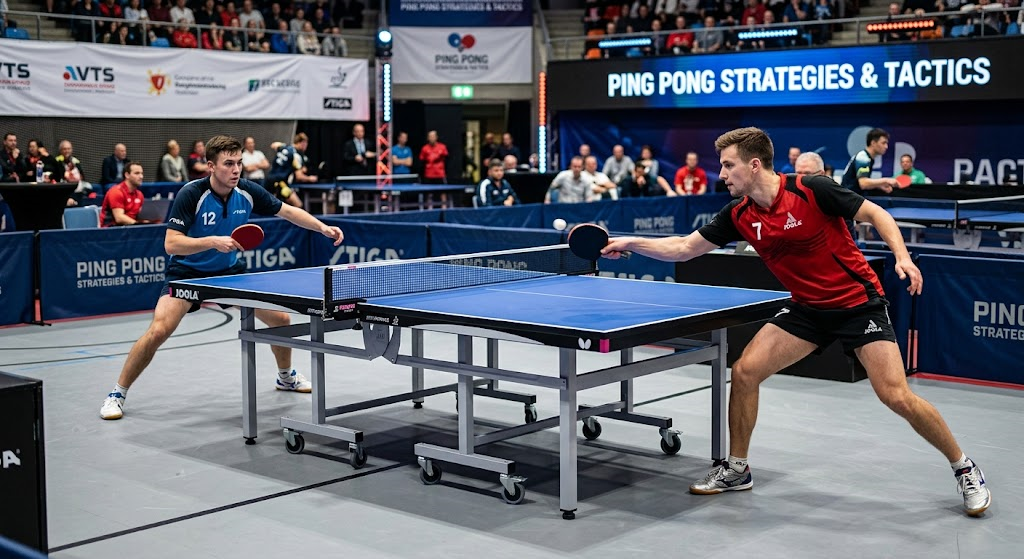
Ping Pong Strategies and Tactics: How to Outsmart Your Opponent
Ping pong is often described as a game of speed, reflexes, and hand-eye coordination.
Those things certainly matter.
But once two players develop reasonable technique, something else starts separating the winners from the losers: strategy.
You can have a powerful forehand and still lose because you keep hitting it to the wrong place. You can have a great serve and still struggle because you don’t know what to do with the return. You can move quickly around the table but constantly find yourself out of position because you’re reacting instead of anticipating.
Good ping pong strategy is about making better decisions.
It is about understanding your opponent, controlling the ball, creating weaknesses, protecting your own weaknesses, changing pace, using spin intelligently, and constructing points instead of simply hitting whatever ball happens to come toward you.
The good news is that beginners can start learning strategy much earlier than they might think.
You don’t need to be an advanced tournament player to understand the basic principles of tactical table tennis.
In fact, learning simple strategy while you are developing your strokes can accelerate your improvement because it gives every shot a purpose.
This guide explains the most important ping pong strategies and tactics for beginners, including serve strategy, return strategy, placement, spin, tempo, attacking weaknesses, third-ball tactics, defensive strategies, doubles tactics, mental game concepts, and how to build an actual game plan.
If you’re still developing your fundamental strokes, start with Ping Pong Tips for Beginners: How to Improve Your Forehand, Backhand, and Footwork. And if you’re unfamiliar with spin, our guide How to Put Spin on a Ping Pong Ball: Topspin, Backspin, Sidespin, and More will help you understand one of the most important tactical weapons in the sport.
Strategy vs. Tactics in Ping Pong
The words “strategy” and “tactics” are often used interchangeably, but there is a useful distinction.
Strategy is your overall plan.
Tactics are the individual decisions you make to execute that plan.
For example, your strategy might be:
Attack your opponent’s weaker backhand.
Your tactics could include:
- Serving to the backhand
- Pushing to the backhand
- Playing topspin to the backhand
- Moving the ball to the middle
- Waiting for a weak return
- Then attacking the forehand side
The strategy gives you direction.
The tactics help you accomplish it.
A good player constantly combines both.
The Most Important Tactical Principle: Make Your Opponent Uncomfortable
You don’t necessarily need to hit the hardest shot.
You need to make your opponent’s job difficult.
That might mean:
- Making them move
- Giving them difficult spin
- Changing the pace
- Hitting into their weaker side
- Keeping the ball short
- Going long unexpectedly
- Changing direction
- Attacking the middle
- Forcing awkward decisions
The objective isn’t simply to hit winners.
Sometimes the best shot is the one that causes your opponent to make the mistake for you.
Learn Your Opponent Before Trying to Beat Them
One of the biggest beginner mistakes is entering a match with a predetermined plan and never adjusting it.
Instead, spend the first few points gathering information.
Ask yourself:
- Which side is stronger?
- Which side is weaker?
- Do they struggle with backspin?
- Do they attack short balls?
- Do they return serves aggressively?
- Do they have trouble moving sideways?
- Do they favor the forehand?
- Do they struggle with balls to the middle?
- Do they make mistakes when rushed?
- Do they become impatient during long rallies?
You are not wasting points by observing.
You are collecting information.
Find the Opponent’s Weakness
Every player has weaknesses.
They may not be obvious immediately.
A weakness could be technical.
For example, their backhand might be inconsistent.
It could be physical.
Perhaps they struggle moving to their forehand.
It could be tactical.
Maybe they don’t handle short serves well.
It could even be mental.
Some players become impatient when they cannot immediately attack.
Your job is to identify the weakness and determine whether you can exploit it consistently.
Don’t Confuse a Bad Shot With a True Weakness
Suppose your opponent misses their first three backhands.
That doesn’t automatically mean their backhand is terrible.
Maybe they were surprised by your serve.
Maybe the balls had unusual spin.
Maybe they simply made three mistakes.
Test the weakness.
Continue sending balls to that area.
If the problem continues, you’ve found something useful.
If they adjust and begin returning everything comfortably, change your plan.
Good strategy is based on evidence rather than assumptions.
The Importance of Placement
One of the simplest ways to become a smarter ping pong player is to stop thinking only about how hard you hit the ball.
Start thinking about where you hit it.
You generally have several broad targets:
- Forehand
- Backhand
- Middle
- Wide forehand
- Wide backhand
- Short forehand
- Short backhand
- Deep corners
Each location creates a different problem.
Placement becomes even more powerful when combined with spin and speed.
Attack the Middle
The middle of the table is one of the most valuable targets in ping pong.
Why?
Because it can create indecision.
The opponent may have to decide whether to use the forehand or backhand.
That decision takes time.
If the ball arrives quickly, they may not have enough time to choose comfortably.
The middle can also be particularly effective against players who have a large difference between their forehand and backhand positioning.
Don’t assume that every point should be played to the corners.
Sometimes the best target is directly between them.
Play to the Crossover Point
The crossover area is the region between an opponent’s natural forehand and backhand zones.
It can be uncomfortable because the player has to make a quick decision.
A ball to the crossover can force:
- A late stroke
- An awkward backhand
- An uncomfortable forehand
- Poor footwork
- A weak return
Learning to identify this area is a major step toward smarter placement.
Move the Opponent Side to Side
Another fundamental tactic is making your opponent move.
For example:
- Hit to their backhand.
- Then move the ball to their forehand.
- Then attack the middle.
The objective is not necessarily to hit a winner immediately.
You are forcing your opponent to reposition.
Movement creates openings.
Once a player is pulled away from their ideal position, another area of the table becomes available.
Don’t Move the Ball Randomly
There is a difference between changing placement and randomly changing placement.
Good placement has a purpose.
You might play:
Backhand → forehand → middle
because you want to force movement and create a weak return.
That’s tactical.
Simply hitting wherever you feel like hitting is not.
Try to know why you’re changing direction.
The Serve Is the Beginning of Your Strategy
A serve isn’t just a way to start the point.
It is your first tactical opportunity.
You control:
- Spin
- Placement
- Speed
- Length
- Height
- Variation
That means you can influence what happens next.
This is why serving should be viewed as the first step in a point-construction plan.
For a detailed guide to developing your serve, read How to Improve Your Ping Pong Serve: Techniques, Spin, and Placement.
Short Serve Strategy
A short serve lands close to the net and generally bounces twice or would bounce twice if left untouched.
Short serves can limit an opponent’s ability to attack aggressively.
They must move forward.
They may have to push or flick the ball.
That can create opportunities for you.
Short serves are particularly useful when an opponent likes to attack long serves aggressively.
Long Serve Strategy
Long serves travel deep into the opponent’s court.
A long serve can be risky because your opponent has more opportunity to attack.
But that doesn’t make long serves useless.
A fast, well-placed long serve can surprise an opponent who expects a short ball.
Long serves can be particularly effective when:
- The opponent stands too close to the table
- You disguise the serve well
- You target the body
- You change the direction
- You use effective spin
The key is variation.
Serve to the Body
Many beginners think only about forehand and backhand corners.
The body is another excellent target.
A serve directly toward an opponent’s playing area can force an awkward decision.
They may have to move.
They may not know whether to use forehand or backhand.
This can produce a weak return.
Body placement is especially useful when an opponent has become comfortable covering the corners.
Use Spin Variation on Serves
If every serve has the same spin, your opponent will eventually adjust.
Instead, develop several related serves.
For example:
- Heavy backspin
- Light backspin
- Sidespin
- Sidespin/backspin
- Sidespin/topspin
- No-spin
The goal isn’t to perform complicated tricks.
The goal is to make the opponent uncertain.
A serve that looks similar but behaves differently can be particularly effective.
No-Spin Serves Can Be Dangerous
This is one of the simplest examples of deception.
Suppose you’ve served several heavy backspin balls.
Your opponent begins opening their paddle and preparing to lift the ball.
Then you serve a ball that looks nearly identical but has little spin.
They make the same adjustment.
The ball may fly long.
That’s tactical deception.
The appearance of the serve and the actual spin don’t always have to match.
The Serve + First Attack
Your serve should ideally create an opportunity for your next shot.
Think about the sequence:
Serve → Return → Attack
This is often called the third-ball pattern because your first shot after the opponent’s return is your third ball of the rally.
For example:
- Short backspin serve
- Opponent pushes
- You attack the backspin with forehand topspin
Your serve created the situation.
Your third ball takes advantage of it.
This is much more effective than serving randomly and hoping something good happens.
Build Serve Combinations
You don’t need 20 different serves.
You need a small collection that work together.
For example:
Combination 1
Short backspin → opponent pushes → forehand topspin
Combination 2
Short sidespin → opponent returns wide → attack the open area
Combination 3
Long fast serve → weak return → attack immediately
Combination 4
Heavy backspin → opponent pushes long → topspin attack
Practice these combinations until they become familiar.
Return Strategy
The serve gets a lot of attention, but receiving serve is equally important.
When returning, your first job is not necessarily to attack.
Your first job is to understand what the server has given you.
Read:
- Spin
- Placement
- Length
- Speed
Then choose the appropriate response.
The Four Basic Return Options
Against a serve, you can generally think about several broad choices:
- Push
- Block or control
- Flick
- Attack
Beginners will use the push frequently.
That’s perfectly fine.
You don’t need to attack every serve.
The Safe Return
Sometimes the best return is simply a reliable one.
If your opponent serves with heavy spin and you aren’t confident about attacking it, return the ball safely.
A controlled return keeps you in the point.
Taking a low-percentage attacking shot may give your opponent a free point.
Good strategy includes knowing when not to attack.
Change the Return Placement
Don’t automatically return every serve to the same place.
If you always return to the opponent’s backhand, they may begin waiting for it.
Try different locations.
For example:
- Deep backhand
- Deep forehand
- Middle
- Short
Variation makes your return harder to predict.
Attack the Weakest Ball, Not Every Ball
This is a critical tactical lesson.
Not every ball deserves an attack.
If the opponent gives you a short, high, weak ball, attack it.
If they give you a low, heavy backspin ball, perhaps you should use a controlled push or carefully executed topspin.
The goal is to recognize attackable balls.
Good players don’t attack simply because they can.
They attack when the situation favors them.
Learn to Recognize a Neutral Ball
A neutral ball doesn’t give either player a major advantage.
If you receive one, you don’t necessarily need to force the point.
Keep the rally going.
Wait for the opportunity.
This requires patience.
Beginners often lose points because they try to manufacture a winner from a neutral situation.
Use the Opponent’s Power Against Them
If your opponent hits extremely hard, don’t assume you must hit harder.
Sometimes their speed can work against them.
A controlled block or counter can redirect their pace.
Placement becomes extremely important.
If they are committed to hitting hard, a well-placed return can force them to move unexpectedly.
Change the Speed of the Rally
Players often become comfortable with one pace.
That’s an opportunity.
You can change tempo by alternating:
- Slow and fast
- Soft and hard
- Short and deep
- High-spin and low-spin
- Heavy and light
A sudden change can disrupt an opponent’s rhythm.
Slow Doesn’t Mean Weak
A slower ball can be strategically excellent.
Imagine a player expecting a fast topspin rally.
You suddenly give them a slower, heavily spinning ball.
Their timing changes.
They may overhit.
The important point is that speed is a tactical variable.
It isn’t automatically connected to quality.
Use Depth to Your Advantage
Depth refers to how far the ball travels on the table.
Short balls and deep balls create different problems.
A short ball may force the opponent forward.
A deep ball may push them away from the table.
Changing depth can make an opponent move constantly.
A particularly effective pattern can be:
Short → deep → wide
or
Deep → short → deep
Again, the objective is movement and discomfort.
Attack the Open Court
Suppose you move your opponent wide to their backhand.
They have to stretch.
That may leave their forehand area open.
Rather than automatically hitting back to their backhand, you can redirect to the open space.
This is basic court awareness.
You’re not simply reacting to the ball.
You’re reacting to the opponent’s position.
Watch Your Opponent’s Position
You should not stare only at the ball.
Of course, tracking the ball is essential.
But develop the ability to notice where your opponent is standing.
Ask:
- Are they too far to one side?
- Are they too close?
- Are they backing up?
- Are they leaning?
- Are they recovering?
- Is one area open?
This information can help you select your next shot.
Attack the Backhand—But Don’t Become Predictable
A weak backhand is a common target.
But if you hit 10 consecutive balls there, your opponent gets comfortable.
They may adjust their position.
They may start anticipating the shot.
A better approach is often:
Pressure the weakness → change direction → return to the weakness.
Variation keeps the opponent guessing.
Attack the Forehand When Appropriate
Some players have excellent forehands.
Others struggle with wide forehand balls.
Some players become uncomfortable when forced to move to their forehand side.
Don’t automatically assume the backhand is always weaker.
Test both sides.
Find the actual weakness.
Use the Middle Against Strong Forehands
Suppose your opponent has an outstanding forehand.
You might want to avoid giving them comfortable forehand balls.
The middle can reduce their ability to use that weapon effectively.
If they have to decide between forehand and backhand, their powerful forehand may become less useful.
This is an excellent example of strategy rather than simply trying to hit harder.
Control the Rally With Spin
Spin is a tactical tool.
Topspin can help you attack.
Backspin can slow the rally and create difficult returns.
Sidespin can change direction and complicate the opponent’s response.
No-spin can disrupt expectations.
The key is not simply producing spin.
It’s choosing the right spin for the situation.
For a detailed technical explanation, see How to Put Spin on a Ping Pong Ball: Topspin, Backspin, Sidespin, and More.
Don’t Give the Opponent the Same Ball Repeatedly
If every shot has:
- The same speed
- The same spin
- The same depth
- The same placement
your opponent doesn’t have to think.
You become predictable.
Instead, develop variation.
You don’t need to change everything on every shot.
Even small variations can matter.
The Importance of Patterns
Although variation is important, good players don’t simply play randomly.
They create patterns.
For example:
Serve short backspin → receive push → attack backhand
Or:
Serve long to body → weak return → attack forehand
Or:
Backhand → backhand → middle → forehand
Patterns give your game structure.
Variation keeps those patterns from becoming predictable.
Play the Pattern Until It Stops Working
Suppose you discover that your opponent struggles with short backspin serves.
Keep using them.
You don’t have to abandon a successful tactic just because you’re afraid of becoming predictable.
Make them prove they can handle it.
Once they adjust, change your approach.
That’s tactical adaptation.
Exploit a Weakness Without Becoming Obsessed With It
There is a difference between exploiting a weakness and becoming predictable.
If your opponent’s backhand is clearly weaker, attack it.
But don’t automatically hit there every time.
Use the weakness to create opportunities elsewhere.
For example:
- Pressure the backhand.
- Force them to shift over.
- Attack the open forehand.
- Return to the backhand.
Now the weakness becomes part of a larger strategy.
Defensive Strategy
Not every player wants to attack constantly.
Defensive play can also be tactical.
A defensive player may focus on:
- Keeping the ball low
- Using backspin
- Changing placement
- Forcing errors
- Extending rallies
- Waiting for the opponent to overattack
If your opponent is impatient, this can be extremely effective.
Don’t Panic When You Are Under Pressure
Suppose your opponent starts attacking.
Your natural reaction may be to attack harder.
That isn’t always the answer.
Sometimes you should:
- Block
- Slow down
- Change placement
- Reset the rally
- Return safely
- Wait for an opening
A point isn’t lost simply because your opponent attacked first.
Blocking as a Tactical Weapon
A block can look defensive, but it can also be highly strategic.
If an opponent attacks aggressively, you can use their speed.
A controlled block can redirect the ball.
You can aim it:
- Wide
- To the middle
- At the body
- Into the weaker side
The goal is to make them attack another difficult ball.
Know When to Change From Defense to Attack
Good defense shouldn’t necessarily continue forever.
If your opponent gives you a weak ball, take the opportunity.
This creates a transition:
Defense → Neutral → Attack
Learning to recognize that transition is an important tactical skill.
Mental Strategy: Don’t Chase the Score
One of the easiest ways to make poor decisions is to panic about the scoreboard.
If you’re down 7–3, you may suddenly start trying to hit winners.
That’s often exactly what your opponent wants.
Instead, return to your plan.
One point at a time.
If you’re up 9–8, don’t become overly conservative simply because you’re close to winning.
Continue making smart decisions.
Play the Point, Not the Score
A great tactical mindset is:
What is the best decision for this point?
Not:
What shot will make me win the match immediately?
This keeps you focused.
Pressure Changes Decision-Making
Your technique may look excellent during practice.
Then the score reaches 9–9 and suddenly everything changes.
You grip the paddle tighter.
You rush.
You swing harder.
You stop moving your feet.
You make poor decisions.
Pressure is part of the game.
One solution is to deliberately practice pressure situations.
Practice at 9–9
During training, play games that begin at:
- 8–8
- 9–9
- 10–10
This teaches you how to handle pressure.
Develop a routine.
Before serving:
- Take a breath
- Choose your serve
- Visualize the first shot
- Commit to the plan
Don’t change your entire game simply because the score is close.
Have a Plan Before Every Serve
Before serving, know what you’re trying to accomplish.
Ask:
Where do I want the return?
What type of return do I expect?
What will I do next?
You won’t always get the return you expect.
That’s okay.
But having a plan puts you ahead of simply reacting.
Don’t Telegraphed Your Serve
If your opponent can easily tell what you’re serving before contact, your deception is reduced.
Try to maintain similar preparation for different serves when possible.
The opponent should have to read the ball rather than simply reading your setup.
Serve Variation vs. Serve Quantity
You don’t need dozens of serves.
You need several reliable serves that look similar but behave differently.
For example, you might have:
- Short backspin
- Short no-spin
- Short sidespin/backspin
- Long fast sidespin
Four good serves can be more useful than 15 unreliable ones.
The Importance of Placement on Serve Returns
A serve can be excellent.
But if the return comes back exactly where you expect every time, you may still need to make adjustments.
Learn to recognize where the return is going.
If you serve short to the forehand and the opponent consistently pushes wide to your backhand, you now have information.
Build a plan around it.
Singles Strategy vs. Doubles Strategy
Singles and doubles require different tactical thinking.
In singles, you are responsible for the entire table.
In doubles, you and your partner share the table and must alternate shots.
That changes:
- Placement
- Movement
- Serving
- Returning
- Communication
- Positioning
For beginners, understanding the basic doubles rotation is essential.
Doubles Serving Strategy
Doubles serves have specific rules governing where the ball must travel.
But beyond the rules, serving creates a tactical sequence involving your partner.
You need to think about what return you want your partner to face.
A good doubles serve isn’t simply about making the serve difficult.
It is about setting up the next player.
Doubles Placement Strategy
In doubles, hitting directly at an opponent can be particularly useful because movement is restricted by the alternating hitting order.
Placement can force awkward transitions between partners.
A well-placed ball can make opponents hesitate or disrupt their rhythm.
Doubles requires more anticipation because the next shot may come from an entirely different angle.
Communicate With Your Doubles Partner
Before the match, discuss:
- Preferred serves
- Return preferences
- Who attacks which situations
- What happens after certain serves
- How you handle difficult balls
Communication can prevent confusion.
Equipment and Strategy
Your equipment affects your tactical options.
A very fast paddle may make aggressive attacks easier but reduce control for a beginner.
A more controlled setup may make placement and consistency easier.
The goal isn’t to own the most expensive equipment.
It’s to use equipment that supports your style.
See Ping Pong Equipment Guide: Choosing the Right Paddle, Balls, Table, and Gear for more information.
Strategy Must Match Your Skill Level
This is important.
Don’t try to play like a professional if you don’t yet have the technique to execute advanced tactics.
If your topspin is inconsistent, don’t build your entire game around complicated third-ball looping patterns.
If your footwork is still developing, don’t constantly attempt extreme wide-angle placements.
Start with strategies you can execute reliably.
The Three-Ball Rule for Beginners
A useful beginner concept is to think about the first three balls:
Ball 1
Your serve.
Ball 2
Your opponent’s return.
Ball 3
Your first attacking or controlling shot.
Instead of trying to predict the entire rally, focus on this small sequence.
As your skill improves, your tactical planning will naturally expand.
The Five-Ball Concept
Eventually, you can think beyond the third ball.
For example:
- Serve
- Return
- Attack
- Opponent blocks
- You redirect
Now you’re constructing a longer pattern.
This is how strategic thinking develops.
Build a Personal Game Style
You don’t have to copy another player.
Some players naturally become aggressive attackers.
Others prefer controlled rallies.
Some rely heavily on serves.
Some use placement.
Some excel at defense.
Some develop exceptional backhands.
Your style will evolve.
Pay attention to what works for you.
But Don’t Become One-Dimensional
A strong game needs options.
If your only strategy is:
Hit forehand as hard as possible
better players will eventually find ways to stop you.
Develop at least:
- A reliable serve
- A reliable return
- A dependable forehand
- A dependable backhand
- Basic spin control
- Basic placement
- Basic footwork
Then build specialized strengths around that foundation.
The Importance of Consistency
Strategy doesn’t work if you can’t keep the ball on the table.
This is why technique and tactics must develop together.
A player who hits a moderate shot successfully 90% of the time can often create more tactical opportunities than someone who hits a spectacular shot successfully 40% of the time.
Consistency gives strategy a foundation.
Common Strategic Mistakes Beginners Make
Trying to Hit Winners Too Early
You don’t need a winner on every ball.
Wait for the opportunity.
Always Attacking
Some balls should be controlled.
Always Playing to the Same Side
Predictability makes your opponent’s job easier.
Ignoring the Middle
The crossover area can be extremely valuable.
Ignoring Spin
Incoming spin changes how the ball reacts.
Playing Faster When Nervous
Pressure should not automatically make you rush.
Never Adjusting
If your opponent solves your strategy, change it.
Overthinking
You also don’t want to analyze every ball for five seconds.
Good strategy eventually becomes instinctive.
Our guide Common Ping Pong Mistakes Beginners Make and How to Fix Them covers these types of errors in greater detail.
How to Develop Better Tactical Awareness
You can improve strategy even when you’re not playing.
Watch good players.
Don’t simply watch who wins.
Watch their decisions.
Ask:
- Where do they serve?
- Where do they return?
- When do they attack?
- When do they slow down?
- How do they respond to pressure?
- How often do they use the middle?
- How do they exploit weaknesses?
Try to understand why they make each decision.
Keep a Match Notebook
After playing, write down a few observations.
For example:
What worked?
Short backspin serves.
What failed?
Long forehand attacks.
Opponent weakness?
Backhand under pressure.
My weakness?
Wide forehand movement.
Next practice goal?
Improve forehand footwork.
This turns matches into learning experiences.
Create a Simple Pre-Match Game Plan
Before playing, decide:
Serve Plan
Which two or three serves will you start with?
Return Plan
Will you push safely or attack certain serves?
Placement Plan
Where will you test your opponent first?
Attack Plan
Which ball will you look to attack?
Adjustment Plan
What will you change if your first strategy fails?
This doesn’t have to be complicated.
A simple plan is better than no plan.
The First Five Minutes of a Match
Use the beginning of a match to gather information.
Don’t immediately reveal everything you can do.
Test your opponent.
Try different serves.
Try different placements.
Watch their response.
You are learning.
Adjust During the Match
Suppose your opponent handles your short backspin serve perfectly.
Don’t keep using it simply because it worked in practice.
Change something.
Maybe use:
- No-spin
- Sidespin
- A longer serve
- A different placement
Good players adjust continuously.
Don’t Abandon a Good Strategy Too Quickly
The opposite mistake is changing too often.
If a strategy is working, keep using it.
You don’t need to change simply because you’ve used it several times.
Make your opponent prove they can stop it.
Strategy Is About Probabilities
Ping pong isn’t about guaranteeing what will happen.
You can’t control every return.
Instead, you’re trying to increase the probability of a favorable outcome.
For example:
A short backspin serve might make it more likely that your opponent pushes.
A good push might make it more likely that you can attack.
A strong attack might make a weak return more likely.
You are building a chain of favorable probabilities.
That’s strategy.
The Ultimate Beginner Strategy
If you’re overwhelmed by everything discussed in this article, simplify.
Use this basic framework:
1. Keep the ball on the table.
Consistency comes first.
2. Find the opponent’s weakness.
Test both sides and the middle.
3. Make them move.
Use placement.
4. Vary spin and speed.
Don’t become predictable.
5. Attack the right ball.
Don’t force winners.
6. Recover after every shot.
Stay ready.
7. Adjust when your opponent adjusts.
Don’t stubbornly repeat a failed plan.
8. Stay calm under pressure.
Play the point.
These eight principles can take a beginner a surprisingly long way.
A Simple Beginner Strategy for a Full Match
Here’s an example of how you might approach a match.
First Few Points
Test the opponent’s forehand, backhand, and middle.
Early Game
Identify their biggest weakness.
Use simple, reliable serves.
Middle of Game
Start exploiting the weakness.
Mix in placement changes.
Late Game
Use the strategies that have produced the most reliable results.
Avoid unnecessary experimentation.
Pressure Points
Choose a high-confidence serve and plan the next shot.
Stay relaxed.
This isn’t a rigid formula.
It’s a framework.
Frequently Asked Questions About Ping Pong Strategy
What is the best strategy for a beginner?
Consistency, placement, and identifying weaknesses are excellent starting points. Keep the ball on the table, make your opponent move, and avoid unnecessary low-percentage attacks.
Should beginners always attack?
No. Beginners should learn when to attack and when to control the ball. Attacking every shot often produces unnecessary errors.
Should I always hit to my opponent’s backhand?
Not necessarily. If the backhand is genuinely weaker, it can be a useful target, but mixing in the middle and forehand keeps you from becoming predictable.
Why is the middle of the table such a good target?
The middle can force an opponent to decide between forehand and backhand. This can create hesitation and awkward positioning.
How important is spin to strategy?
Extremely important. Spin affects how your opponent must position and angle the paddle and can be combined with placement and speed to create difficult situations.
How many serves should I learn?
Beginners don’t need dozens. Start with a small collection of reliable serves that provide different combinations of spin, speed, and placement.
What should I do against a player who hits harder than me?
Don’t automatically try to match their power. Use control, placement, blocking, changes of pace, and their own speed against them.
What should I do if my strategy isn’t working?
Change one variable at a time. Try a different placement, spin, speed, or serve. Continue observing your opponent’s response.
How do I get better at reading opponents?
Watch their positioning, paddle movement, reactions to spin, and preferred shots. After matches, write down what you noticed.
Is strategy more important than technique?
You need both. Strategy determines what you want to do, while technique determines whether you can execute the plan.
Final Thoughts: Outsmarting Your Opponent Starts With Better Decisions
Ping pong strategy doesn’t mean developing a complicated master plan before every match.
It means learning to make better decisions.
Where should you serve?
Where should you return?
When should you attack?
When should you wait?
Which side is weaker?
Can you make your opponent move?
Can you change the pace?
Can you use spin to create an advantage?
Can you recognize when your opponent has adjusted?
Those decisions separate simply hitting a ping pong ball from actually constructing points.
The most important strategic lesson for beginners is this:
Don’t try to hit the best shot. Try to hit the best shot for the situation.
Sometimes that’s a powerful forehand.
Sometimes it’s a soft push.
Sometimes it’s a serve to the body.
Sometimes it’s a ball to the middle.
Sometimes it’s a no-spin serve that looks like heavy backspin.
And sometimes the smartest shot is simply the one that keeps you in the point.
As your technique improves, your strategic options will expand.
Your forehand and backhand will become more reliable. Your footwork will allow you to reach more balls. Your understanding of spin will help you control both your serves and your returns. Your knowledge of serving will allow you to construct points before the rally even begins.
Eventually, you’ll stop thinking about every individual shot.
You’ll start seeing patterns.
You’ll recognize weaknesses.
You’ll anticipate returns.
You’ll move before the ball arrives.
You’ll know when to attack.
And you’ll begin forcing your opponent to make decisions rather than simply reacting to theirs.
That is the essence of tactical ping pong.
You aren’t just hitting the ball.
You’re playing the point.
Continue Exploring the Ping Pong Series
This article is part of The Sports Utopia’s comprehensive ping pong content cluster. Continue building your knowledge with these related guides:
- The Ultimate Beginner’s Guide to Ping Pong (Table Tennis): Rules, Equipment, Skills, and How to Play
- Ping Pong Rules Explained: How to Play, Score Points, and Win Games
- Ping Pong Equipment Guide: Choosing the Right Paddle, Balls, Table, and Gear
- How to Improve Your Ping Pong Serve: Techniques, Spin, and Placement
- Ping Pong Tips for Beginners: How to Improve Your Forehand, Backhand, and Footwork
- How to Put Spin on a Ping Pong Ball: Topspin, Backspin, Sidespin, and More
- Common Ping Pong Mistakes Beginners Make and How to Fix Them
- Ping Pong Tournaments and Competitive Table Tennis: How Competition Works
Whether you’re playing your first recreational match or beginning to take competition seriously, learning to think strategically will make ping pong more rewarding.
Build your skills.
Study your opponents.
Control the ball.
Control the pace.
Control the placement.
And above all, learn to make every shot have a purpose.