
Why Major Leagues Are Demanding Lifetime Bans for Bettor Harassment
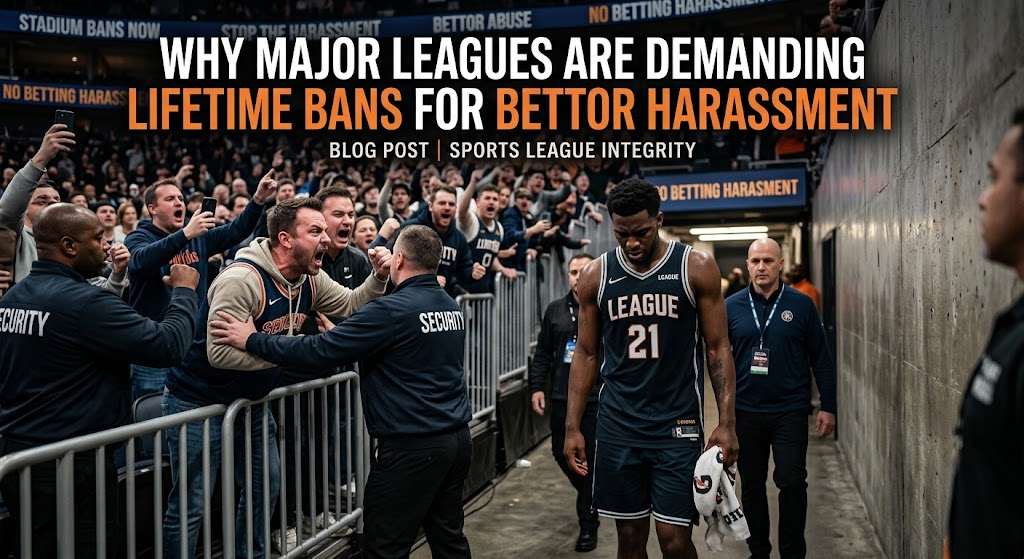
Why Major Leagues Are Demanding Lifetime Bans for Bettor Harassment
Sports betting has transformed the relationship between professional sports and their fans.
A fan can now place a wager on a game from a smartphone, follow individual player statistics in real time, bet on specific outcomes during a game and receive immediate updates about whether a wager is winning or losing.
That accessibility has created a massive sports-betting industry.
It has also created a problem that professional sports leagues and players’ associations are now demanding that regulators address more aggressively.
On September 15, 2026, the NFL, Major League Baseball, NBA, NHL and Major League Soccer, along with their respective players’ associations, sent a joint letter to gambling regulators in 35 states and the District of Columbia. The organizations are asking for stronger protections for athletes, coaches, officials, team personnel and their families who are subjected to threats and abusive harassment from sports bettors.
Among their requests is one that immediately stands out:
Permanent revocation of betting privileges for individuals who are verified to have abusively harassed or threatened sports participants and their families.
That proposal represents a significant escalation in the fight against betting-related abuse.
The issue is no longer simply about rude comments on social media.
It is about threats.
It is about personal confrontations.
It is about athletes being targeted because someone lost money on a wager.
And it raises an increasingly important question for professional sports:
Where should the line be drawn between being an angry fan and becoming a threat to the people playing the game?
The Major Leagues Are Taking a Unified Position
The significance of the September 15 announcement is partly its scope.
Five major professional sports leagues have joined forces.
The NFL, MLB, NBA, NHL and MLS are participating, along with their players’ associations.
That means the issue crosses sports.
It is not exclusively a basketball problem.
It is not exclusively a baseball problem.
It is not exclusively a football problem.
It is a problem connected to the modern sports-betting environment.
The organizations are asking state gaming regulators to establish more consistent rules for dealing with abusive bettors. Their letter specifically calls for permanent betting bans for people verified to have threatened or abusively harassed professional or amateur athletes, coaches, officials, team personnel or their families.
The leagues also want better reporting mechanisms and greater responsibility from sportsbooks and mobile betting operators.
That is important because the current regulatory landscape varies from state to state.
What Does a “Lifetime Ban” Actually Mean?
The headline phrase “lifetime ban” can create some confusion.
The leagues are not asking for every person who sends an angry message to be banned from attending sporting events for life.
They are asking for the permanent loss of betting privileges for individuals who are verified to have engaged in abusive harassment or threats.
In other words, the proposed punishment would target a person’s ability to participate in legal sports wagering.
That distinction matters.
A person could potentially lose the privilege of placing legal sports wagers without being prohibited from watching sports, attending games or being a fan.
The proposal is aimed specifically at removing access to the activity that the leagues say is motivating the abusive conduct.
Why Are the Leagues Doing This Now?
The timing is significant.
Legal sports betting has expanded dramatically since the 2018 Supreme Court decision that opened the door for individual states to legalize and regulate sports wagering.
Since then, betting has become deeply integrated into the sports-viewing experience.
Odds appear on television broadcasts.
Sports websites publish betting lines.
Mobile applications make wagers available almost instantly.
Professional leagues have entered commercial relationships with sportsbooks.
And fans have increasingly become participants in the betting ecosystem.
That expansion has created substantial economic opportunities.
It has also created new interactions between athletes and bettors.
The leagues say that some of those interactions have crossed a serious line.
When a Player Becomes Part of the Bet
One of the biggest changes brought by modern sports betting is the growth of player-specific wagers.
A bettor can care about whether a quarterback throws for a certain number of yards.
Whether a basketball player scores a certain number of points.
Whether a baseball pitcher records a certain number of strikeouts.
Whether a hockey player records a point.
That can change how a fan watches the game.
Instead of simply wanting a team to win, a bettor may become emotionally invested in the performance of one individual player.
If that player fails to reach a betting target, the financial loss can become associated directly with the athlete.
That is where the problem begins.
The athlete did not make a promise to the bettor.
The athlete was not hired to make the bettor’s wager successful.
Yet the player can become the target of anger when the bet loses.
Athletes Do Not Control the Betting Line
This is one of the most important concepts in understanding the issue.
Sportsbooks establish odds.
Bettors decide whether to wager.
Players compete according to the rules of their sport.
A player who misses a three-pointer, throws an interception, strikes out or commits a penalty may have contributed to a particular game outcome.
That does not mean the player has any obligation to produce the statistical result a bettor needs.
Sports are unpredictable.
That uncertainty is fundamental to sports betting.
A wager can lose because of an injury.
A coaching decision.
A defensive adjustment.
A bad bounce.
A missed opportunity.
Or simply because the opposing team played better.
The financial risk belongs to the bettor.
Losing Money Does Not Create a Right to Harass an Athlete
This is the central issue behind the leagues’ request.
Someone who loses a bet may be frustrated.
That frustration is understandable as an emotion.
But there is a significant difference between disappointment and harassment.
There is an even larger difference between harassment and threats.
The leagues are asking regulators to create stronger consequences for people who cross that line.
Their letter specifically identifies threats to athletes and their families as a serious ethical and criminal matter.
The Problem Can Follow Athletes Home
Professional athletes already deal with enormous public attention.
They are criticized after bad games.
They are praised after good games.
Their performances are analyzed constantly.
Social media has made that scrutiny almost instantaneous.
Betting adds another layer.
An athlete can finish a game and immediately discover messages from people who lost money because of something that happened during the contest.
That means the game doesn’t necessarily end when the final whistle sounds.
The emotional reaction can continue online.
And in some cases, the interaction can become personal.
Fred VanVleet Described an Unusual Confrontation
Houston Rockets guard Fred VanVleet provided a striking example in February 2026.
During an appearance on the Club 520 podcast, VanVleet described being confronted by a bettor at church over a lost parlay.
According to accounts of his comments, the bettor blamed VanVleet for losing a wager worth approximately $3,000. VanVleet said that online criticism was one thing, but in-person confrontations were different.
The story illustrates why the leagues are concerned about the issue.
An athlete’s professional performance can follow him into everyday life.
The person making the bet may see the athlete as responsible for the financial loss.
But the athlete is simply performing his job.
Social Media Makes the Problem Easier to Scale
Before social media, an angry fan might complain to friends, write a letter or yell from the stands.
Today, an angry bettor can potentially reach an athlete directly.
Players have public social-media accounts.
Their family members may also have public accounts.
Teams have public accounts.
Coaches and officials can be identified easily.
A message that once might have stayed inside someone’s living room can now be delivered directly to its target.
That accessibility is one reason the leagues are asking sportsbooks and regulators to take a more active role.
The Difference Between Criticism and Harassment
Not every negative comment is harassment.
Sports have always involved criticism.
Fans are allowed to disagree with coaching decisions.
They can criticize a player’s performance.
They can argue about whether a referee made the correct call.
They can complain about a team’s strategy.
They can express disappointment.
The concern arises when criticism turns into targeted abuse, threats or conduct that creates a legitimate safety concern.
That distinction will be extremely important if permanent betting bans become more widespread.
Verification Will Matter
A lifetime or permanent betting ban is a serious consequence.
That means regulators and sportsbooks will need reliable procedures for determining what actually happened.
A system cannot simply ban someone because an athlete receives a complaint.
There must be a process for establishing whether the person was responsible and whether the conduct meets the applicable standard.
The leagues’ proposal uses the concept of individuals being verified as having engaged in abusive harassment or threats.
That word is important.
Verification will determine how credible and workable such a system becomes.
What Would a Reporting System Look Like?
The leagues are also calling for improved reporting mechanisms.
That could allow athletes, teams, leagues or others to report abusive bettors through a standardized process.
A centralized system could potentially make it easier to identify repeat offenders.
Without coordination, someone banned by one sportsbook might simply create another account elsewhere.
That is one reason uniform state rules could become important.
The Problem With a Patchwork System
Sports betting is regulated primarily at the state level.
That creates a complicated landscape.
One state may have a specific mechanism for excluding abusive bettors.
Another may not.
A bettor who loses access to one sportsbook could potentially attempt to place wagers through another operator or in another jurisdiction, depending on the applicable rules.
The leagues are therefore calling for more uniform rules.
The joint letter was sent to regulators in 35 states and Washington, D.C., rather than simply asking individual sportsbooks to create their own policies.
Four States Already Have Specific Protections
The leagues’ letter points out that Ohio, West Virginia, Louisiana and Wyoming already have mechanisms that can exclude certain “bad actors” from licensed sportsbooks and mobile betting applications.
That means the idea is not completely theoretical.
Some states have already taken steps toward addressing the problem.
The new proposal would expand that concept nationally across the states participating in legal sports betting.
Ohio Has Been Addressing Bettor Harassment
Ohio was among the states that moved toward addressing sports-betting harassment through regulatory and legislative action.
The state has been part of a broader effort to prevent bettors from targeting athletes because of wagers.
That is particularly significant in college sports, where individual athletes can have less financial security and less experience dealing with public attention than established professional players.
West Virginia Has Taken Similar Steps
West Virginia has also adopted measures addressing bettor harassment.
The state’s approach demonstrates why supporters of national standards believe state-by-state rules may not be enough.
Sports are national.
Sportsbooks operate across multiple jurisdictions.
Athletes travel constantly.
A harassment incident may involve a bettor in one state and an athlete in another.
That makes coordination complicated.
Louisiana and Wyoming Have Joined the Effort
Louisiana and Wyoming have also established mechanisms for excluding abusive bettors.
The existence of these states provides examples that other jurisdictions can examine as they consider their own policies.
But the leagues want the protections to become much broader.
Sportsbooks Are Already Responding
The betting industry itself has not ignored the problem.
In February 2026, BetMGM updated its terms of service to explicitly prohibit harassment of athletes, coaches and team or league personnel.
The company said customers found to have engaged in harassment could have their accounts suspended.
That represents an important development.
It demonstrates that sportsbook operators can establish their own rules even before broader legislation is adopted.
Fanatics Has Also Created a Bad Actor Program
Fanatics Sportsbook announced a partnership with Integrity Compliance 360 and Signify Group in June 2026 to create a Bad Actor Program.
The program is designed to monitor public social-media activity for abusive and threatening content involving athletes, teams and organizations.
According to Fanatics, individuals identified through the program can be placed into a system intended to help operators identify problematic accounts.
That is another example of the betting industry moving toward greater monitoring.
Why the Leagues Want Sportsbooks Involved
The leagues could discipline their own players.
They can establish rules for teams.
They can control access to league facilities.
But they generally cannot independently prevent an individual fan from placing a legal sports wager in another jurisdiction.
Sportsbooks and gaming regulators have that authority.
That is why the leagues are directing their request toward state regulators.
They want the people responsible for administering legal sports betting to help police behavior connected to that activity.
This Is Also a Player-Safety Issue
At its core, this debate is about safety.
Professional athletes accept a tremendous amount of public scrutiny as part of their jobs.
They do not necessarily accept being threatened because someone lost money on a bet.
The same applies to coaches.
Officials.
Team employees.
And family members.
The leagues’ joint letter specifically includes those groups in its proposed protections.
Families Become an Especially Serious Concern
An athlete can choose to participate in professional sports.
Family members do not.
If a bettor begins contacting a player’s spouse, parent or children because of a lost wager, the situation moves into an entirely different category.
That is one reason the leagues specifically included families in their request.
The consequences of betting-related harassment should not extend beyond the person who actually participates in the sport.
Officials Face Similar Problems
Referees and officials can become particularly vulnerable to betting-related anger.
A controversial call can directly affect a point spread, total or player prop.
That can lead some bettors to blame an official for losing money.
The official may become the target of online abuse even when the call was simply a judgment made during a fast-moving game.
Protecting officials is therefore part of protecting the integrity of the sport itself.
Betting and Game Integrity Are Connected
There is another reason leagues are paying close attention.
Sports betting depends on public confidence that games are legitimate.
If athletes, coaches or officials begin feeling threatened because of betting outcomes, the environment around the sport changes.
The leagues have long emphasized the importance of protecting game integrity.
MLB, for example, has strict rules prohibiting players and other baseball personnel from betting on baseball under circumstances covered by Major League Rule 21. MLB has described enforcement of those rules as essential to maintaining the integrity of the game.
The rules governing participants and the proposed rules governing bettors address different problems, but they are connected by the same underlying principle:
Sports must remain trustworthy.
The Jontay Porter Case Shows the Other Side of the Equation
The NBA’s 2024 lifetime ban of Jontay Porter illustrates how seriously professional leagues treat violations involving betting and game integrity.
The NBA determined that Porter had disclosed confidential information to a bettor, limited his participation for betting purposes and bet on NBA games.
The league banned him permanently.
That case involved a player rather than a fan.
But together with the current bettor-harassment issue, it demonstrates that professional sports organizations are attempting to establish boundaries around the rapidly expanding sports-betting environment.
Legal Betting Does Not Mean Anything Goes
This may be the most important point for fans.
Legal sports betting creates a legal way to wager.
It does not create a legal right to threaten people.
It does not create a legal right to stalk an athlete.
It does not make abusive behavior acceptable.
And it does not transfer responsibility for a losing wager from the bettor to the player.
The leagues’ proposal is essentially an attempt to establish that distinction more clearly.
What Would a Permanent Ban Accomplish?
The intended effect is straightforward.
If someone knows that verified threats against an athlete could result in permanently losing access to legal sports betting, the consequence may deter some people from engaging in that behavior.
It could also give sportsbooks a mechanism for removing repeat offenders.
And it could make it harder for a person banned by one operator to simply move to another.
Whether it will have that effect depends on how the rules are written and enforced.
Enforcement Will Be the Hard Part
Creating a rule is easier than enforcing it.
Regulators will have to determine:
- What qualifies as harassment?
- What qualifies as a threat?
- What evidence is sufficient?
- Who verifies the complaint?
- How quickly should action occur?
- Does the accused bettor receive an opportunity to respond?
- How are false reports handled?
- How are multiple sportsbook accounts connected?
- How are bans shared between states?
- What happens if an offender uses another person’s account?
Those questions will need serious answers.
Protecting Athletes While Protecting Due Process
There are two legitimate objectives that have to coexist.
Athletes need protection from genuine threats and abusive conduct.
At the same time, permanent sanctions should be based on reliable evidence and clearly defined standards.
A system that is too weak may fail athletes.
A system that is too vague may create disputes about enforcement.
The challenge is building a framework that addresses both concerns.
Why Uniform Rules Could Matter
Imagine two bettors committing essentially the same offense.
One lives in a state with a strong exclusion policy.
The other lives in a state without one.
Their consequences could be completely different.
That inconsistency is part of what the leagues are attempting to address.
Uniform standards could make expectations clearer for bettors, sportsbooks, athletes and regulators.
The National Nature of Professional Sports Makes This Complicated
An NFL player might live in one state, play a game in another and be targeted online by someone living hundreds or thousands of miles away.
A baseball player can travel across the country during a single road trip.
An NBA team can play multiple states in one week.
Sports betting doesn’t necessarily care where the athlete is located.
The digital nature of the harassment makes geographic boundaries less meaningful.
College Athletes Are Part of the Conversation Too
One particularly important aspect of the leagues’ proposal is that it includes professional and amateur athletes.
That means the issue extends into college sports.
College athletes have become increasingly visible in sports betting discussions, particularly because of player-specific wagers.
The NCAA has separately identified betting-related harassment as a significant concern for student-athletes.
That makes the proposed protections relevant beyond professional sports.
Women Athletes and Other Sports Matter Too
The September 15 joint letter involves five major men’s professional leagues.
The WNBA Players Association publicly expressed disappointment that women’s professional sports were not included in the initiative, according to reporting published the same day.
That development is worth watching because the underlying issue is not limited to men’s sports.
Any athlete whose performance is connected to a wager can potentially become a target.
The broader policy discussion may therefore continue beyond the leagues involved in today’s announcement.
This Is Bigger Than Social Media
It would be easy to think of bettor harassment as an internet problem.
It isn’t.
Social media is simply one way it happens.
The VanVleet incident demonstrates that betting-related confrontations can occur face-to-face.
That distinction matters because an angry message on a phone and an angry person approaching an athlete in person create very different safety concerns.
The Athlete’s Perspective Is Changing the Conversation
For years, sports betting was primarily discussed in terms of economics.
How much money could leagues make?
How much revenue could sportsbooks generate?
How much additional engagement could betting create?
Those questions remain important.
But athletes are increasingly asking a different question:
What happens to us when the financial interests of bettors become attached to our individual performances?
That question is now impossible for leagues to ignore.
Sports Are Entertainment, But Athletes Are People
Fans can become emotionally invested in sports.
That is part of what makes sports powerful.
But emotional investment has boundaries.
Players have families.
They have homes.
They have private lives.
They have children.
They have communities.
They also have bad games.
A quarterback will throw an interception.
A baseball player will strike out.
A basketball player will miss a shot.
A hockey player will commit a penalty.
None of those things justify threats or personal harassment.
The Economics Are Complicated
There is an additional layer to this story.
The major leagues have embraced sports betting as a business opportunity.
They have partnerships with sportsbooks.
Betting information is integrated into broadcasts.
Fans are encouraged to engage with games in new ways.
That creates an economic relationship between professional sports and the betting industry.
The current push for stronger protections therefore represents an effort to manage one of the consequences of that relationship.
The Leagues Are Not Calling for an End to Sports Betting
That distinction is important.
The joint request is not a proposal to eliminate legal sports betting.
Instead, the leagues are asking for stronger safeguards around abusive behavior.
They want sportsbooks and regulators to identify and punish bettors who cross specific lines.
That suggests the objective is to make the existing legal betting system more controlled rather than eliminate it.
What Happens Next?
The next stage will belong largely to state regulators and policymakers.
The leagues and players’ associations have made their position clear.
Now individual jurisdictions will have to determine how they respond.
Some states already have mechanisms.
Others may need legislation or regulatory changes.
Sportsbooks may also strengthen their own policies.
A National System Could Eventually Emerge
If enough states adopt similar rules, the country could eventually develop something approaching a standardized system for dealing with abusive bettors.
That could include:
- Shared exclusion lists
- Standard definitions of harassment
- Centralized reporting systems
- Cooperation between sportsbooks
- Law-enforcement referrals for serious threats
- Permanent betting restrictions
- Monitoring of repeat offenders
Creating such a system would be complicated.
But the increasing nationalization of sports betting makes coordination increasingly important.
The Future of Sports Betting and Athlete Safety
The growth of legalized sports betting has changed professional sports in ways that nobody could fully predict when the modern expansion began.
Fans have more ways to interact with games.
Sportsbooks have developed enormous businesses.
Leagues have created new revenue opportunities.
Television broadcasts incorporate betting information.
And individual player statistics have become wagering markets.
But the same system has created an uncomfortable side effect.
Some bettors have begun treating athletes as though they are personally responsible for the success of individual wagers.
They are not.
A player is not responsible for a bettor’s parlay.
A pitcher is not responsible for someone’s over-under.
A referee is not responsible for a spread.
A coach is not responsible for somebody’s accumulator.
The bettor assumes the financial risk.
The athlete performs the sport.
Those responsibilities must remain separate.
The 2026 Push Represents a New Stage
The September 15 joint action by the NFL, MLB, NBA, NHL, MLS and their players’ associations represents a significant development because the leagues are asking regulators to establish permanent consequences for verified abusive bettors.
The proposal goes beyond asking athletes to block accounts.
It goes beyond asking fans to behave better.
It asks the legal sports-betting industry itself to deny access to people who cross clearly defined lines.
That is a meaningful shift.
The Goal Is to Protect the People Who Make Sports Possible
Professional sports cannot exist without athletes.
They cannot exist without coaches.
They cannot exist without officials.
They cannot exist without team personnel.
And they cannot function without the families and communities that support the people involved.
Betting is now an important part of the sports business.
But betting should remain an addition to the sports experience rather than something that threatens the people responsible for creating it.
The challenge facing regulators is finding the right balance between accessibility, accountability, enforcement and athlete safety.
The leagues have now put that challenge directly in front of them.
Final Thoughts
The debate over sports betting has entered a new phase.
For years, much of the conversation centered on legalization, revenue, advertising, responsible gambling and the integrity of sporting events.
Now there is another issue demanding attention:
What happens when bettors take their losses out on the athletes?
The major professional leagues believe the answer requires stronger consequences.
The NFL, MLB, NBA, NHL and MLS, together with their players’ associations, are asking regulators in 35 states and Washington, D.C., to establish permanent betting bans for people verified to have threatened or abusively harassed athletes, coaches, officials, team personnel or their families.
Several states already have mechanisms for excluding abusive bettors, while sportsbook operators including BetMGM and Fanatics have taken steps of their own.
The next challenge is consistency.
What qualifies as harassment?
What qualifies as a threat?
Who investigates?
Who verifies?
How are offenders identified across multiple sportsbooks and states?
And how can the system protect athletes without creating vague or arbitrary enforcement?
Those questions will shape the next stage of the debate.
But one principle is becoming increasingly clear.
Losing a sports bet does not give anyone the right to threaten the people who played the game.
Professional athletes understand that criticism comes with their jobs.
They understand that fans will celebrate them one night and criticize them the next.
They understand that sports create intense emotions.
But there is a fundamental difference between being disappointed by a game and targeting a human being because of a financial wager.
As sports betting continues to grow, that distinction will become increasingly important.
The future of legalized sports wagering may depend not only on how much money the industry generates, but also on whether the system can protect the athletes, coaches, officials and families who make the games possible.
The sports world has drawn a line.
Now the regulators, sportsbooks and policymakers must determine how that line will be enforced.