
Why the Transfer Portal Changed College Football Forever
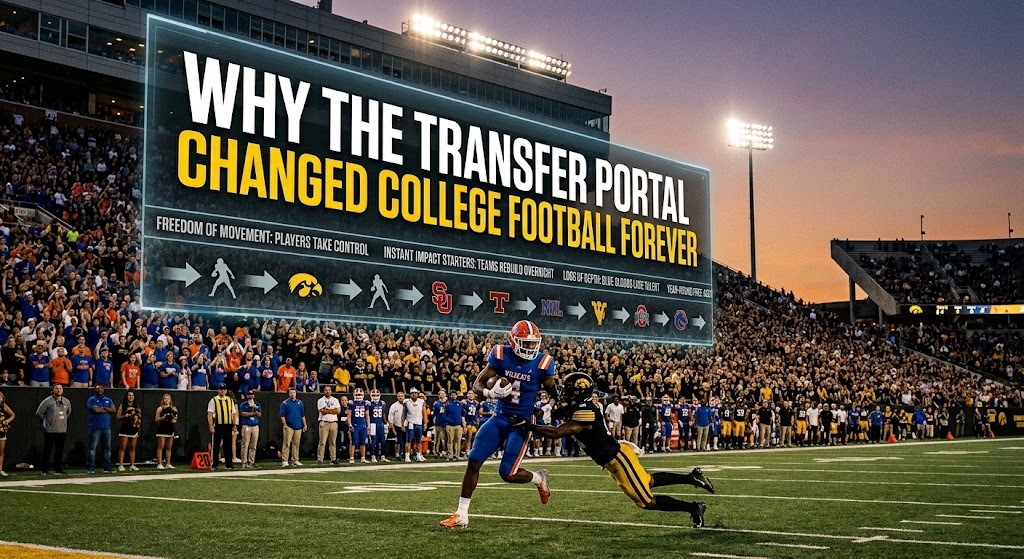
Why the Transfer Portal Changed College Football Forever
College football has always been a sport built around recruiting, player development, coaching, tradition, and competition. For generations, coaches recruited high school athletes, developed them over several seasons, and built programs around the idea that players would remain with one school throughout their college careers.
That model has changed dramatically.
The transfer portal has transformed how college football teams build rosters, how players manage their careers, how coaches recruit, and how fans understand college football. What was once an unusual decision—leaving one university for another—has become a normal and strategically important part of the sport.
The modern transfer portal has created a much more fluid college football environment. Players can seek new opportunities when their situations change, while coaches can address roster weaknesses by recruiting experienced college players instead of relying exclusively on incoming freshmen.
The result is a college football landscape that looks fundamentally different from the one that existed just a few years ago.
Understanding why the transfer portal changed college football forever requires examining how it affected player freedom, recruiting, roster construction, coaching, competition, team chemistry, and the broader business of college athletics.
What Is the Transfer Portal?
The transfer portal is a centralized system that allows college athletes to indicate their intention to transfer from one school to another.
Before the modern transfer system developed, transferring could be complicated.
Players often faced restrictions, uncertainty, and significant consequences when attempting to change schools.
The portal simplified the process by creating a more organized mechanism through which athletes could enter the transfer market.
Once a player enters the portal, other programs can contact and recruit that athlete according to applicable NCAA rules.
This fundamentally changed the relationship between players and universities.
College athletes gained greater control over their careers.
Coaches gained access to an entirely new source of talent.
The roster-building process became dramatically more dynamic.
Players Gained Greater Control Over Their Futures
Perhaps the most important change created by the transfer portal is the increased power given to athletes.
A player who is buried on a depth chart no longer necessarily has to remain stuck in that position.
If a quarterback loses a starting competition, a receiver cannot find playing time, or a linebacker believes another program offers a better developmental opportunity, transferring may provide a solution.
Players can evaluate their circumstances and make decisions based on their goals.
Those goals may include:
- More playing time
- A better system fit
- Greater development opportunities
- Coaching changes
- Geographic preferences
- Academic considerations
- Competition for championships
The portal has given athletes more leverage over their careers.
Playing Time Became a Major Recruiting Tool
Coaches have always promised recruits opportunities.
The transfer portal has made those promises even more important.
Established college players already know what it means to compete at the collegiate level.
They are often looking for something specific.
A backup quarterback may want a starting opportunity.
A talented receiver may want a larger role.
A defensive player may want to play in a scheme better suited to his strengths.
As a result, coaches increasingly sell immediate playing time rather than simply long-term potential.
The transfer market has become a major component of roster management.
Recruiting Is No Longer Limited to High School Players
Traditional recruiting remains important.
However, college programs now recruit from two major talent pools.
The first consists of high school prospects.
The second consists of experienced college players in the transfer portal.
This creates an entirely different recruiting environment.
Coaches must determine how much of their roster should come from developing freshmen and how much should come from experienced transfers.
The best programs often combine both approaches.
Experience Has Become a Valuable Commodity
One of the greatest advantages of the transfer portal is the opportunity to acquire players who already understand college football.
A freshman may require several years to develop.
A transfer may already have:
- College experience
- Strength and conditioning experience
- Game experience
- Knowledge of offensive or defensive systems
- Understanding of college-level competition
That experience can be extremely valuable.
A team with a weakness at a particular position can potentially address it immediately.
The portal effectively allows coaches to shop for proven college talent.
Coaches Can Rebuild Rosters Faster
Before the transfer portal era, rebuilding a struggling program could take several recruiting cycles.
A coach might need three or four years to recruit enough players, develop them, and establish a competitive roster.
The transfer portal accelerated that timeline.
A new coach can now enter a program and immediately pursue experienced players who fit the new system.
This creates opportunities for rapid improvement.
It also increases pressure on coaches.
Expectations can rise quickly because programs are no longer necessarily required to wait several years for a complete rebuild.
Coaching Changes Became Even More Significant
A coaching change can dramatically affect a roster.
Players recruited to play in one system may suddenly find themselves in another.
An offensive scheme may change.
A defensive philosophy may change.
Position coaches may leave.
The transfer portal gives athletes a mechanism for responding to those changes.
Instead of remaining with a program whose direction no longer fits their goals, players can explore other opportunities.
At the same time, new coaches can use the portal to find athletes suited to their systems.
This creates a two-way flow of talent following coaching changes.
The Portal Changed Quarterback Recruiting
Few positions demonstrate the impact of the transfer portal better than quarterback.
Quarterbacks have limited opportunities to play.
Only one can normally start.
A highly talented player may therefore spend years waiting behind an established starter.
The transfer portal provides another path.
A quarterback can leave a crowded depth chart and search for a program needing a starter.
This has created an increasingly active market for experienced quarterbacks.
Programs can also use the portal to find immediate replacements when starters graduate or leave.
The quarterback position has become one of the most visible areas of transfer activity.
Immediate Impact Became More Important
Traditional recruiting emphasizes potential.
Transfer recruiting emphasizes what a player has already demonstrated.
That distinction is important.
Coaches can evaluate a transfer using college game film, statistics, physical development, and previous competition.
While there is still uncertainty, the player has already experienced the demands of college football.
This makes transfers particularly attractive when teams need immediate help.
Programs competing for championships increasingly value players capable of contributing immediately.
The Transfer Portal Changed Team Building
Roster construction used to resemble a long-term pipeline.
Recruit freshmen.
Develop them.
Redshirt some players.
Build experience.
Graduate players.
Repeat.
The portal introduced a much more flexible model.
Coaches can now make adjustments every offseason.
If a roster lacks an experienced offensive lineman, the program can search for one.
If a secondary needs additional depth, coaches can pursue defensive backs.
If a team loses a star player, the portal may provide a replacement.
Roster building has become more similar to professional sports.
NIL Added Another Layer
The growth of name, image, and likeness opportunities has further changed the transfer environment.
College athletes can now consider financial opportunities alongside traditional factors such as playing time, coaching, academics, and location.
This does not mean every transfer decision is financially motivated.
However, compensation has become part of the broader college football landscape.
Players and programs must navigate a more complicated environment involving athletic development, educational opportunities, branding, and financial considerations.
The transfer portal and NIL era have therefore developed together.
The Portal Increased Competition Between Programs
College football programs are no longer competing exclusively on the recruiting trail for high school prospects.
They are also competing for experienced college players.
This creates another layer of competition.
A program might lose a player to a rival and then attempt to replace him by taking a player from another school.
Talent moves throughout the college football ecosystem.
This constant movement has made roster management increasingly important.
Smaller Programs Can Lose Their Best Players
The transfer portal has created opportunities for athletes, but it has also created challenges for smaller programs.
A player who becomes a star at a lower-profile school may attract attention from larger programs.
Those schools may offer greater exposure, resources, or opportunities to compete for major championships.
As a result, successful smaller programs can find themselves constantly trying to retain their best players.
Player development can therefore create both opportunity and risk.
But Smaller Programs Can Also Benefit
The transfer portal works in both directions.
Smaller programs can recruit players who did not find success at major universities.
A former highly rated prospect may transfer after failing to earn playing time.
That athlete could become a star at a smaller program.
This creates opportunities for second chances.
Programs outside the traditional power structure can use the portal to acquire talented players who need a different environment.
Team Chemistry Became More Complicated
One of the biggest challenges associated with the transfer portal is team chemistry.
A roster filled with transfers may include players from many different programs and football cultures.
Coaches must integrate new personalities quickly.
Players must learn new systems.
Leadership structures may change.
Established players may wonder why an incoming transfer is receiving opportunities they expected to earn themselves.
Successful programs must therefore manage personalities as carefully as they manage talent.
Competition Can Motivate Returning Players
Transfers can also create healthy competition.
A returning player who knows the coaching staff can bring in outside competition may have greater motivation to improve.
Competition can elevate the overall quality of a position group.
Coaches gain more flexibility when evaluating players.
The key is maintaining a culture in which competition remains productive rather than destructive.
The Portal Increased Pressure on Coaches
Modern coaches must now perform several jobs simultaneously.
They must:
- Recruit high school players
- Recruit transfer players
- Develop existing athletes
- Manage NIL relationships
- Retain current players
- Evaluate roster weaknesses
- Maintain team chemistry
The job has become increasingly complex.
A coach who ignores the transfer portal risks falling behind competitors.
At the same time, excessive reliance on transfers can create its own problems.
Successful coaching now requires finding the right balance.
Player Development Still Matters
The transfer portal has not eliminated the importance of development.
In fact, development may be more important than ever.
Programs that consistently develop players can attract athletes looking for a proven path to success.
Development also helps teams retain talent.
Players are less likely to leave if they believe they are improving and have a clear future with the program.
The strongest organizations use the portal as a supplement to development rather than a replacement for it.
Recruiting Philosophy Has Changed
College programs now have to determine what kind of roster they want to build.
Some prefer experienced transfers.
Others emphasize younger players with long-term potential.
Most successful programs use a combination.
A healthy roster may include:
- Highly recruited freshmen
- Redshirt development players
- Experienced starters
- Transfer additions
- Veteran leaders
Balancing these groups has become one of the central challenges of modern roster management.
The Portal Made College Football More Fluid
The old college football model emphasized continuity.
Players generally stayed at one school.
The modern model emphasizes mobility.
Players can change programs.
Coaches can change systems.
Entire rosters can change dramatically from one season to the next.
This increased fluidity has made college football more unpredictable.
Teams can improve quickly.
They can also lose important talent quickly.
Every offseason now carries enormous significance.
Fans See a Different Kind of Recruiting
The transfer portal has also changed how fans follow college football.
Recruiting is no longer limited to high school signing classes.
Fans track portal announcements, commitments, departures, and roster changes.
The offseason has become an extended recruiting season.
Sports media organizations provide constant coverage.
Transfer announcements can generate enormous attention.
For fans, roster building has become a year-round storyline.
The Portal Changed Rivalries
Transfer movement can add another dimension to rivalries.
A player can leave one program and join another.
Former teammates can become opponents.
Former coaches can face players they once recruited.
These situations create compelling storylines.
They also demonstrate how dramatically college football has changed.
The boundaries between programs have become more fluid than ever.
Competitive Balance Has Become More Complicated
The transfer portal can improve competitive balance by allowing struggling programs to rebuild quickly.
However, it can also strengthen already powerful programs.
Well-funded teams with strong recruiting operations may have greater ability to attract experienced players.
This creates an ongoing debate about whether the portal will ultimately spread talent more evenly or concentrate it among the sport’s most powerful programs.
The answer may vary by conference, program, and era.
The Portal Resembles Professional Free Agency
The comparison between the transfer portal and professional free agency has become increasingly common.
The systems are not identical.
College athletes remain students and operate within a unique regulatory environment.
Nevertheless, the basic concept is similar.
Teams have access to experienced talent that can fill immediate needs.
Players have greater control over where they compete.
Coaches must evaluate available talent and determine how additions fit into their existing roster.
This has made college football increasingly resemble professional roster management.
The Transfer Portal Changed the Meaning of Loyalty
College football has traditionally emphasized loyalty to schools.
Players often became closely associated with one university throughout their careers.
The transfer portal changed that culture.
Players now have more freedom to prioritize their individual development and career goals.
Some fans view this negatively.
Others believe athletes deserve the ability to make decisions about their futures.
The debate reflects a much larger transformation in college athletics.
The Future of College Football Will Be More Mobile
There is little reason to believe player movement will disappear.
The transfer portal has become an integral part of college football.
Programs will continue refining how they evaluate transfers.
Players will continue weighing their options.
Coaches will continue building rosters through multiple talent pipelines.
Technology and data will likely make transfer evaluation even more sophisticated.
The portal is no longer an experiment.
It is part of the modern game.
Final Thoughts
The transfer portal changed college football forever because it fundamentally altered the relationship between players, coaches, and programs. Athletes gained greater control over their careers, while coaches gained a powerful new tool for rebuilding rosters and addressing immediate weaknesses.
The result is a faster-moving, more competitive, and considerably more complicated sport.
High school recruiting remains important, but it now exists alongside a massive transfer market. Player development remains essential, but programs must also be prepared to recruit experienced athletes who can contribute immediately. Team chemistry remains critical, but coaches must increasingly integrate players from different football cultures.
Ultimately, the transfer portal did more than create another recruiting tool. It changed the entire structure of college football roster management. Players have more choices, coaches have more options, and programs must constantly adapt.
The teams that thrive in this new era will not necessarily be the ones that collect the most talent. They will be the ones that understand how to identify the right players, develop them, retain them, integrate transfers into the culture, and build a sustainable team capable of competing year after year.
College football will never return to the old recruiting model. The transfer portal has permanently changed the sport—and its influence will continue shaping college football for generations.