
How to Throw Wiffle Ball Pitches: Curveballs, Sliders, and More
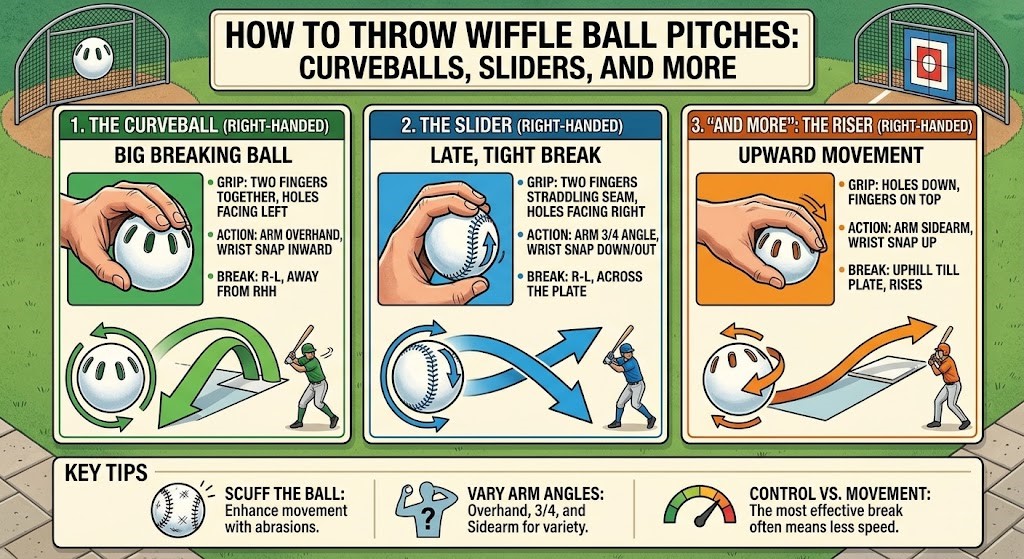
How to Throw Wiffle Ball Pitches: Curveballs, Sliders, and More
One of the biggest reasons Wiffle Ball stands out from other sports is pitching. Unlike baseball, you do not need to throw hard to dominate hitters.
Instead, the secret to success lies in movement.
Because of the ball’s unique design, pitchers can create dramatic curves, drops, and rises with simple adjustments in grip and release.
This makes pitching both exciting and challenging.
Beginners often struggle at first. They may throw the ball too straight or lose control when trying to add movement.
However, with the right techniques, anyone can learn to throw effective Wiffle Ball pitches.
If you are new to the game, start with The Ultimate Beginner’s Guide to Wiffle Ball: Rules, Equipment, Backyard Setup, and Winning Strategies. That guide explains the basics and helps you get started.
In this article, we will break down how to throw Wiffle Ball pitches, including curveballs, sliders, risers, and more.
Why Wiffle Ball Pitches Move So Much
The key to Wiffle Ball pitching lies in the ball itself.
One side of the ball contains holes, while the other side remains smooth.
When air flows around the ball during a throw, it creates uneven pressure.
This pressure difference causes the ball to move.
By changing the orientation of the holes and the angle of release, pitchers can control how the ball travels.
Understanding this concept is essential before learning specific pitches.
If you want to understand the equipment in more detail, review Wiffle Ball Equipment Guide: Bats, Balls, and Backyard Essentials.
Basic Pitching Mechanics
Before learning advanced pitches, players should master basic mechanics.
Good mechanics improve both control and consistency.
Grip Basics
Hold the ball with your fingers across the holes.
Your grip should feel comfortable but firm.
Avoid squeezing too tightly.
Instead, focus on control.
Arm Motion
Use a smooth, controlled throwing motion.
Avoid jerky or rushed movements.
Consistency matters more than speed.
Release Point
The release point determines how the ball moves.
A slight change in wrist angle can create a completely different pitch.
Practice releasing the ball at different angles to see how it reacts.
Starting with Control
Many beginners try to throw advanced pitches immediately.
This approach often leads to frustration.
Instead, start with simple throws.
Focus on accuracy.
Once you can consistently hit the strike zone, begin adding movement.
Understanding the strike zone is easier after reading Official Wiffle Ball Rules Explained: Gameplay, Scoring, and Outs.
The Curveball
The curveball is the most popular Wiffle Ball pitch.
It creates a sharp, sweeping movement that can confuse hitters.
How to Throw a Curveball
Hold the ball with the holes facing to one side.
When you release the ball, snap your wrist slightly in the direction you want the ball to move.
For example:
- holes on the right side create a curve to the left
- holes on the left side create a curve to the right
Tips for Better Curveballs
- keep your motion smooth
- do not overpower the throw
- focus on wrist action
With practice, the curveball becomes a reliable strikeout pitch.
The Slider
The slider is similar to the curveball but moves less dramatically.
It is faster and more subtle.
How to Throw a Slider
Hold the ball with the holes slightly angled.
Release the ball with a smaller wrist motion than a curveball.
This creates a late, sharp break.
When to Use a Slider
Sliders work well when hitters expect a curveball.
The reduced movement can catch them off guard.
The Risers (Rising Fastball)
One of the most surprising pitches in Wiffle Ball is the riser.
Although the ball does not truly rise, it appears to climb as it approaches the hitter.
How to Throw a Riser
Hold the ball with the holes facing downward.
Release the ball with a quick upward motion.
This creates lift and reduces drop.
Why Risers Work
Hitters often expect the ball to drop.
When it does not, they swing under it.
This leads to missed swings or weak contact.
The Drop Ball
The drop ball does the opposite of the riser.
It falls sharply as it reaches the plate.
How to Throw a Drop Ball
Hold the ball with the holes facing upward.
Release the ball with a downward wrist motion.
This increases the ball’s drop.
When to Use a Drop Ball
Drop balls are effective after throwing risers.
The contrast in movement makes both pitches harder to hit.
The Knuckleball
The knuckleball creates unpredictable movement.
It can be difficult to control, but it is also difficult to hit.
How to Throw a Knuckleball
Hold the ball loosely with minimal spin.
Release it gently.
The lack of spin causes the ball to wobble.
Why the Knuckleball Is Effective
Hitters cannot predict where the ball will go.
This unpredictability creates confusion.
Developing Pitch Combinations
Great pitchers do not rely on a single pitch.
Instead, they mix different pitches to keep hitters guessing.
For example:
- curveball followed by riser
- slider followed by drop ball
Changing speeds and movement creates more strikeouts.
Strategic pitching plays a major role in Winning Wiffle Ball Strategies: Pitching, Hitting, and Game Tactics.
Controlling Your Pitches
Movement is important, but control matters even more.
Wild pitches can lead to walks and easy runs.
Tips for Improving Control
- practice regularly
- focus on consistent mechanics
- aim for the strike zone
- avoid overcomplicating your motion
Control allows you to use your pitches effectively.
Practicing Pitching
Practice is essential for improvement.
Players should spend time working on:
- accuracy
- consistency
- pitch variety
Set up a strike zone target and practice hitting it.
This helps develop muscle memory.
A proper setup makes practice easier.
You can learn more in How to Set Up a Wiffle Ball Field in Your Backyard (Dimensions and Layout Tips).
Common Pitching Mistakes
Beginners often make similar mistakes.
These errors can limit improvement.
Common mistakes include:
- throwing too hard
- ignoring control
- using the same pitch repeatedly
- poor grip technique
Recognizing these issues helps players improve faster.
You can explore solutions in Common Wiffle Ball Mistakes Beginners Make and How to Fix Them.
How Pitching Affects the Game
Pitching often determines the outcome of Wiffle Ball games.
A skilled pitcher can dominate even strong hitters.
Good pitching forces weak contact and generates strikeouts.
This gives your team a major advantage.
Understanding pitching also helps hitters improve.
You can develop better hitting skills by studying Wiffle Ball Hitting Tips: How to Improve Contact and Power.
Pitching in Competitive Play
In competitive Wiffle Ball, pitching becomes even more important.
Players refine their techniques and develop advanced strategies.
Pitchers often study their opponents to identify weaknesses.
Competitive play rewards consistency and creativity.
If you want to compete, learn more in Wiffle Ball Leagues and Tournaments: How Competitive Play Works.
Final Thoughts on Wiffle Ball Pitching
Wiffle Ball pitching is both fun and challenging.
The unique design of the ball allows for incredible movement.
By mastering basic mechanics and learning different pitches, players can develop a wide range of skills.
Start with simple throws.
Focus on control.
Then add movement and variety.
With practice, you will become a more effective and confident pitcher.
Continue Learning About Wiffle Ball
Explore the rest of the Wiffle Ball series:
Official Wiffle Ball Rules Explained: Gameplay, Scoring, and Outs
Wiffle Ball Equipment Guide: Bats, Balls, and Backyard Essentials
How to Set Up a Wiffle Ball Field in Your Backyard (Dimensions and Layout Tips)
Wiffle Ball Hitting Tips: How to Improve Contact and Power
Wiffle Ball Fielding and Defense: Positioning and Strategy
Winning Wiffle Ball Strategies: Pitching, Hitting, and Game Tactics
Common Wiffle Ball Mistakes Beginners Make and How to Fix Them
Wiffle Ball Leagues and Tournaments: How Competitive Play Works



4 Responses
[…] Learn proper mechanics in How to Throw Wiffle Ball Pitches: Curveballs, Sliders, and More. […]
[…] Learn the mechanics in How to Throw Wiffle Ball Pitches: Curveballs, Sliders, and More. […]
[…] You can study pitching techniques in How to Throw Wiffle Ball Pitches: Curveballs, Sliders, and More. […]
[…] To understand how these pitches work, read How to Throw Wiffle Ball Pitches: Curveballs, Sliders, and More. […]