
Official Wiffle Ball Rules Explained
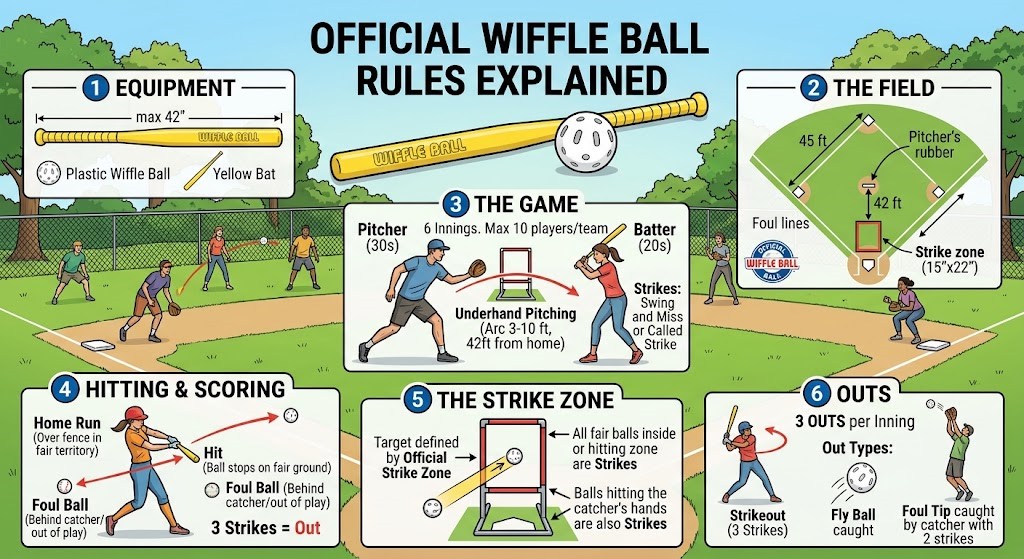
Official Wiffle Ball Rules Explained: Gameplay, Scoring, and Outs
Wiffle Ball is one of the most flexible and accessible sports in the world. It offers the excitement of baseball while allowing players to adapt the game to small spaces and casual environments.
However, this flexibility often creates confusion for beginners.
Different groups use different rules. Some games include base running, while others rely on imaginary bases. Some use multiple fielders, while others rely only on the pitcher.
Because of these variations, many new players ask the same question:
What are the official rules of Wiffle Ball?
Understanding the standard rules provides a strong foundation. Once players learn these basics, they can adapt the game to fit their environment.
If you are just starting, begin with The Ultimate Beginner’s Guide to Wiffle Ball: Rules, Equipment, Backyard Setup, and Winning Strategies. That guide explains how the game works and how beginners can get started quickly.
In this article, we will break down the official Wiffle Ball rules, including gameplay structure, scoring, outs, and common variations.
What Makes Wiffle Ball Different from Baseball
Wiffle Ball shares many similarities with baseball, but several key differences make it unique.
First, the ball itself creates unpredictable movement. This design allows pitchers to throw curveballs and other breaking pitches without high velocity.
Second, the game requires fewer players.
Third, the field is much smaller and often customized.
These differences make Wiffle Ball more accessible while still maintaining competitive depth.
Basic Objective of the Game
The objective of Wiffle Ball is simple.
Each team attempts to score more runs than the opposing team.
Teams take turns batting and fielding.
The batting team tries to hit the ball and score runs.
The fielding team tries to record outs and prevent scoring.
After a set number of innings, the team with the most runs wins.
Number of Players
Wiffle Ball can be played with a wide range of players.
Some games use full teams, while others use only two players.
Common formats include:
- one-on-one (pitcher vs hitter)
- small teams (2–5 players per side)
- larger recreational teams
In many backyard games, the pitcher is the only defensive player.
However, additional fielders can be added depending on the number of participants.
Field Setup and Layout
Wiffle Ball fields vary significantly depending on available space.
Most games include:
- a home plate area
- a strike zone target
- designated boundaries for hits
Players often use objects such as fences, trees, or cones to define the field.
Because field dimensions can vary, it is important to agree on boundaries before starting the game.
For a complete breakdown of setup options, read How to Set Up a Wiffle Ball Field in Your Backyard (Dimensions and Layout Tips).
The Strike Zone
Unlike baseball, Wiffle Ball often uses a physical strike zone target.
This target may be:
- a plastic board
- a chair
- a drawn rectangle
- a manufactured strike zone frame
The strike zone determines whether a pitch counts as a strike or a ball.
If the ball hits the strike zone target, it counts as a strike.
If it misses, it counts as a ball.
This system simplifies the game and removes the need for an umpire.
Balls and Strikes
Most Wiffle Ball games use a simplified count system.
A common format includes:
- 3 strikes for a strikeout
- 4 balls for a walk
Some backyard variations use fewer pitches to speed up the game.
For example:
- 2 strikes for a strikeout
- 3 balls for a walk
Regardless of the format, consistency is important.
Players should agree on the count rules before the game begins.
Types of Hits
Wiffle Ball uses creative scoring zones instead of traditional base running in many cases.
Common hit types include:
- single
- double
- triple
- home run
These results are often determined by where the ball lands or how far it travels.
For example:
- a ball that rolls past a certain point may count as a single
- a ball that reaches a fence may count as a double
- a ball that clears a boundary may count as a home run
Some games also include automatic outs for certain types of hits.
Outs in Wiffle Ball
Outs are essential to the structure of the game.
Most innings end after a set number of outs.
Common ways to record outs include:
Strikeouts
A batter strikes out after accumulating the maximum number of strikes.
Pitching plays a major role in generating strikeouts.
Learning pitch movement can improve performance significantly.
You can study these techniques in How to Throw Wiffle Ball Pitches: Curveballs, Sliders, and More.
Caught Balls
If a defensive player catches the ball before it hits the ground, the batter is out.
This rule applies in games with fielders.
Ground Rule Outs
Some backyard games include automatic outs based on where the ball lands.
For example:
- hitting the ball into a designated “out zone”
- hitting the ball too short
These rules help balance gameplay in smaller spaces.
Force Outs (Optional)
In games with base running, players may record outs by tagging bases or runners.
However, many Wiffle Ball games do not use this rule.
Innings and Game Length
Wiffle Ball games typically consist of innings, similar to baseball.
Each inning includes:
- one half where Team A bats
- one half where Team B bats
Common game lengths include:
- 3 innings (short games)
- 5 innings (standard backyard play)
- 7 or more innings (competitive play)
The number of innings can vary based on time and player preference.
Scoring Runs
Teams score runs by successfully advancing hitters around the bases or through scoring zones.
In simplified formats, runs are awarded automatically based on hit type.
For example:
- a home run scores one or more runs
- a double may advance runners
Scoring systems should be clearly defined before play begins.
Pitching Rules
Pitching is one of the most important aspects of Wiffle Ball.
The ball’s design allows for significant movement.
However, most games include rules to maintain fairness.
Common pitching rules include:
- no excessive speed or dangerous throws
- consistent pitching distance
- legal delivery motion
Pitchers often dominate games when they develop strong control and movement.
Understanding pitch mechanics can provide a major advantage.
Batting Rules
Batters must follow basic rules to ensure fair play.
These rules often include:
- staying within the batter’s box
- avoiding interference with the pitcher
- respecting strike calls
In addition, some games limit bunting or certain types of swings.
To improve performance at the plate, review Wiffle Ball Hitting Tips: How to Improve Contact and Power.
Fielding Rules
Fielding rules depend on the number of players.
In games with multiple fielders, defensive positioning becomes important.
Players must cover key areas of the field.
They must also communicate effectively to avoid confusion.
You can learn more about defensive positioning in Wiffle Ball Fielding and Defense: Positioning and Strategy.
Common Rule Variations
One of the defining features of Wiffle Ball is its adaptability.
Players often create custom rules to fit their environment.
Common variations include:
- automatic runners
- ghost runners
- modified strike counts
- custom scoring zones
These variations allow players to enjoy the game in almost any setting.
However, consistency is important.
All players should agree on the rules before starting.
Safety Considerations
Although Wiffle Ball is generally safe, players should still take precautions.
For example:
- avoid throwing too close to players
- maintain safe distances
- watch for obstacles in the playing area
These steps help prevent injuries and ensure a fun experience for everyone.
Learning Strategy Through the Rules
Understanding the rules does more than ensure fair play.
It also helps players develop strategy.
For example:
- knowing strike counts helps pitchers plan sequences
- understanding scoring zones helps hitters aim their shots
- recognizing out rules helps defenders position themselves
Strategic thinking becomes easier when players understand how the game works.
You can explore advanced tactics in Winning Wiffle Ball Strategies: Pitching, Hitting, and Game Tactics.
Avoiding Beginner Rule Mistakes
New players often misunderstand or overlook certain rules.
Common issues include:
- miscounting balls and strikes
- unclear scoring zones
- inconsistent strike zone targets
These mistakes can disrupt gameplay.
Fortunately, they are easy to fix with practice and communication.
You can learn more in Common Wiffle Ball Mistakes Beginners Make and How to Fix Them.
Transitioning to Competitive Play
Once players understand the rules, they may want to explore competitive Wiffle Ball.
Organized leagues and tournaments often use standardized rules.
These events provide structured competition and consistent gameplay.
Competitive play adds another layer of excitement to the sport.
If you are interested in this level, read Wiffle Ball Leagues and Tournaments: How Competitive Play Works.
Final Thoughts on Wiffle Ball Rules
Wiffle Ball rules provide a flexible framework for one of the most enjoyable sports available.
Although variations exist, the core principles remain consistent.
Teams alternate between batting and fielding.
Players score runs by hitting the ball effectively.
Pitchers attempt to record outs through strikes and strategic play.
Understanding these fundamentals allows players to enjoy the game fully.
Once you learn the rules, you can adapt them to fit your playing environment.
This flexibility is one of the reasons Wiffle Ball continues to thrive.
Continue Learning About Wiffle Ball
Explore the rest of the Wiffle Ball series:
Wiffle Ball Equipment Guide: Bats, Balls, and Backyard Essentials
How to Set Up a Wiffle Ball Field in Your Backyard (Dimensions and Layout Tips)
How to Throw Wiffle Ball Pitches: Curveballs, Sliders, and More
Wiffle Ball Hitting Tips: How to Improve Contact and Power
Wiffle Ball Fielding and Defense: Positioning and Strategy
Winning Wiffle Ball Strategies: Pitching, Hitting, and Game Tactics
Common Wiffle Ball Mistakes Beginners Make and How to Fix Them
Wiffle Ball Leagues and Tournaments: How Competitive Play Works



2 Responses
[…] Understanding those fundamentals begins with Official Wiffle Ball Rules Explained: Gameplay, Scoring, and Outs. […]
[…] To fully understand how the game works, you should review Official Wiffle Ball Rules Explained: Gameplay, Scoring, and Outs. […]