
Wiffle Ball Leagues and Tournaments: How Competitive Play Works
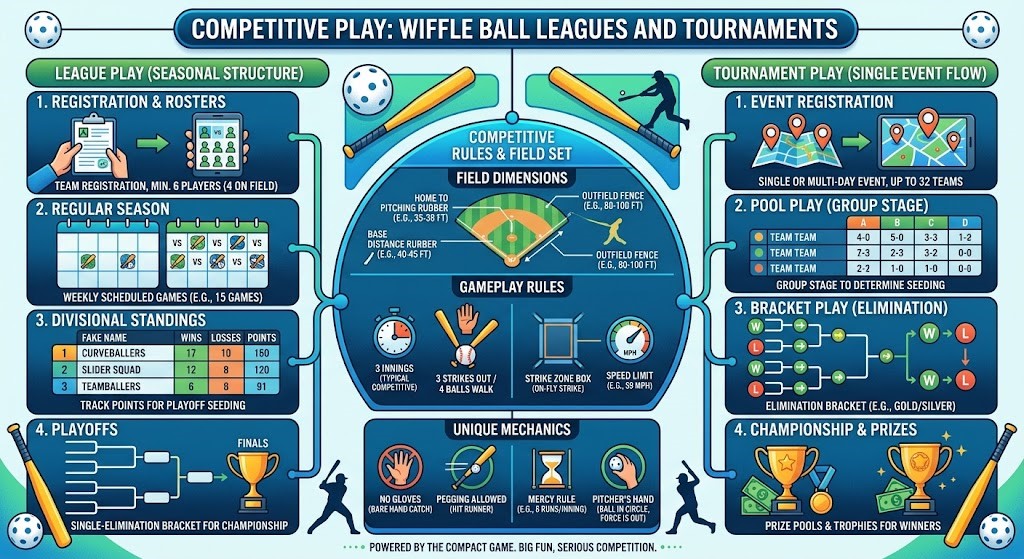
Wiffle Ball Leagues and Tournaments: How Competitive Play Works
Wiffle Ball may have started as a simple backyard game, but it has grown into much more than a casual summer activity. Across the country, players have created organized leagues, tournaments, clubs, and competitive communities dedicated to the sport.
For beginners, the idea of competitive Wiffle Ball can be surprising.
After all, the game uses a lightweight plastic ball and bat. Players can set up a field in a backyard, driveway, or open area. There is no need for a massive stadium or expensive equipment.
Yet beneath that simplicity is a surprisingly deep competitive game.
Pitchers develop specialized pitches. Hitters learn to recognize movement. Defenders study tendencies and positioning. Teams develop strategies based on their opponents, field dimensions, and game situations.
As a result, competitive Wiffle Ball can be far more challenging than a casual backyard game.
If you are just learning the sport, begin with The Ultimate Beginner’s Guide to Wiffle Ball: Rules, Equipment, Backyard Setup, and Winning Strategies. That parent guide provides the foundation you need before moving into organized competition.
In this article, we will explore Wiffle Ball leagues and tournaments, how competitive Wiffle Ball works, what players can expect, and how beginners can prepare for organized competition.
What Is Competitive Wiffle Ball?
Competitive Wiffle Ball takes the basic concepts of the backyard game and places them into a more structured environment.
Instead of simply deciding on rules before a game, organized leagues and tournaments typically establish specific regulations that every participating team must follow.
These rules can address:
- field dimensions
- pitching distances
- ball and bat requirements
- strike zones
- innings
- scoring
- player eligibility
- roster sizes
- tournament formats
- tie-breaking procedures
The exact rules can vary between organizations.
That is important because Wiffle Ball has never had one universal format for every backyard game.
Instead, different competitive organizations have developed their own versions of the sport.
Nevertheless, most competitive games share the same basic objective.
Score more runs than the opposing team while preventing that team from scoring.
Understanding those fundamentals begins with Official Wiffle Ball Rules Explained: Gameplay, Scoring, and Outs.
Why Wiffle Ball Works as a Competitive Sport
At first, Wiffle Ball might seem too simple for serious competition.
However, its simplicity actually creates some of its greatest strengths.
The lightweight ball limits the amount of physical space required.
The plastic bat makes the sport accessible.
The smaller field allows games to take place in relatively compact locations.
Most importantly, the unusual movement of the ball creates a tremendous amount of strategic depth.
A pitcher can develop several different pitches.
A hitter must recognize those pitches quickly.
Defenders have to anticipate where the ball will travel.
Therefore, players can develop specialized skills without needing the facilities associated with traditional baseball.
The Difference Between Backyard Wiffle Ball and Competitive Wiffle Ball
A backyard game usually emphasizes fun.
Competitive Wiffle Ball emphasizes consistency.
In a backyard game, players might decide that hitting a particular tree counts as a double.
Another group might use a fence as the home-run boundary.
A third group might eliminate base running entirely.
There is nothing wrong with any of those approaches.
However, organized competition requires everyone to play under the same conditions.
Competitive leagues therefore establish rules before the season or tournament begins.
This makes results easier to compare and reduces disagreements.
How Wiffle Ball Leagues Work
A Wiffle Ball league usually consists of multiple teams competing over a period of time.
The season might last several weeks or several months.
Teams play scheduled games against one another.
At the end of the regular season, standings determine which teams advance to playoffs or championship rounds.
The exact format varies.
Some leagues use divisions.
Others use a single standings table.
Some organizations separate teams based on experience.
Others allow everyone to compete together.
Forming a Wiffle Ball Team
Joining a league usually starts with forming a team.
A team might consist of several players, although the exact roster size depends on the league’s rules.
Before joining, players should understand the requirements.
Important questions include:
- How many players can be on a roster?
- How many players can participate in each game?
- Are substitutes allowed?
- Are there age divisions?
- Can players switch teams?
- Are there registration fees?
- What equipment must players provide?
Answering these questions beforehand prevents problems later.
League Divisions and Skill Levels
Some competitive organizations divide players into different levels.
This approach allows newer players to compete against teams with similar experience.
Possible categories include:
- beginner
- recreational
- intermediate
- advanced
- open
- elite
Not every league uses these exact classifications.
However, the concept remains useful.
A beginner who immediately competes against highly experienced pitchers may find the experience frustrating.
Meanwhile, experienced players may want stronger competition.
Skill divisions can help create better matches for everyone.
Regular Season Competition
The regular season provides the foundation of most leagues.
Teams play scheduled games and accumulate wins and losses.
Depending on the organization, standings may consider several factors.
These can include:
- overall record
- winning percentage
- runs scored
- runs allowed
- head-to-head results
Some leagues award points rather than simply counting wins and losses.
The important thing is consistency.
A team cannot rely on one great game.
Instead, it must perform well throughout the season.
Wiffle Ball Playoffs
Many leagues conclude their regular seasons with playoffs.
The best teams qualify for postseason competition.
A playoff format might include:
- quarterfinals
- semifinals
- championship game
Some leagues allow more teams into the postseason.
Others may only invite the top few teams.
Playoffs create a different atmosphere because every game becomes more important.
A team that struggled early in the season can sometimes make a deep playoff run if it improves at the right time.
Wiffle Ball Tournaments
Unlike a league, a tournament usually takes place over a shorter period.
Teams may travel to a specific location and play multiple games during a weekend or single day.
Tournament formats can vary considerably.
Common formats include:
- round robin
- pool play
- single elimination
- double elimination
- pool play followed by elimination rounds
Each format has advantages.
Round-robin competition gives teams multiple opportunities to play.
Single elimination creates immediate pressure.
Double elimination provides teams with a second chance after a loss.
Pool Play
Pool play is common in tournaments with many teams.
Organizers divide teams into smaller groups called pools.
Each team plays several games within its pool.
The strongest teams then advance to an elimination bracket.
This format balances competition and efficiency.
Teams get multiple opportunities to demonstrate their ability while organizers can still complete the tournament within a reasonable amount of time.
Single-Elimination Tournaments
Single elimination is easy to understand.
Lose, and you are out.
Win, and you advance.
This format creates enormous pressure.
Every pitch matters.
Every defensive mistake can become costly.
For spectators, single elimination can also create exciting games because teams know they cannot afford to make many mistakes.
Double-Elimination Tournaments
Double elimination provides more room for error.
A team generally remains alive after its first loss.
It must then fight through another bracket to reach the championship.
This format rewards consistency while allowing teams to recover from one bad performance.
For players, it can also provide more games and more opportunities to learn.
How Competitive Wiffle Ball Fields Differ
Field design becomes particularly important in organized competition.
A backyard field might change dimensions from one game to another.
Competitive organizations usually establish consistent measurements.
Important factors may include:
- pitching distance
- strike zone location
- foul territory
- outfield boundaries
- home-run distances
- scoring areas
Consistency ensures that one team does not receive an advantage simply because it knows how to exploit a particular field.
If you are creating your own competitive field, review How to Set Up a Wiffle Ball Field in Your Backyard (Dimensions and Layout Tips).
Equipment Rules in Competitive Wiffle Ball
Organized competition may also regulate equipment.
This can include the type of:
- ball
- bat
- strike zone
- protective equipment
Players should never assume that any equipment will automatically meet tournament requirements.
Always check the rules before an event.
Understanding equipment choices is also useful through Wiffle Ball Equipment Guide: Bats, Balls, and Backyard Essentials.
Competitive Wiffle Ball Pitching
Pitching becomes one of the biggest differences between casual and competitive play.
A recreational pitcher may throw a few basic curves.
A serious competitor may develop an entire pitching arsenal.
That arsenal could include:
- curveballs
- sliders
- risers
- drop pitches
- straight pitches
- changeups
- knuckle-style pitches
The goal is not simply to throw the most complicated pitch.
The goal is to keep hitters uncertain.
A pitcher who throws the same breaking ball repeatedly becomes predictable.
A pitcher who changes movement, location, and timing can become much harder to hit.
For a detailed look at pitching mechanics, see How to Throw Wiffle Ball Pitches: Curveballs, Sliders, and More.
Pitch Selection During a Tournament
Competitive pitchers must also manage their pitches.
Throwing maximum-effort pitches repeatedly can affect consistency.
Therefore, smart pitchers think about:
- pitch count
- control
- opponent tendencies
- game situation
- fatigue
- score
For example, a pitcher may use a breaking pitch when a strikeout is particularly valuable.
At another point, the same pitcher may choose a safer pitch designed to produce weak contact.
That decision-making separates experienced competitors from beginners.
Competitive Wiffle Ball Hitting
Hitters face an equally difficult challenge.
The ball can move significantly during its flight.
Consequently, hitters cannot simply swing as hard as possible.
They need to recognize the pitch early.
Timing becomes critical.
Patience matters.
So does understanding the pitcher’s tendencies.
Hitters can improve these skills by studying Wiffle Ball Hitting Tips: How to Improve Contact and Power.
Learning a Pitcher’s Tendencies
Competitive hitters should watch carefully.
A pitcher might prefer a particular pitch in certain counts.
Another pitcher might throw breaking pitches when ahead in the count.
Some pitchers may favor the outside portion of the strike zone.
Others may attack the same area repeatedly.
Recognizing those patterns gives hitters valuable information.
The more experienced the competition, the more important this preparation becomes.
Competitive Wiffle Ball Defense
Defense can make the difference between winning and losing a close tournament game.
Because Wiffle Ball fields are relatively small, defensive positioning becomes extremely important.
Players need to understand:
- where the hitter tends to make contact
- how far the ball travels
- where scoring zones begin
- how teammates are positioned
Good defenders anticipate rather than simply react.
They move before the ball reaches them.
For a deeper look at defensive fundamentals, read Wiffle Ball Fielding and Defense: Positioning and Strategy.
Communication Between Teammates
Competitive teams must communicate.
Players should know who covers particular areas.
They should also communicate when pursuing difficult balls.
A simple call can prevent two defenders from chasing the same ball.
Likewise, communication can help teammates adjust positioning before a pitch.
Strong communication becomes particularly valuable during pressure situations.
Strategy in Competitive Wiffle Ball
Competitive Wiffle Ball requires considerably more strategy than many beginners expect.
Teams must decide how aggressively to attack.
They must determine where to position defenders.
They need to understand when to take risks.
They also need to recognize the strengths and weaknesses of their opponents.
These concepts are explored in greater detail in Winning Wiffle Ball Strategies: Pitching, Hitting, and Game Tactics.
Managing the Score
Score management becomes increasingly important as a game progresses.
A team with a large lead may choose a conservative strategy.
A team that trails late in the game may need to take greater risks.
Those decisions can affect:
- pitch selection
- defensive positioning
- hitting approach
Good teams understand that the best strategy can change from inning to inning.
Preparing for Your First Tournament
Beginners should not feel intimidated by competitive Wiffle Ball.
The best approach is preparation.
Before entering a tournament, players should understand the rules.
They should also practice under conditions that resemble competition.
That means:
- using the tournament ball
- using the tournament bat
- practicing from the correct pitching distance
- following the tournament strike zone
- playing against strong opponents
Preparation reduces surprises.
Building a Practice Routine
A good practice routine should address several areas.
Pitchers should work on:
- control
- movement
- pitch variety
Hitters should practice:
- timing
- contact
- pitch recognition
Defenders should practice:
- reaction time
- catching
- positioning
- communication
Teams should also practice complete games.
Individual skills matter, but players eventually need to combine those skills in realistic situations.
Handling Pressure
Competitive games create pressure.
A player may perform well during practice but struggle when the score is close.
That is normal.
The key is learning how to manage pressure.
Players should focus on the next pitch rather than the entire game.
Pitchers should concentrate on executing their delivery.
Hitters should focus on seeing the ball.
Defenders should focus on their responsibilities.
Breaking the game into smaller moments can make pressure easier to manage.
Learning From Losses
Losing is part of competitive sports.
A tournament loss does not mean the team failed.
Instead, it provides information.
Ask:
- What worked?
- What did not work?
- Which pitches caused problems?
- Which hitters struggled?
- Where did defensive mistakes occur?
- Did the team communicate effectively?
Honest evaluation turns losses into future improvements.
Beginners can also identify technical problems through Common Wiffle Ball Mistakes Beginners Make and How to Fix Them.
The Social Side of Wiffle Ball Tournaments
Competitive Wiffle Ball is not only about winning.
Tournaments also create communities.
Players meet competitors from other areas.
Teams develop rivalries.
Friends travel together.
Families attend games.
Because Wiffle Ball remains relatively accessible, competitive events can retain a relaxed atmosphere even when the games themselves become intense.
That combination of competition and camaraderie is one of the sport’s greatest strengths.
Youth Wiffle Ball Competition
Wiffle Ball can also introduce younger players to organized competition.
The sport offers a relatively simple entry point.
Young players can learn:
- teamwork
- coordination
- sportsmanship
- communication
- strategy
At the same time, the lighter equipment and smaller playing environment can make the game less intimidating than traditional baseball.
Youth leagues can therefore provide a useful introduction to competitive sports.
Adult Wiffle Ball Competition
Adults also participate in competitive Wiffle Ball.
Some players return to the sport after discovering it during childhood.
Others discover organized Wiffle Ball later in life.
The sport accommodates a wide range of experience levels.
That makes it possible for adults to enjoy meaningful competition without needing the training schedule associated with some traditional sports.
How to Find a Wiffle Ball League or Tournament
Finding competitive opportunities begins with researching local organizations.
Potential sources include:
- local recreation departments
- community sports organizations
- Wiffle Ball clubs
- social sports groups
- online communities
- tournament organizers
Because the sport has both informal and organized communities, availability can vary by location.
Players should search for current events and verify that the rules match their preferred style of play.
Starting Your Own Wiffle Ball League
If you cannot find a local league, you can create one.
The basic process is surprisingly simple.
First, find several interested teams.
Next, establish rules.
Then determine:
- field location
- schedule
- roster requirements
- equipment requirements
- scoring system
- standings
- playoff format
Consistency should remain the priority.
Everyone should understand the rules before the first game.
Creating a Tournament
A tournament can be even easier to organize.
Start by determining how many teams will participate.
Then choose a format.
For example, eight teams could participate in pool play followed by a championship bracket.
Organizers should establish the rules before registration begins.
They should also create a schedule that gives teams adequate time between games.
Keeping Competition Fair
Fairness is essential.
Organizers should apply the same rules to every team.
That means avoiding last-minute changes that favor one side.
Officials or organizers should also communicate decisions clearly.
When disputes occur, the published rules should provide the answer.
Fair competition protects the integrity of the league or tournament.
Sportsmanship in Competitive Wiffle Ball
Competition should never eliminate sportsmanship.
Players should respect:
- opponents
- teammates
- officials
- organizers
- spectators
Arguments are sometimes inevitable.
However, players should handle disagreements respectfully.
The best competitive environments combine intensity with good sportsmanship.
What Makes a Great Wiffle Ball Team?
A great team needs more than talented individuals.
Successful teams typically have:
- reliable pitching
- disciplined hitting
- strong defense
- communication
- adaptability
- confidence
Perhaps most importantly, great teams trust one another.
A pitcher trusts defenders to make plays.
Hitters trust teammates to contribute.
Defenders trust pitchers to challenge hitters.
That teamwork can make an enormous difference during close games.
Moving From Beginner to Competitive Player
Players do not need to become experts before entering their first tournament.
Competition itself is part of the learning process.
Start small.
Play against friends.
Join a recreational league.
Then try a local tournament.
As experience increases, players can seek stronger competition.
The important thing is to continue learning.
Final Thoughts on Wiffle Ball Leagues and Tournaments
Wiffle Ball has come a long way from its backyard roots.
Today, organized leagues and tournaments provide opportunities for players who want to take the sport more seriously.
Competitive Wiffle Ball combines the accessibility of a backyard game with the strategy and intensity of organized sports.
Pitchers develop specialized techniques.
Hitters learn to recognize movement.
Defenders improve their positioning.
Teams develop strategies.
Most importantly, players discover that a simple plastic ball and bat can create remarkably competitive games.
Whether you want to join an existing league, enter your first tournament, or organize your own competition, Wiffle Ball offers plenty of opportunities.
Start by learning the rules.
Practice the fundamentals.
Find people who enjoy the game.
Then gradually increase the level of competition.
You may discover that the little plastic ball you once associated with backyard fun can provide a surprisingly deep and rewarding sporting experience.
Continue Learning About Wiffle Ball
This article completes the competitive-play portion of the Wiffle Ball cluster. Continue exploring the other articles in the series:
Official Wiffle Ball Rules Explained: Gameplay, Scoring, and Outs
Wiffle Ball Equipment Guide: Bats, Balls, and Backyard Essentials
How to Set Up a Wiffle Ball Field in Your Backyard (Dimensions and Layout Tips)
How to Throw Wiffle Ball Pitches: Curveballs, Sliders, and More
Wiffle Ball Hitting Tips: How to Improve Contact and Power
Wiffle Ball Fielding and Defense: Positioning and Strategy
Winning Wiffle Ball Strategies: Pitching, Hitting, and Game Tactics
Common Wiffle Ball Mistakes Beginners Make and How to Fix Them