
How to Read a Rock Climbing Route
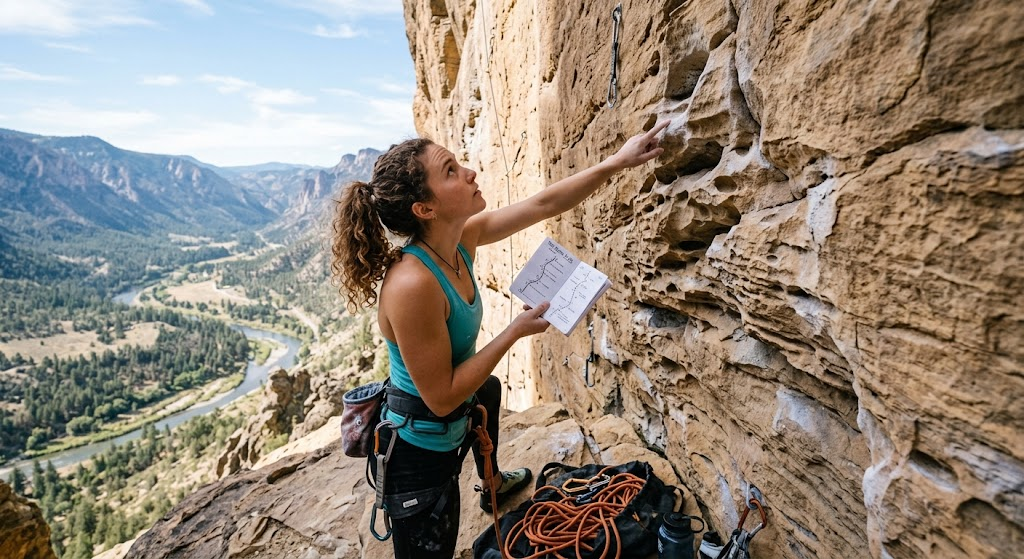
How to Read a Rock Climbing Route: Grades, Routes, Problems, and Climbing Strategy
Rock climbing is often described as a physical sport, but some of the most important work happens before a climber ever leaves the ground.
Look at an unfamiliar climbing route and two climbers may see completely different things. One sees a confusing collection of handholds and footholds. Another immediately notices a sequence, a rest, a difficult section, and several possible ways to reach the top.
That difference is route reading.
Route reading is the ability to study a climb, understand what the wall is asking you to do, develop a movement plan, and adjust that plan when reality does not cooperate. It is one of the skills that separates simply climbing harder from becoming a smarter climber.
The good news is that route reading can be learned.
You do not need years of experience to begin developing the skill. Even a beginner can learn to identify the start, look for usable holds, find potential footholds, recognize changes in wall angle, anticipate difficult sections, and think several moves ahead.
This guide explains how to read rock climbing routes and bouldering problems, how climbing grades work, how to recognize important features, how to plan a sequence, and how to become better at solving climbs.
For the physical movement skills that allow you to execute the plan, see our guide to rock climbing techniques, footwork, grip, body position, and efficient movement. For training methods that can help you become a stronger climber, see how to get better at rock climbing through training, strength, endurance, and practice.
What Does It Mean to Read a Rock Climbing Route?
Route reading means analyzing a climb before and during your attempt.
A climber is essentially trying to answer a series of questions:
- Where does the climb begin?
- Where does it end?
- Which holds can I actually use?
- Where should my hands go?
- Where should my feet go?
- Which direction do the holds face?
- How will my body need to move?
- Where is the hardest section?
- Where can I rest?
- How should I approach the difficult section?
- What happens if my first plan does not work?
Route reading combines observation, experience, movement knowledge, and problem-solving.
It is important to understand that route reading is not the same thing as memorizing a route.
A climber who memorizes every hand movement on one wall may perform well on that climb but still struggle with an unfamiliar route. A good route reader can walk up to something new and begin figuring it out.
That ability becomes increasingly valuable as climbs become more difficult.
Start by Understanding the Climb
Before worrying about individual moves, look at the entire climb.
Take a few moments to stand back and examine the wall.
Do not immediately focus on the first handhold.
Instead, ask:
What is this climb trying to make me do?
Does it move straight upward?
Does it traverse sideways?
Does it change direction?
Does it move from a slab into a vertical section?
Does it become steeper near the top?
Does it contain a large ledge or obvious rest?
Does one section appear significantly more difficult than everything around it?
These broad observations give you a framework.
A climb is not simply a collection of individual moves. It is a sequence of movements connected together.
Identify the Start
This sounds obvious, but start holds can sometimes be confusing, especially on busy gym walls.
Determine exactly which holds are designated as the starting holds and how the climb is intended to begin.
Some routes have obvious starting handholds. Others require specific hand and foot positions.
Starting incorrectly can completely change the first sequence.
If you are unsure, ask a staff member or experienced climber.
The same principle applies outdoors. Never assume that the first attractive hold you see represents the actual beginning of a route.
Find the Finish
Before climbing upward, identify where you are trying to go.
On indoor routes, the finish may be an obvious finishing hold or a designated finishing position.
On bouldering problems, the finishing movement may require controlling a particular hold or reaching a defined finishing position.
Knowing the finish gives you a destination.
It also helps you work backward.
Instead of thinking only:
Start → next hold → next hold → next hold
you can think:
Finish → final moves → difficult section → earlier setup → start
Working backward is one of the most useful route-reading techniques.
Learn to Read Holds
Not all climbing holds are meant to be grabbed in the same way.
The shape of a hold provides clues about how it might be used.
You may encounter:
- Jugs
- Crimps
- Slopers
- Pinches
- Pockets
- Underclings
- Side pulls
- Gastons
- Edges
- Volumes
The hold’s shape matters, but so does its orientation.
A hold that looks poor from the ground may become useful when your body is positioned correctly.
Likewise, a large hold may be surprisingly awkward if you approach it from the wrong direction.
Look at the Direction of the Hold
One of the biggest beginner route-reading mistakes is seeing a hold without noticing its orientation.
Imagine a side-pull.
From the ground it may look like an ordinary handhold.
But the direction in which it pulls tells you something about the intended body position.
The same applies to underclings, gastons, and many other specialized holds.
Ask:
If I grab this hold, where will my body naturally want to go?
Then ask:
What foothold would allow me to use it effectively?
This turns route reading into a movement puzzle.
Find the Feet Before You Need Them
Beginners often study the handholds and largely ignore their feet.
Experienced climbers constantly look for footholds.
A route can appear impossible because the hands look weak when the real solution is hiding at your feet.
When studying a climb, scan the wall for:
- Small footholds
- Edges
- Smears
- Volumes
- Features in the rock
- Foot placements beneath or beside handholds
Do not simply ask:
What can I grab?
Ask:
Where can I put my feet so I can use the next handhold?
That question can completely change how you see a route.
For a deeper discussion of foot placement and body movement, see rock climbing techniques for footwork, balance, grip, and body position.
Look for the Sequence
A route is essentially a sequence.
The challenge is figuring out which holds belong together.
Suppose you see three handholds above you.
The obvious solution might be:
- Reach the left hold.
- Reach the middle hold.
- Reach the right hold.
But that may not work.
Perhaps the middle hold is only useful if you first move your right foot.
Maybe the left hold is designed for the right hand.
Maybe a hidden foothold allows you to stand higher.
Maybe you are supposed to skip the middle hold entirely.
Route reading means looking for relationships between holds rather than treating every hold as an isolated object.
Think About Three or Four Moves Ahead
Beginners often look only at the next move.
That is understandable.
You are trying to survive the movement immediately in front of you.
As your route-reading improves, try looking farther ahead.
Instead of:
Where does my right hand go?
think:
If my right hand goes there, where does my left hand go next?
Then:
Where will my feet need to be for that movement?
You do not necessarily need to predict the entire climb.
Sometimes three or four moves is enough.
The goal is to avoid constantly reaching a hold and then having to stop and figure out what comes next.
Identify the Crux
The crux is generally the most difficult section of a climb.
It may be difficult because of:
- Small holds
- A long reach
- An awkward body position
- Steep terrain
- Poor footholds
- A powerful movement
- Technical sequencing
- Mental difficulty
- A combination of factors
Finding the crux before you start is extremely useful.
If you know the hardest section is coming, you can manage your energy accordingly.
You may climb easier terrain efficiently rather than wasting strength.
You may also decide to study the crux more carefully before leaving the ground.
The Crux Isn’t Always the Hardest-Looking Move
This is an important lesson.
The move that looks dramatic from the ground is not necessarily the hardest part.
Sometimes a visually intimidating move is easy once you understand the body position.
Meanwhile, a seemingly insignificant sequence of small holds may be extremely difficult.
Do not judge difficulty purely by appearance.
Instead, consider:
- How good are the holds?
- How far apart are they?
- What footholds are available?
- What body position will be required?
- Is the wall steep?
- Can you rest afterward?
- Does the movement require precision?
The wall often tells you more than the size of the holds alone.
Look for Rest Positions
Good climbers do not simply move from bottom to top without thinking about energy.
They look for opportunities to recover.
Potential rests might include:
- Large jugs
- Good ledges
- Stemming positions
- Stable footholds
- Corners
- Straight-arm positions
- Hanging positions that allow one arm to shake out
Before climbing, look for likely rest points.
Then ask:
Can I actually rest here?
A large hold does not automatically equal a good rest.
Your body position determines how useful the hold becomes.
Pay Attention to Wall Angle
The angle of the wall tells you a tremendous amount about how a climb may need to be approached.
Slab
Slab climbing often emphasizes:
- Footwork
- Balance
- Precise weight placement
- Friction
- Body positioning
When reading a slab, look carefully for small footholds and subtle features.
The solution may involve standing on something that barely looks like a foothold.
Vertical Walls
Vertical climbing often requires a balance between:
- Hand strength
- Footwork
- Body position
- Efficient movement
Look for opportunities to keep your weight over your feet rather than constantly pulling with your arms.
Overhangs
Steep climbing changes the problem.
You may need:
- More body tension
- Stronger pulling
- Better core engagement
- More powerful movement
- Better use of heel and toe hooks
- Efficient sequencing
When reading an overhang, look farther ahead.
A single hold may be easy to reach but difficult to control if you arrive with the wrong body position.
Look for Features in the Wall
The wall itself can be part of the route.
Look for:
- Corners
- Arêtes
- Aretes and edges
- Ridges
- Grooves
- Cracks
- Flakes
- Volumes
- Pockets
- Ledges
- Changes in texture
Outdoor climbing makes this especially important because natural rock does not have brightly colored holds telling you where to put your hands.
The rock itself becomes part of the puzzle.
Reading Indoor Routes
Indoor climbing gyms provide an excellent environment for learning route reading because routes are deliberately created and marked.
Color-coded holds usually indicate which holds belong to a route.
But do not assume that every hold is equally important.
Route setters often create movement patterns.
You may notice:
- A sequence of side pulls
- A series of opposing holds
- A large move followed by an easy section
- A rest before a difficult sequence
- A change in wall angle
- A technical footwork section
Learning to recognize these patterns helps you understand what the setter may be asking you to do.
Route Setters Are Creating Problems, Not Just Paths
A climbing route is usually designed around a particular movement challenge.
The route setter may want the climber to:
- Reach
- Twist
- Flag
- Stem
- Mantle
- Pull
- Push
- Use a particular hold orientation
- Change body position
- Move dynamically
- Maintain balance
This does not mean there is always one correct sequence.
There may be several solutions.
That is one of the most enjoyable parts of climbing.
The “Intended” Beta Is Not Always Your Beta
Beta is information about how to climb a route or solve a problem.
A climber might tell you:
“Put your left foot here, reach with your right hand, then match.”
That is beta.
It can be useful, but you should not assume someone else’s beta will work perfectly for you.
Your:
- Height
- Arm length
- Flexibility
- Strength
- Mobility
- Experience
- Confidence
can all change the solution.
A shorter climber may use a foothold that a taller climber ignores.
A flexible climber may use a position that another climber cannot.
A powerful climber may solve a sequence differently from a technical climber.
The best route readers learn to use beta as information rather than a rigid set of instructions.
How Height Changes Route Reading
Height can dramatically affect climbing sequences.
A taller climber may be able to:
- Skip a hold
- Reach around a difficult section
- Use a different foothold
- Avoid a dynamic movement
A shorter climber may need to:
- Use intermediate holds
- Change foot positions
- Use more precise body positioning
- Generate momentum
Neither approach is automatically better.
The important lesson is:
Do not assume the route has only one solution.
Reading a Route Before You Leave the Ground
Before starting an unfamiliar climb, take a few moments.
You do not need to stare at the wall for five minutes.
A quick, deliberate inspection can be enough.
Try this process.
Step 1: Find the start
Identify exactly where you begin.
Step 2: Find the finish
Know your destination.
Step 3: Trace the general path
Follow the route visually from bottom to top.
Step 4: Find obvious handholds
Identify the major movement points.
Step 5: Find the feet
Look for footholds that will support those movements.
Step 6: Find the crux
Determine where the climb appears to become most difficult.
Step 7: Find rests
Look for places where you might recover.
Step 8: Consider the wall angle
Ask how the terrain will affect your movement.
Step 9: Develop a rough sequence
You do not need every move.
Step 10: Start climbing
Then be prepared to change the plan.
Route Reading While You Are Climbing
Planning from the ground is useful, but the plan is never guaranteed to work.
Once you are on the wall, you gain information that was unavailable from below.
A hold might be worse than expected.
A foothold may be smaller.
A move may be easier than it looked.
You may discover a better sequence.
That is why good climbers constantly update their plan.
Stop and Look
There is nothing wrong with pausing on a route.
If you reach a position where you are unsure what to do, stop if you can do so safely.
Look around.
Search for:
- Better footholds
- Alternate handholds
- Features
- Rest positions
- Different body positions
Sometimes the solution becomes obvious when you stop rushing.
Don’t Commit to a Bad Plan Just Because It Was Your Original Plan
One of the biggest route-reading mistakes is stubbornness.
You planned:
Left hand → right foot → right hand → left foot.
It isn’t working.
So you try it again.
And again.
And again.
Instead, ask:
What information did that failed attempt give me?
Maybe the foothold is too low.
Maybe the hold needs to be approached from the side.
Maybe your hips need to move first.
Maybe the opposite hand should go there.
Failure is information.
Strong climbers use it.
What to Do When Your Plan Fails
When a sequence doesn’t work, systematically change one variable.
Try changing:
Your feet
Move them to different positions.
Your hips
Rotate or shift your hips.
Your hand order
Try the opposite hand.
Your grip
The hold may work differently than you assumed.
Your body position
Turn sideways rather than facing the wall directly.
Your movement style
Try moving statically rather than dynamically—or vice versa.
Your sequence
Skip a hold or use an intermediate hold.
Changing one variable at a time helps you understand the problem rather than randomly throwing yourself at it.
Reading Bouldering Problems
Bouldering requires route reading just as much as roped climbing.
In some ways, it may require even more concentrated problem-solving because the sequence is short and the movements can be highly specific.
Before attempting a boulder, look at the entire problem.
Identify:
- Start
- Finish
- Hand sequence
- Foot sequence
- Crux
- Possible rests
- Direction of holds
- Body positions
Because the problem is short, you may be able to visualize the entire sequence.
Route Reading vs. Bouldering Reading
There are important differences.
| Roped Route | Bouldering Problem |
|---|---|
| Often longer | Usually shorter |
| Energy management is important | Individual moves may be more powerful |
| Multiple rest opportunities may exist | Rest opportunities may be limited |
| Route reading can involve many sequences | Sequence can often be visualized more completely |
| Endurance can become important | Power and movement precision may dominate |
| Falls can occur at many points | Attempts are often repeated frequently |
Both require problem-solving.
Understanding Climbing Grades
Climbing grades provide a general indication of difficulty.
However, grades are not perfect measurements.
They are influenced by:
- Location
- Climbing style
- Rock type
- Route setter
- Grading tradition
- Individual perception
A grade should be treated as useful information, not absolute truth.
The Yosemite Decimal System
In the United States, roped climbs commonly use the Yosemite Decimal System, or YDS.
Climbs are generally classified as Class 5 when technical climbing is involved, with additional decimal ratings such as:
- 5.5
- 5.6
- 5.7
- 5.8
- 5.9
- 5.10
- 5.11
- 5.12
- 5.13
- 5.14
- 5.15
At higher levels, additional letter subdivisions are commonly used.
The exact experience of a particular grade can vary considerably from one area to another.
French Sport Climbing Grades
French grades are widely used internationally for sport climbing and many indoor climbing environments.
They commonly appear as:
- 4
- 5a
- 5b
- 5c
- 6a
- 6b
- 6c
- 7a
- 7b
- 7c
- 8a
- 8b
- 8c
- 9a and beyond
Letters and plus signs provide further subdivisions.
Because grading systems developed differently, exact numerical conversions between systems should be treated as approximate rather than absolute.
Bouldering Grades
Bouldering has its own grading systems.
In the United States, the V-scale is commonly used:
- V0
- V1
- V2
- V3
- V4
- V5
- and upward
Another common system is the Fontainebleau, or Font, scale.
Indoor gyms may also use their own color systems or grading approaches.
The important thing for beginners is not memorizing every conversion.
Learn the system used at the gym or climbing area where you are climbing.
Indoor Grades Can Be Different
Two climbing gyms may both label a route with the same grade while the climbs feel very different.
That does not necessarily mean one gym is wrong.
Indoor grading can be subjective.
One gym might have:
- Softer grades
- More powerful routes
- More technical routes
- Different setter philosophies
Another might have a completely different style.
Over time, you will learn what grades mean to you at particular gyms and climbing areas.
Don’t Let the Grade Become the Goal
A common beginner mistake is becoming obsessed with numbers.
Suppose you climb a V2.
Then you desperately want to climb V3.
You finally do it.
Now V4 becomes the goal.
The problem is that grades can become the scoreboard instead of climbing itself.
Grades are useful for tracking progress, choosing appropriate challenges, and comparing climbs within a reasonable context.
But they should not be the only measurement of improvement.
You may become much better at climbing without immediately moving up a grade.
Learn to Read the Route, Not Just the Grade
A grade tells you something about overall difficulty.
It does not tell you:
- Where the crux is
- What movement is required
- Whether the climb suits your strengths
- Whether the route is powerful or technical
- Where you should rest
- How the holds face
- Which sequence might work best
Two climbs with the same grade can feel completely different.
This is why route reading matters.
Onsight, Flash, Redpoint, and Projecting
As you become more involved in climbing, you will encounter terms describing different types of success.
Onsight
An onsight generally means successfully climbing a route on your first attempt without having received prior information about how to climb it.
This makes route reading especially important.
You have to interpret the climb yourself.
Flash
A flash generally means successfully climbing a route on the first attempt while having received some information or beta beforehand.
You might have watched someone else climb it.
You might have been given sequence information.
Redpoint
A redpoint generally means successfully climbing a route after previous attempts, without falling or weighting the rope during the successful ascent.
This is common when working on difficult routes.
Projecting
Projecting means repeatedly working on a climb that is currently near or beyond your comfortable ability.
Projecting can be one of the best ways to improve route reading.
Each attempt gives you information.
Why Projecting Improves Route Reading
Imagine a difficult climb that you cannot complete.
Your first attempt tells you:
- Where you fall
- Which holds feel bad
- Which movement feels difficult
Your second attempt lets you test another sequence.
Your third attempt may reveal a better foot position.
Eventually, you begin understanding the route.
You are not simply becoming stronger.
You are learning how to solve climbing problems.
Reading Routes by Climbing Style
Different types of climbing require different kinds of route reading.
For an overview of bouldering, top-rope, sport, trad, multi-pitch, and other disciplines, see the different types of rock climbing explained for beginners.
Sport Climbing
When reading a sport route, consider:
- Clip locations
- Rest positions
- Cruxes
- Rope path
- Wall angle
- Potential sequences
You should also understand how the route’s protection affects the overall climbing experience.
Detailed protection and equipment considerations belong in a broader rock climbing safety guide, especially before transitioning outdoors.
Trad Climbing
Trad climbing adds another layer of decision-making.
The climber must consider not only movement but also where protection can be placed and how the route features affect protection opportunities.
That makes route reading substantially more complicated than simply identifying the next handhold.
Trad climbing requires appropriate instruction and experience before attempting it independently.
Multi-Pitch Climbing
Multi-pitch climbing adds another strategic dimension.
You must consider:
- Pitch length
- Belays
- Route-finding
- Protection
- Rope management
- Descents
- Communication
- Overall time and conditions
In other words, you are reading an entire climbing system rather than one short sequence.
Route Reading Outdoors
Outdoor climbing presents a major difference from indoor climbing.
Indoor walls are deliberately designed.
Outdoor rock is not.
There may be:
- Natural variations
- Weathered rock
- Hidden holds
- Multiple possible lines
- Route-finding challenges
- Less obvious footholds
The route may not visually announce itself.
This is one reason the transition from gym climbing to outdoor climbing should be gradual and guided by experienced climbers.
Our upcoming article on how to transition from indoor climbing to outdoor rock climbing will explore that process in greater detail.
Learn to Read Rock Features
Outdoor route reading requires learning how different rock formations behave.
For example:
Cracks
Cracks can provide handholds, footholds, jams, protection placements, or combinations of these.
Edges
Edges may provide useful handholds or footholds.
Pockets
Pockets may provide limited finger placements and require careful body positioning.
Slopers
Sloping surfaces depend heavily on friction and body position.
Flakes
Flakes can provide useful climbing features, but climbers must understand the condition and integrity of the rock.
Corners
Corners can create stemming opportunities and opposing pressure.
The rock itself becomes your route map.
How to Read a Slab
On a slab, route reading should emphasize feet.
Look for:
- Tiny edges
- Friction surfaces
- Natural features
- Balance points
- Opportunities to keep your weight over your feet
Ask:
Where can I stand?
before asking:
Where can I pull?
That single change in perspective can dramatically improve slab climbing.
How to Read Vertical Climbing
On vertical terrain, look for relationships between hand and foot positions.
You may be able to:
- Stand high
- Rotate your hips
- Use opposing holds
- Rest with straight arms
- Maintain balance rather than pull continuously
A route that appears hand-intensive may become much easier once the feet are understood.
How to Read an Overhang
On steep terrain, look farther ahead.
Overhangs often punish inefficient sequencing.
Look for:
- Rest positions
- Good feet
- Kneebars where appropriate
- Heel hooks
- Toe hooks
- Body tension opportunities
- Large holds that allow recovery
You may need to determine how to conserve energy before reaching the crux.
Use Your Eyes Before Using Your Strength
This is one of the simplest route-reading principles.
When you encounter a difficult move, your first response should not automatically be:
Pull harder.
Instead:
Look again.
Ask:
- Is there another foothold?
- Is the hold directional?
- Am I using the correct hand?
- Should my hips move first?
- Can I rotate my body?
- Is there a rest?
- Is there an intermediate hold?
Many climbing problems are solved visually before they are solved physically.
Common Route-Reading Mistakes
Mistake #1: Looking Only at Handholds
Your feet are part of the route.
Mistake #2: Looking Only One Move Ahead
Try to anticipate several movements.
Mistake #3: Assuming the Obvious Sequence Is Correct
The obvious sequence may not be the best sequence.
Mistake #4: Ignoring Hold Direction
A hold’s orientation can determine the correct body position.
Mistake #5: Ignoring Wall Features
Corners, edges, volumes, cracks, and other features can completely change the solution.
Mistake #6: Refusing to Change the Plan
A failed sequence is information.
Use it.
Mistake #7: Chasing the Grade
The number does not tell the whole story.
Mistake #8: Copying Another Climber Exactly
Someone else’s body is not your body.
Beta may need to be adapted.
Mistake #9: Rushing
Sometimes the best move is simply to stop and look.
Mistake #10: Trying to Muscle Through Every Problem
Strength is valuable, but route reading can save enormous amounts of energy.
How to Practice Route Reading
You do not need a special training facility.
You can practice route reading every time you climb.
Practice Easy Routes
This is one of the best methods.
Choose a climb that is comfortably within your ability.
Before leaving the ground, study it.
Predict:
- Hand sequence
- Foot sequence
- Rest points
- Crux
- Body positions
Then climb it.
Compare what you predicted with what actually happened.
Because the climb is easy enough that you are not fighting for survival, you can concentrate on observation.
Try a “No Climbing Yet” Exercise
At the gym, choose a route and study it without climbing.
Ask yourself:
How would I climb this?
Visualize the sequence.
Then watch another climber attempt it.
Compare your plan with theirs.
This is an excellent way to develop your ability to interpret movement.
Practice Reading Routes You Don’t Climb
You can improve without touching the wall.
Watch other climbers.
Before they start, predict:
- Where they will put their hands
- Where they will place their feet
- Where they will struggle
- Where they will rest
- How they will solve the crux
Then see what actually happens.
This turns the climbing gym into a classroom.
Film Yourself When Appropriate
If your gym permits filming, watching yourself climb can reveal things that are difficult to notice while climbing.
You may discover that you:
- Ignore obvious footholds
- Look down too often
- Re-grip constantly
- Rush difficult sections
- Use poor body positions
- Miss rest opportunities
Self-analysis can be extremely valuable.
Keep a Climbing Journal
A simple climbing journal can help you recognize patterns.
Record things such as:
- Route grade
- Type of climbing
- What felt difficult
- Where you fell
- What sequence worked
- What sequence failed
- How tired you were
- What technique solved the problem
Over time, you may discover that certain problems repeatedly appear.
Perhaps you struggle with:
- Slopers
- Overhangs
- Long reaches
- Small footholds
- Route reading
- Fear
- Endurance
That information can guide your training.
Develop a Personal Route-Reading Checklist
Eventually, route reading should become automatic.
Before climbing, ask:
- Where does it start?
- Where does it finish?
- What is the general line?
- What are the best-looking handholds?
- Where are the feet?
- Which direction do the holds face?
- Where is the crux?
- Where can I rest?
- What wall angle am I dealing with?
- What is my initial sequence?
- What will I do if that sequence fails?
That checklist only takes a few seconds once it becomes habitual.
Route Reading Is a Skill That Grows With Experience
You may initially feel like experienced climbers have some mysterious ability to “see” a route.
They do not have magical vision.
They have accumulated thousands of observations.
They have seen:
- Similar hold shapes
- Similar wall angles
- Similar movement patterns
- Similar cruxes
- Similar body positions
- Similar route-setting concepts
Experience creates a library of patterns.
The more you climb thoughtfully, the larger that library becomes.
The Goal Is Not to Predict Everything
You should not expect to perfectly visualize every route.
Even elite climbers misread climbs.
The goal is not certainty.
The goal is to make a reasonable plan based on the information available and then adapt intelligently.
That is a much more realistic definition of route reading.
Route Reading and Mental Strength
There is also a mental component.
A difficult route can make you rush.
You may become frustrated.
You may stop looking for solutions.
You may convince yourself that a move is impossible before properly testing it.
Good route reading requires patience.
When a sequence fails, take a breath.
Look again.
Think.
Then try something different.
Climbing rewards problem-solving more than panic.
Route Reading and Efficiency
Good route reading can make you stronger without physically making you stronger.
That sounds strange, but consider what happens when you improve your sequence.
You may:
- Make fewer unnecessary movements
- Use better footholds
- Grip less aggressively
- Rest more effectively
- Avoid wasted attempts
- Reach holds in better positions
- Preserve energy for the crux
The climb becomes easier because you are doing less unnecessary work.
That is one of the great advantages of becoming a smart climber.
How Route Reading Fits Into Overall Climbing Progress
Route reading does not replace technique.
It works with technique.
You might understand exactly what a route requires but lack the physical ability to execute it.
That is where technique and training become important.
Likewise, you might be strong enough to complete a climb but waste enormous energy because you cannot read the sequence.
The best climbers combine:
- Route reading
- Technique
- Strength
- Endurance
- Mobility
- Mental control
- Experience
For the physical side of progression, see how to get better at rock climbing through training, strength, endurance, flexibility, and practice.
For the movement skills themselves, see rock climbing techniques for footwork, grip, body position, balance, and efficient movement.
A Practical Route-Reading Strategy for Beginners
Here is a simple approach you can use during your next climbing session.
Before climbing
Study the route.
Find the start and finish.
Trace the general path.
Identify several important handholds and footholds.
Look for the crux.
Look for rests.
Develop a rough sequence.
During the climb
Don’t rush.
Use your feet.
Look ahead.
Pay attention to hold direction.
Stay aware of your body position.
If the plan fails, stop if possible and reassess.
After the climb
Ask:
- What did I read correctly?
- What did I miss?
- Where did my plan fail?
- What sequence worked?
- What would I change next time?
That final step is extremely important.
Every climb can teach you something.
Rock Climbing Route-Reading FAQs
How far ahead should I read a climbing route?
Beginners can start by looking two or three moves ahead. As your experience improves, you may be able to visualize much longer sequences. You do not need to memorize the entire route.
What is the crux of a climbing route?
The crux is generally the most difficult section or sequence of a climb. It may be difficult because of strength, technique, balance, reach, poor holds, steepness, or other factors.
What does beta mean in rock climbing?
Beta is information about how to climb a route or solve a bouldering problem. It can include specific movement instructions, sequence suggestions, or general strategy.
Should beginners use beta?
Absolutely. Beta can be a useful learning tool. However, beginners should also practice solving climbs independently so they develop their own route-reading ability.
Why do two climbers use different sequences on the same route?
Climbers have different heights, strengths, flexibility, mobility, experience, and preferences. A sequence that works well for one climber may not work for another.
Are climbing grades accurate?
Grades provide a useful general indication of difficulty, but they are subjective. Difficulty can vary between gyms, climbing areas, route setters, rock types, and climbing styles.
Should I always climb routes at my maximum grade?
No. Climbing easier routes can be extremely valuable because they allow you to focus on technique, movement, route reading, and efficiency without being overwhelmed physically.
How can I improve route reading quickly?
Study routes before climbing, watch other climbers, practice predicting sequences, deliberately look for footholds, and analyze what went wrong when a plan fails.
Is route reading more important for bouldering or roped climbing?
Both require route reading. Bouldering often involves shorter, highly concentrated movement puzzles, while longer roped climbs may require more attention to sequencing, rests, energy management, and overall strategy.
Can route reading make me a better climber without making me stronger?
Yes. Better route reading can reduce wasted movement, improve positioning, conserve energy, and help you choose more efficient sequences.
Final Thoughts: Learn to See the Climb
Rock climbing becomes much more interesting when you stop seeing a wall as a collection of colorful holds and start seeing it as a problem to solve.
Every hold provides information.
Every foothold provides information.
The wall angle provides information.
The route’s shape provides information.
The crux provides information.
Even a failed attempt provides information.
The goal is to put all of that information together.
You begin by learning to identify the start and finish. Then you learn to recognize useful holds, footholds, rests, wall features, and difficult sections. Eventually, you begin predicting movement before you make it.
That is route reading.
And the more thoughtfully you climb, the better you become at it.
The progression through this rock climbing series now moves naturally from understanding the sport, to getting started, learning equipment, understanding climbing disciplines, developing technique, improving physical ability, managing risk, and finally learning how to analyze and solve climbs.
The next step is taking those skills beyond the controlled environment of a climbing gym and learning what changes when the wall becomes real rock.
That is where how to transition from indoor climbing to outdoor rock climbing becomes especially important.