
Rock Climbing Techniques
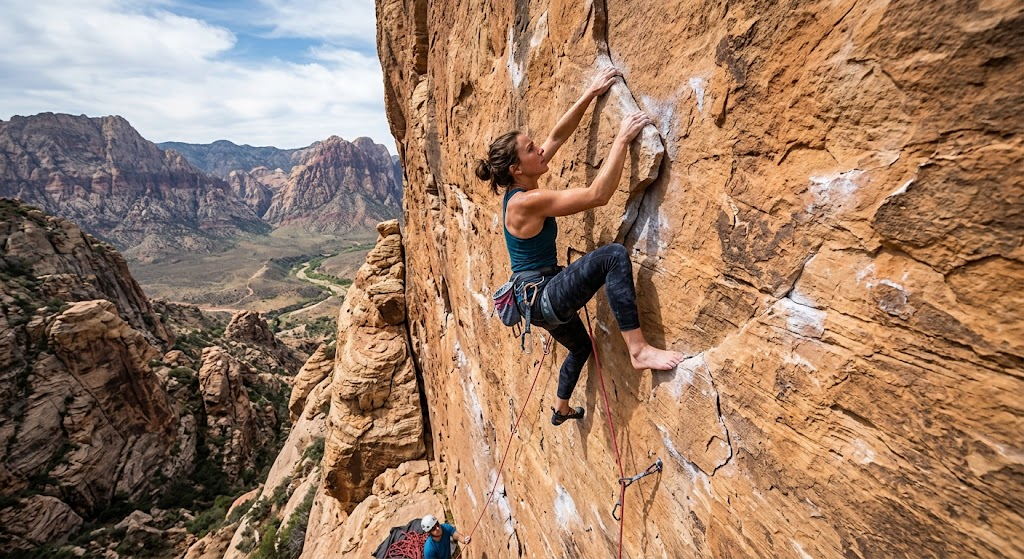
Rock Climbing Techniques: Footwork, Grip, Body Position, Balance, and Efficient Movement
Rock climbing can look like a test of upper-body strength.
Watch an inexperienced climber approach a difficult wall, however, and you will often see the same thing happen. They grab a hold, pull hard with their arms, reach for the next hold, and repeat the process until their forearms are exhausted.
Then watch an experienced climber attempt the same route.
The experienced climber may appear to use considerably less effort.
Their feet move deliberately. Their hips rotate. Their arms stay relatively straight. Their body remains balanced. They shift their weight rather than trying to muscle themselves upward.
That difference is one of the most important lessons in climbing:
Good climbing technique allows you to accomplish more while using less energy.
Strength certainly matters. Flexibility matters. Endurance matters. But technique can dramatically change how effectively you use whatever physical abilities you already possess.
This guide examines the fundamental techniques that help climbers move efficiently, including footwork, grip, balance, body position, flagging, smearing, edging, stemming, laybacking, mantling, resting, route reading, and movement strategy.
If you are new to the sport, this article works alongside The Ultimate Beginner’s Guide to Rock Climbing: Types, Equipment, Techniques, Safety, and How to Get Started, which provides the broader introduction to climbing.
And if you’re still getting familiar with the different disciplines, Types of Rock Climbing Explained: Bouldering, Sport Climbing, Trad Climbing, Top-Rope, and More explains how techniques can change depending on the type of climbing you choose.
The Most Important Climbing Technique: Use Your Feet
If there is one lesson a beginner should remember, it is this:
Your legs are usually stronger than your arms.
Yet beginners frequently treat their legs as little more than something that keeps them attached to the wall.
That is a mistake.
Your feet are incredibly important climbing tools.
Good footwork allows you to:
- Support your body weight
- Reduce strain on your arms
- Reach farther
- Maintain balance
- Change body position
- Generate upward movement
- Conserve energy
- Control difficult sequences
Learning to trust your feet may produce a bigger improvement than gaining significant upper-body strength.
Why Beginners Overuse Their Arms
Several things encourage new climbers to pull too hard.
The most obvious is fear.
If you are uncomfortable with heights or uncertain about your footing, grabbing the nearest hold tightly feels reassuring.
Another problem is that pulling is intuitive.
When something is above you, your instinct may be to reach up and pull yourself toward it.
Climbing requires a different mindset.
Instead of asking:
“How can I pull myself to that hold?”
Try asking:
“How can I position my feet and body so reaching that hold becomes easier?”
That small change in thinking can transform your climbing.
Climbing With Straight Arms
One of the most useful energy-saving techniques is learning to climb with relatively straight arms whenever the position allows it.
Bent elbows require your muscles to work continuously.
A straighter arm can allow your skeletal structure to support more of your weight while your legs do the majority of the work.
This does not mean your arms should always be completely straight.
There will be situations where bent arms are necessary.
The goal is to avoid remaining in a heavily bent-arm position unnecessarily.
Proper Foot Placement
Foot placement is one of the foundations of efficient climbing.
Beginners often step on footholds without thinking carefully about where their shoe contacts the hold.
Experienced climbers are much more deliberate.
Before moving your foot, identify the part of the foothold you want to use.
Then place the shoe precisely.
Avoid repeatedly scraping your shoe against the wall.
A controlled placement is usually more effective than several small adjustments.
Edging
Edging involves standing on the edge of your climbing shoe, usually using the inside or outside edge of the rubber.
This technique is particularly useful when a foothold is narrow.
The climber positions the shoe so the edge contacts the hold.
Good edging requires:
- Precise foot placement
- Controlled weight transfer
- Stable hips
- Appropriate shoe positioning
Beginners sometimes try to place their entire foot on a tiny foothold.
That simply may not be possible.
Edging allows you to use smaller features effectively.
Smearing
Smearing is different.
Instead of placing the edge of your shoe on a distinct foothold, you use the rubber sole against a relatively flat section of rock or wall.
There may be little or no obvious foothold.
Smearing depends heavily on friction.
It is particularly useful on:
- Slab climbing
- Smooth rock
- Large featureless surfaces
- Certain indoor climbing walls
How to Improve Smearing
When smearing, avoid assuming that more pressure automatically produces better results.
Good body positioning matters enormously.
Try to:
- Keep your weight over your feet
- Maintain controlled pressure
- Avoid sudden movements
- Keep your center of gravity positioned appropriately
- Trust the rubber
If you become nervous and immediately pull harder with your hands, you may actually make the situation worse.
Quiet Feet
One excellent exercise for improving footwork is practicing quiet feet.
The concept is simple.
When you move a foot, try to place it on the foothold without making a noticeable scraping or banging sound.
This forces you to:
- Look carefully
- Plan the movement
- Control your leg
- Place your foot precisely
- Avoid unnecessary repositioning
It may sound like a small exercise.
It isn’t.
Developing precise foot placement can have a tremendous effect on climbing efficiency.
Look Before You Move
Another common beginner mistake is moving first and figuring things out afterward.
Experienced climbers often spend time looking at a route before they begin.
They identify:
- Handholds
- Footholds
- Rest positions
- Potential cruxes
- Direction of movement
- Useful body positions
This is called route reading.
You don’t have to memorize every move.
You simply want to create a rough plan.
Climb With Your Hips
Your hips play a huge role in climbing.
Many beginners keep their body square to the wall.
That can work on easy terrain, but it becomes inefficient as difficulty increases.
Rotating your hips can allow you to:
- Reach farther
- Keep your center of gravity closer to the wall
- Reduce arm strain
- Improve balance
- Create more efficient movement
Instead of thinking only about moving your hands, start thinking about moving your entire body.
Center of Gravity
Climbing is essentially a continuous battle to keep your body balanced.
Your center of gravity changes whenever you:
- Move a hand
- Move a foot
- Rotate your hips
- Reach sideways
- Shift your weight
If your body moves too far away from the wall, your arms may have to compensate.
That can increase fatigue.
Good climbers constantly reposition themselves to keep their weight where it provides the greatest advantage.
The Triangle Concept
Beginners can think about climbing through a simple concept:
Two feet and one hand.
Then:
Two hands and one foot.
You are constantly creating different combinations of points of contact.
The goal isn’t necessarily to keep all four limbs rigidly attached to the wall.
Instead, think about maintaining enough contact and balance to move efficiently.
This concept becomes especially useful when reaching for the next hold.
Flagging
Flagging is a technique in which one leg extends to the side or crosses behind the other leg to help maintain balance.
The foot may not necessarily be placed on a traditional foothold.
Flagging can:
- Prevent your body from swinging
- Improve balance
- Help position your hips
- Reduce unnecessary movement
- Allow longer reaches
There are several variations of flagging.
The exact technique depends on the direction of movement and the available footholds.
Inside Flag
An inside flag generally involves extending one leg inward behind or across the other leg.
It can be useful when you need to shift your body toward one side while maintaining balance.
Outside Flag
An outside flag generally extends the leg away from the primary supporting foot.
It can provide balance when moving sideways or reaching from an awkward position.
The important thing is not memorizing the terminology.
The important thing is understanding that your free leg can be used as a counterbalance.
Drop Knees
A drop knee involves lowering one knee while rotating the hip, often allowing the climber to create a more efficient body position.
This technique can:
- Extend reach
- Reduce arm strain
- Improve body tension
- Help keep the hips closer to the wall
Drop knees can be especially useful on steep terrain.
They should be learned progressively and performed with appropriate attention to body mechanics.
Grip Types
Climbing holds come in many shapes.
Your hand position should change according to the hold.
Some common grip types include:
- Open hand
- Crimp
- Half crimp
- Pinch
- Gaston
- Undercling
- Side pull
- Sloper grip
Understanding these grips helps you recognize how a hold is intended to be used.
Open-Hand Grip
An open-hand grip involves keeping the fingers relatively extended rather than aggressively curling them around the hold.
This grip can be useful on larger holds and can place less stress on the fingers than aggressive crimping.
For many beginners, learning to use an open grip effectively is valuable.
Crimp Grip
A crimp involves curling the fingers more aggressively over a relatively small edge.
Crimping can provide significant holding power.
It can also place substantial stress on the fingers.
Beginners should not assume that maximum crimp strength is the goal.
Develop finger strength gradually through climbing and appropriate training.
Half Crimp
A half crimp is similar to a crimp but uses a somewhat different finger position.
It can provide strong contact on smaller edges.
As with full crimping, climbers should be cautious about unnecessarily aggressive finger loading.
Pinching
A pinch involves squeezing a hold between the thumb and fingers.
Pinches can appear in many shapes and may require significant thumb strength.
Good body positioning can make pinches easier.
If you simply squeeze harder without improving your body position, you may fatigue your hands quickly.
Slopers
Slopers are rounded holds that may provide little obvious edge.
They rely heavily on friction and body positioning.
The best way to hold a sloper isn’t necessarily to squeeze it as hard as possible.
Instead, you often need to:
- Keep your body positioned correctly
- Apply downward pressure
- Maintain contact
- Use your feet effectively
Slopers are a great example of why climbing is not simply a strength contest.
Underclings
An undercling is a hold that is grabbed from underneath.
Instead of pulling down on the hold, you may pull upward or outward against it while using your feet to create opposing force.
Underclings can become much more effective when your feet are positioned properly.
Side Pulls
A side pull is a hold that works particularly well when you pull sideways.
The key is understanding the direction in which the hold provides the most useful resistance.
Again, body positioning matters.
A hold can feel terrible from one position and excellent from another.
Gastons
A Gaston involves pulling outward against a hold, somewhat like opening elevator doors or pushing outward with both hands.
Gastons can create strong opposition between your hands and body.
They often require good shoulder positioning and foot placement.
Body Position Is Often More Important Than Grip Strength
One of the most valuable climbing lessons is that a difficult hold can become easier when you change your body position.
Suppose you encounter a side pull.
If your body is directly beneath it, the hold may feel awkward.
Move your feet.
Rotate your hips.
Create opposition.
Suddenly the same hold may feel much better.
This is why experienced climbers can sometimes appear to “magically” use holds that beginners cannot manage.
The secret is often body position rather than stronger fingers.
Pulling vs. Pushing
Beginners tend to think about pulling.
Experienced climbers also think about pushing.
Your legs can push against footholds while your hands maintain contact.
This creates opposition throughout the body.
Think of climbing as using:
Hands to connect.
Feet to push.
Hips to position.
Core to stabilize.
That combination is much more efficient than pulling yourself upward with your arms.
Stemming
Stemming involves using two opposing surfaces or features to create stability.
For example, you may place one foot against one wall and another against a different surface.
The resulting opposition can allow you to rest your hands or move more efficiently.
Stemming can be particularly useful in corners.
Laybacking
Laybacking involves using an edge or crack while pulling with your hands and pushing with your feet in the opposite direction.
This creates opposing forces that allow upward movement.
Laybacking can be physically demanding, particularly if the position requires sustained tension.
Good footwork makes it considerably more efficient.
Mantling
Mantling is a movement that resembles pushing yourself upward over the edge of a surface.
It is common in:
- Bouldering
- Ledges
- Certain outdoor routes
- The top of some climbing problems
Instead of simply pulling upward, you may need to press downward with your hands while bringing your body over the edge.
Mantling requires coordination and confidence.
Dynamic Movement
Not every climbing move is slow and controlled.
Some situations require dynamic movement.
A dynamic move uses momentum to reach a hold.
In bouldering, these movements can be dramatic.
They may involve:
- Jumping
- Swinging
- Coordinated body movement
- Powerful reaches
Dynamic movement can be useful, but beginners should not assume every difficult reach requires a jump.
Often, better footwork or body positioning can make a static movement possible.
Static vs. Dynamic Climbing
Static Movement
Static movement is controlled and deliberate.
You move one body part at a time while maintaining relatively stable contact.
Advantages include:
- Precision
- Control
- Energy management
- Reduced unnecessary movement
Dynamic Movement
Dynamic movement uses momentum.
Advantages include:
- Reaching farther
- Crossing difficult gaps
- Creating powerful sequences
- Solving certain boulder problems
Strong climbers learn when to use each approach.
Avoid Unnecessary Movement
One of the biggest differences between beginners and experienced climbers is how much unnecessary movement they make.
A beginner may:
- Adjust a foot repeatedly
- Shake a hand without reason
- Re-grip holds
- Change positions unnecessarily
- Reach before establishing balance
Every unnecessary movement consumes energy.
Before moving, ask:
“What exactly am I trying to accomplish?”
Then make the movement.
Efficient Hand Movement
Avoid repeatedly grabbing and re-grabbing the same hold.
Once you establish a secure grip, focus on what comes next.
If you constantly readjust your hand, you may be using energy without gaining anything.
Experienced climbers often make small, precise adjustments rather than frantic ones.
Matching Hands
Sometimes a route requires both hands to use the same hold.
This is called matching.
You may need to:
- Establish control with one hand.
- Bring the other hand onto the same hold.
- Reposition your body.
- Move toward the next hold.
Matching requires balance and careful body positioning.
Matching Feet
Your feet can also be repositioned or matched on the same foothold.
This can create room for a different movement sequence.
However, blindly matching feet can sometimes waste space or energy.
Think about what the next move requires.
Rest Positions
Good climbers do not climb at maximum effort every second.
They look for opportunities to recover.
A rest position can allow you to:
- Shake out your arms
- Relax your grip
- Breathe
- Study the route
- Reduce fatigue
Resting is a skill.
Shakeouts
A shakeout involves briefly relaxing and shaking one arm while maintaining your position with the rest of your body.
This can help manage forearm fatigue during longer routes.
The key is finding a stable enough position to rest without fighting to remain on the wall.
Straight-Arm Resting
If you can hang from a relatively straight arm rather than keeping the elbow bent, you may reduce muscular effort.
This becomes especially important during endurance climbing.
A good rest position can make the difference between completing a route and falling near the top.
Breathing While Climbing
Beginners often hold their breath during difficult moves.
That can increase tension and make climbing feel even harder.
Try to breathe deliberately.
Steady breathing can help you:
- Stay relaxed
- Manage fear
- Maintain concentration
- Reduce unnecessary tension
You do not need complicated breathing exercises.
Simply notice whether you are holding your breath.
Climbing With Relaxed Hands
A beginner often squeezes every hold as hard as possible.
That can quickly exhaust the forearms.
Instead, try to grip only as hard as necessary.
If a hold is secure with moderate pressure, there is little benefit to crushing it.
This concept is often described as climbing with “soft hands.”
Route Reading
Technique begins before you leave the ground.
Look at the route.
Identify:
- Starting holds
- Finishing hold
- Major footholds
- Handholds
- Possible rests
- Difficult sections
- Changes in wall angle
Ask yourself:
Where will my body be when I reach that hold?
That question can reveal whether a sequence is practical.
Look for the Crux
The crux is generally the most difficult part of a route or problem.
It may involve:
- A difficult reach
- Tiny footholds
- A powerful move
- Poor holds
- A technical sequence
- A sustained section
Identifying the crux before starting allows you to think about how you will approach it.
Climb From the Ground With a Plan
You don’t need to know every move.
Instead, create a broad sequence.
For example:
Start → establish feet → move left → high right hand → flag → reach top hold.
If the sequence doesn’t work, change it.
The goal isn’t to predict the future perfectly.
The goal is to avoid climbing without thinking.
Read Holds for Direction
A climbing hold often has a preferred direction.
Look at:
- Shape
- Angle
- Texture
- Orientation
Ask:
Which direction does this hold allow me to pull?
This is particularly useful with:
- Side pulls
- Underclings
- Slopers
- Pinches
- Gastons
A hold’s appearance doesn’t tell the whole story.
Its orientation matters.
Route Reading From the Ground vs. On the Wall
The route can look completely different once you are climbing.
From the ground, you may think:
“That reach looks easy.”
Once you’re on the wall, you discover that your foot position makes the reach awkward.
Good climbers adjust.
Route reading is therefore not about being right before you start.
It is about having enough information to make intelligent decisions.
Look Ahead
Don’t focus exclusively on the next hold.
Try to identify what comes after it.
If you reach a hold and discover that you have no idea where your body needs to go next, you may lose valuable energy figuring it out.
Looking ahead can make your movement smoother.
Climb With Your Eyes
Your eyes are another climbing tool.
Look deliberately.
Avoid staring only at the hold you are currently gripping.
Search for:
- Better footholds
- Rest positions
- Alternate handholds
- Opportunities to change body position
Good visual awareness can make difficult routes significantly easier.
The Three-Point Myth
Beginners are sometimes told that they should always maintain three points of contact.
While maintaining secure contact is important, climbing is not governed by an absolute three-point rule.
Good climbing sometimes involves:
- Two hands and one foot
- Two feet and one hand
- Brief dynamic movement
- Repositioning
- Momentary reduction of contact
The goal is controlled movement, not rigidly following a formula.
Use the Wall, Not Just the Holds
The wall itself can be part of the climbing problem.
You may use:
- Volumes
- Sloping surfaces
- Corners
- Arêtes
- Features
- Friction
On natural rock, the variety becomes even greater.
Learning to see the entire climbing surface rather than just colored holds is an important progression.
Arêtes and Corners
An arête is an outside corner or edge of a climbing surface.
Arêtes can provide opportunities for:
- Hand positions
- Foot placement
- Body opposition
- Balance
Corners can allow:
- Stemming
- Bridging
- Opposition
- Specialized body positioning
Recognizing these features expands your movement vocabulary.
Climbing With Your Hips Close to the Wall
A common beginner mistake is allowing the hips to drift far away from the wall.
This can put more weight onto the arms.
However, “hips close to the wall” should not be interpreted as an absolute rule.
Certain moves require the hips to move away from the wall.
The broader principle is:
Position your body where it creates the most efficient balance and leverage for the movement.
When to Keep Your Body Away From the Wall
There are situations where moving away from the wall can actually help.
For example, a climber may need to:
- Generate momentum
- Reach around an obstacle
- Set up a flag
- Create opposition
- Prepare for a dynamic movement
Good climbing is not about maintaining one body position.
It is about changing body position intelligently.
Climbing Efficiency vs. Climbing Strength
Suppose two climbers have similar strength.
One uses excellent technique.
The other pulls aggressively on every hold.
The first climber will often climb farther before becoming exhausted.
That is why technique is such an important part of improvement.
If you constantly hit a physical limit, don’t automatically assume you need more strength.
Ask whether better movement could solve the problem.
Common Technique Mistakes Beginners Make
Pulling Too Hard
This burns your forearms quickly.
Ignoring Feet
You miss one of the strongest tools available to you.
Looking Only at Handholds
Footholds often determine whether the next movement is easy or difficult.
Staying Square to the Wall
Hip rotation can dramatically improve reach and balance.
Gripping Every Hold as Hard as Possible
Use only the grip strength you need.
Making Too Many Movements
Unnecessary movement wastes energy.
Climbing Without a Plan
A little route reading can save a lot of effort.
Moving Too Quickly
Speed isn’t the same as efficiency.
Refusing to Change a Failed Sequence
If a movement isn’t working, experiment.
Blaming Strength for Every Problem
Sometimes the issue is technique, positioning, or sequencing.
How to Practice Technique Without Simply Climbing Harder
One of the biggest mistakes climbers make is treating every session as a test of maximum difficulty.
Technique can be practiced on easy routes.
In fact, easier climbing may be better for learning technique because you have enough mental capacity to focus on movement.
The Silent Feet Drill
Choose an easy route.
Your goal is to make every foot placement as quietly as possible.
Do not worry about grade.
Concentrate on:
- Looking
- Planning
- Precision
- Controlled movement
The Straight-Arm Drill
On easier routes, consciously look for opportunities to climb with straighter arms.
Ask:
Can my legs do more of the work here?
This teaches you to recognize energy-saving positions.
The Slow Climbing Drill
Try climbing an easy route unusually slowly.
Move deliberately.
Avoid unnecessary adjustments.
This exposes inefficient habits that can be hidden when climbing quickly.
The No-Regrip Drill
Try climbing an easy route without repeatedly adjusting your hands after grabbing a hold.
The goal is to establish a secure grip and move efficiently.
This teaches control.
The Look-Ahead Drill
Before leaving each hold, identify your next one or two movements.
This encourages route reading while climbing.
Climb Easy Routes Perfectly
A useful training concept is:
Don’t just climb hard routes badly. Learn to climb easy routes beautifully.
On easy climbs, practice:
- Quiet feet
- Straight arms
- Hip movement
- Relaxed grip
- Precise foot placement
- Efficient breathing
- Looking ahead
Those habits can eventually transfer to harder routes.
Technique for Different Wall Angles
Different wall angles demand different movement strategies.
Slab
Slab climbing emphasizes:
- Balance
- Footwork
- Friction
- Precise movement
Vertical
Vertical climbing often rewards:
- Efficient body positioning
- Precise feet
- Moderate strength
- Good sequencing
Overhang
Overhangs may require:
- Core tension
- Strong feet
- Hip positioning
- Powerful movement
- Efficient pulling
The same technique doesn’t work identically on every angle.
Footwork on Slabs
On slabs, your feet may be more important than your hands.
You often need to trust friction.
Keep your movements controlled.
Avoid sudden weight shifts.
Watch your feet carefully.
Slab climbing can be an excellent way to improve technical precision.
Footwork on Overhangs
Overhangs often require you to maintain tension between your hands and feet.
Good foot placement can prevent your body from swinging away from the wall.
This is where:
- Toe hooks
- Heel hooks
- Flagging
- Drop knees
- Core tension
can become particularly useful.
Heel Hooks
A heel hook involves using the heel against a hold or feature to create tension.
It can help:
- Maintain body position
- Pull the hips toward the wall
- Reach farther
- Control steep terrain
Heel hooks are particularly common in bouldering and steep climbing.
Toe Hooks
A toe hook uses the top of the climbing shoe to create contact with a hold or feature.
It can help maintain body tension and control movement.
Toe hooks require precise positioning.
Body Tension
Body tension refers to your ability to maintain a controlled connection between your upper and lower body.
It becomes particularly important on steep terrain.
If your feet constantly cut loose, you may need better:
- Core engagement
- Hip positioning
- Foot placement
- Grip
- Body awareness
Climbing Is a Chain of Movements
A climbing route isn’t a series of isolated hand movements.
Each movement affects the next.
Your:
Feet affect your hips.
Your:
Hips affect your reach.
Your:
Reach affects your grip.
Your:
Grip affects your ability to reposition your body.
Everything connects.
This is why climbing technique can be difficult to learn by simply memorizing individual moves.
How to Analyze a Failed Move
When you fall from a hold, don’t immediately conclude:
“I’m not strong enough.”
Ask:
- Was my foot placement correct?
- Was my body balanced?
- Did I use the correct grip?
- Was my hip position efficient?
- Did I move too early?
- Did I need more momentum?
- Was there a better sequence?
- Was I gripping too hard?
- Did I miss a foothold?
- Did I understand the hold correctly?
That analysis turns failure into useful information.
Beta: Learning From Other Climbers
Climbers often use the word beta to describe information about how to climb a route or problem.
Beta might include:
- Which holds to use
- Foot placement
- Body positioning
- Sequence
- Rest positions
Learning from others can be useful.
However, try not to become completely dependent on someone else’s sequence.
Different bodies can solve the same problem differently.
Why Different Climbers Use Different Techniques
Climbers vary in:
- Height
- Reach
- Strength
- Flexibility
- Foot size
- Body proportions
- Experience
A sequence that works beautifully for one person may be awkward for another.
That is why climbing is such a creative sport.
There may be multiple legitimate solutions to the same problem.
Height and Technique
Tall climbers often have advantages on certain reaches.
Shorter climbers can sometimes have advantages on other movements, including situations where compact body positioning helps.
Neither body type is universally superior.
Good technique allows climbers to adapt.
Flexibility and Technique
Flexibility can dramatically expand your movement options.
It can help with:
- High feet
- Wide stemming
- Drop knees
- Hip positioning
- High steps
But flexibility should be developed gradually.
Do not force extreme positions simply because another climber can do them.
Strength Still Matters
Technique should not be interpreted as “strength doesn’t matter.”
Strength matters.
Climbers need:
- Grip strength
- Pulling strength
- Core strength
- Leg strength
- Shoulder stability
- Endurance
The point is that strength becomes more useful when combined with efficient technique.
A strong climber using poor technique can still become exhausted quickly.
When Technique Stops Being Enough
Eventually you will encounter routes where technique alone cannot solve the problem.
You may genuinely need:
- More finger strength
- More pulling power
- Better endurance
- Greater flexibility
- More power
- Improved body tension
That is where structured training becomes useful.
But training should build on good movement rather than compensate for poor movement.
Technique and Climbing Grades
As your technique improves, you may notice that routes below your maximum grade begin to feel easier.
That’s a good sign.
You may also discover that your maximum grade does not immediately increase.
That doesn’t mean you’re not improving.
Better technique can produce:
- Less fatigue
- Better control
- More consistency
- Fewer failed attempts
- Better recovery
- Greater confidence
Progress isn’t always represented by a single number.
A Simple Technique-Focused Climbing Session
If you want to improve technique, consider dedicating an entire session to movement rather than maximum difficulty.
Warm Up
Start with easy climbing.
Footwork
Concentrate on quiet feet.
Body Position
Practice rotating your hips.
Grip
Avoid over-gripping.
Movement
Climb slowly and deliberately.
Route Reading
Plan several moves ahead.
Experimentation
Try different sequences on familiar problems.
Cool Down
Finish with easy climbing and recovery.
The goal is to leave the gym having learned something—not necessarily having climbed your hardest route.
How to Know If Your Technique Is Improving
Look for signs beyond grades.
You may notice that:
- Your feet slip less
- You climb more quietly
- Your arms feel less pumped
- You recover more effectively
- You can climb with straighter arms
- You recognize holds more quickly
- You solve routes with fewer attempts
- You feel more comfortable moving your hips
- You can identify rest positions
- You fall less often because of poor balance
- You can repeat routes that once felt difficult
These are meaningful improvements.
Technique Is a Lifelong Climbing Skill
Even elite climbers continue refining technique.
There is always another movement to learn.
Another body position to understand.
Another way to conserve energy.
Another method of solving a problem.
That is part of what makes climbing different from many traditional strength sports.
You are not simply trying to become stronger.
You are learning how to move your body through a constantly changing three-dimensional puzzle.
Frequently Asked Questions About Rock Climbing Technique
What is the most important climbing technique for beginners?
Footwork is arguably the most important place to start. Learning to place and trust your feet can dramatically reduce the amount of work your arms have to do.
Should I use my arms or legs more when climbing?
Your legs should generally contribute heavily to upward movement. Your arms help maintain contact, position your body, and pull when necessary.
Why do my forearms get tired so quickly?
Beginners often over-grip holds and climb with bent arms. Improving technique, relaxing your grip, using your feet, and learning better body positions can reduce unnecessary forearm fatigue.
What is edging in climbing?
Edging involves standing on the edge of your climbing shoe on a relatively small foothold.
What is smearing?
Smearing involves using the rubber sole of your climbing shoe against a surface without relying on a distinct foothold.
What is flagging?
Flagging uses an extended leg as a counterbalance to improve stability and body positioning.
What is a drop knee?
A drop knee involves lowering one knee while rotating the hip to create a more efficient position, often improving reach or reducing strain.
What is a crux?
The crux is generally the most difficult part of a climbing route or problem.
How can I improve my climbing technique?
Practice on easier routes while deliberately focusing on footwork, body positioning, quiet feet, relaxed grip, breathing, route reading, and efficient movement.
Do I need to be strong to climb?
Strength helps, but beginners can make enormous progress through technique. Good movement often allows climbers to accomplish more with the strength they already have.
Should I climb as fast as possible?
Not necessarily. Controlled movement is usually more useful for learning technique. Speed becomes valuable when the situation requires it.
Final Thoughts
Good climbing technique is not about making climbing look elegant for the sake of appearance.
It is about making movement more efficient.
Use your feet.
Trust your footholds.
Keep your grip relaxed when possible.
Rotate your hips.
Maintain useful body tension.
Use your legs to push.
Keep your arms relatively straight when the position allows.
Look ahead.
Read the route.
Find rests.
Experiment when something doesn’t work.
And most importantly, stop thinking of every difficult movement as a test of strength.
Sometimes the answer is stronger fingers.
Sometimes it is stronger legs.
But very often, the answer is simply better positioning.
A small change in foot placement can make a reach possible.
A hip rotation can turn an awkward hold into a comfortable one.
A flag can prevent a swing.
A straight arm can save your forearms.
A well-placed foot can make the next three moves dramatically easier.
Those little improvements accumulate.
Eventually, movements that once seemed impossible begin to feel natural.
That is one of the great rewards of climbing: you aren’t merely becoming stronger. You are becoming better at understanding and controlling your own movement.
Once you have a solid technical foundation, the next question becomes how to develop the physical abilities that support your climbing. How to Get Better at Rock Climbing: Training, Strength, Endurance, Flexibility, and Practice explores how climbers can train intelligently without turning every workout into a test of maximum strength.



1 Response
[…] importance of technique is why Rock Climbing Techniques: Footwork, Grip, Body Position, Balance, and Efficient Movement is such an important companion article in this […]