
Types of Rock Climbing Explained
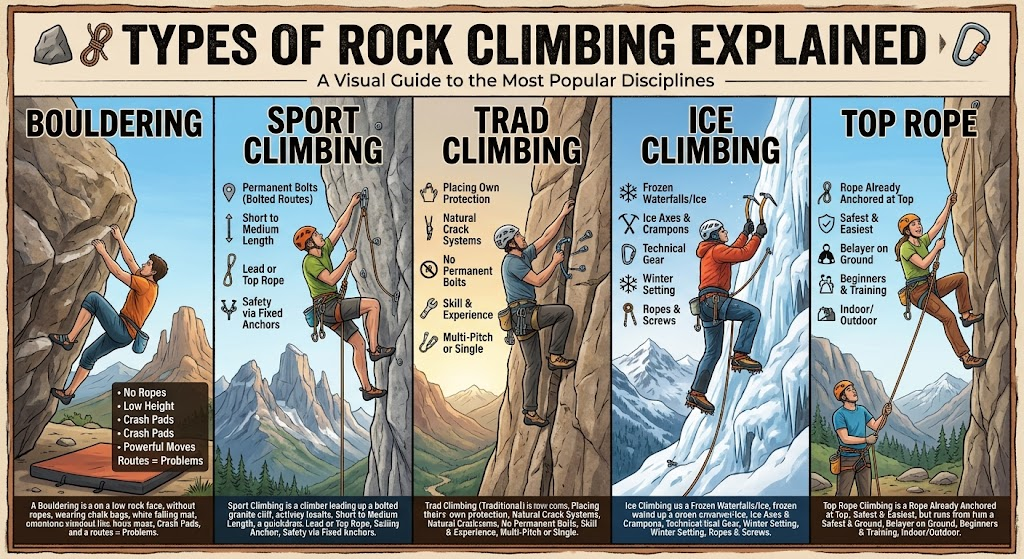
Types of Rock Climbing Explained: Bouldering, Sport Climbing, Trad Climbing, Top-Rope, and More
One of the first things a new rock climber discovers is that rock climbing is not just one sport.
Bouldering, top-rope climbing, sport climbing, traditional climbing, lead climbing, multi-pitch climbing, aid climbing, free climbing, and free soloing are all different forms of climbing. They share the basic idea of moving upward or across rock using your hands and feet, but the experience, equipment, techniques, difficulty, and level of risk can be dramatically different.
That variety is one of the reasons climbing attracts such a wide range of people.
Someone who enjoys short, powerful movements may fall in love with bouldering. Someone who enjoys spending hours outside may prefer traditional or multi-pitch climbing. Another climber may enjoy the structured environment of a climbing gym and never feel the need to climb outdoors at all.
There is no single “correct” way to climb.
The important thing is understanding the differences so you can choose activities that match your interests, experience, and training.
If you are completely new to climbing, The Ultimate Beginner’s Guide to Rock Climbing: Types, Equipment, Techniques, Safety, and How to Get Started provides the broader introduction to the sport. This article goes deeper into the major types of climbing and explains what makes each one unique.
What Is Rock Climbing?
Rock climbing is a sport and recreational activity in which participants use their hands, feet, body movement, and problem-solving skills to travel over rock surfaces.
Depending on the discipline, climbing can take place:
- Indoors
- On natural rock
- Close to the ground
- Hundreds of feet above the ground
- On short boulders
- On long multi-pitch routes
- In climbing gyms
- In mountains and alpine environments
Some forms rely heavily on ropes and protective equipment.
Others deliberately eliminate ropes and focus on climbing relatively low routes over protective landing surfaces.
Understanding that distinction is essential.
The Major Types of Rock Climbing
The most important forms of climbing beginners are likely to encounter include:
- Bouldering
- Top-rope climbing
- Lead climbing
- Sport climbing
- Traditional climbing
- Multi-pitch climbing
- Aid climbing
- Free climbing
- Free soloing
- Indoor climbing
- Outdoor climbing
- Alpine and mountaineering-related climbing
Some of these categories overlap.
For example, sport climbing is generally a form of lead climbing, while top-rope climbing describes how the rope is arranged rather than necessarily the type of rock or route being climbed.
That can make climbing terminology confusing at first.
Let’s break it down.
Bouldering
Bouldering is one of the simplest forms of climbing from an equipment standpoint.
Boulder problems are generally short and are climbed without ropes or harnesses.
Instead, climbers use crash pads and appropriate landing techniques to reduce the consequences of falls.
Bouldering can be performed:
- Indoors
- Outdoors
- On artificial climbing walls
- On natural boulders
Why Bouldering Is Popular
Bouldering has exploded in popularity partly because the equipment requirements are relatively simple.
A climber can often show up with:
- Climbing shoes
- Chalk
- Chalk bag or bucket
An outdoor boulderer may also carry a crash pad.
There is no need to manage a rope, belay partner, or complicated anchor system.
That simplicity makes bouldering an excellent introduction to climbing.
What Does Bouldering Feel Like?
Bouldering often involves short sequences of relatively intense movement.
A problem might require:
- Powerful pulling
- Precise footwork
- Balance
- Dynamic movement
- Flexibility
- Body tension
- Coordination
- Problem solving
You may work on the same problem repeatedly, trying different sequences until you discover a solution.
That problem-solving aspect is one of bouldering’s greatest attractions.
Is Bouldering Easy?
Not necessarily.
The routes are short, but difficult boulder problems can demand tremendous strength, technique, coordination, and body control.
Short does not mean easy.
A beginner may find a seemingly simple problem surprisingly difficult because climbing movement is very different from ordinary exercise.
Top-Rope Climbing
Top-rope climbing is one of the most common ways beginners learn roped climbing.
In a typical top-rope setup, the rope passes through an anchor above the climber and connects the climber to a belayer below.
Because the rope is already positioned above the climber, the amount of rope movement during a fall can be relatively limited compared with lead climbing.
Why Top-Rope Is Good for Beginners
Top-rope climbing allows beginners to concentrate on:
- Footwork
- Grip
- Balance
- Body position
- Route reading
- Movement
- Confidence
without immediately having to learn the additional skills associated with lead climbing.
Many climbing gyms use top-rope climbing as part of their introductory programs.
What Equipment Does Top-Rope Climbing Require?
Depending on the facility, you may use:
- Climbing shoes
- Harness
- Rope
- Belay device
- Carabiner
- Chalk
- Helmet for outdoor climbing
Indoor gyms frequently provide much of this equipment.
For a more detailed discussion of the gear itself, see Rock Climbing Equipment Guide: Shoes, Harnesses, Ropes, Chalk, Helmets, and Essential Gear.
Lead Climbing
Lead climbing changes the relationship between the climber and the rope.
Instead of having the rope already positioned through an anchor above the climber, the climber progressively connects the rope to protection while climbing upward.
Lead climbing requires additional skills.
A lead climber needs to understand:
- Clipping
- Rope management
- Protection
- Falling
- Communication
- Belaying a lead climber
- Route strategy
- Equipment systems
Lead climbing can be performed indoors or outdoors.
Why Do Climbers Move to Lead Climbing?
Top-rope climbing can be an excellent way to learn movement.
Lead climbing adds a new dimension.
The climber must manage both movement and the rope system while progressing up the route.
For many climbers, learning to lead represents an important milestone.
It can also open the door to sport climbing and other forms of outdoor climbing.
Sport Climbing
Sport climbing is generally a form of climbing in which the route has pre-installed protection points, commonly bolts, that the climber clips into while leading.
The climber generally carries quickdraws and clips them into the protection as they progress.
Sport climbing can be performed indoors or outdoors.
What Makes Sport Climbing Different?
Sport climbing places considerable emphasis on:
- Movement
- Endurance
- Route reading
- Clipping
- Managing falls
- Efficient positioning
- Pacing
Because the protection is already installed, the climber does not normally need to place traditional removable protection as they climb.
That does not make sport climbing risk-free.
Falls, rock conditions, equipment mistakes, weather, and other hazards remain important considerations.
Sport Climbing Indoors
Indoor sport climbing is a common way for climbers to learn lead climbing.
The environment is controlled compared with outdoor climbing.
Routes are clearly marked, protection is standardized, and the climbing surface is artificial.
This makes indoor lead climbing an accessible step for climbers who eventually want to climb outdoors.
Traditional Climbing
Traditional climbing, often called trad climbing, involves placing removable protection in the rock rather than relying exclusively on fixed bolts.
Trad climbers may use equipment such as:
- Nuts
- Cams
- Slings
- Carabiners
- Other removable protection
The climber places protection while ascending and removes it afterward.
Why Trad Climbing Is Different
Trad climbing adds a major technical component to the sport.
The climber must learn how to:
- Identify suitable placements
- Place protection correctly
- Evaluate rock quality
- Build anchors
- Manage rope systems
- Assess fall potential
- Manage equipment
- Understand route conditions
The equipment itself is only part of the challenge.
The ability to correctly evaluate whether a piece of protection is reliable is a skill that takes substantial practice.
Should Beginners Start With Trad Climbing?
Generally, beginners should not attempt to learn trad climbing independently.
The consequences of poor protection placement or poor anchor construction can be serious.
A safer path is to learn from qualified instructors and experienced climbers before relying on your own placements.
Trad climbing is rewarding, but it has a significant learning curve.
Multi-Pitch Climbing
Some climbing routes are much longer than a single rope length.
These routes are divided into sections called pitches.
Climbing several pitches to complete one route is known as multi-pitch climbing.
Multi-pitch climbing introduces challenges that do not exist to the same degree on short routes.
What Makes Multi-Pitch Climbing Different?
Climbers may need to manage:
- Multiple belays
- Anchors
- Rope organization
- Route finding
- Communication over distance
- Equipment transitions
- Weather
- Time
- Rappelling or descending
- Exposure
The climbers are not simply climbing higher.
They are managing an entire climbing system over a much longer period.
Multi-Pitch Climbing Is About More Than Height
A multi-pitch route can be technically moderate while still being demanding because of:
- Length
- Exposure
- Navigation
- Weather
- Retreat options
- Communication
- Logistics
This is one reason climbing grades alone do not tell the entire story.
Aid Climbing
Aid climbing is a specialized form of climbing in which climbers use equipment to help ascend rather than relying solely on their hands and feet to climb the rock naturally.
Equipment may include specialized devices and protection used to support upward progress.
Aid climbing is particularly associated with certain big-wall routes and situations where free climbing an entire section would be extremely difficult or impractical.
How Aid Climbing Differs From Free Climbing
In aid climbing, the equipment becomes part of the upward movement.
The climber may stand on specialized equipment or use protection to progress.
In free climbing, the equipment is primarily used for protection rather than as a means of upward progress.
That distinction is fundamental to climbing terminology.
Free Climbing
The term free climbing is frequently misunderstood.
Free climbing does not mean climbing without ropes.
Instead, it generally refers to climbing where the climber uses their hands and feet to make upward progress while the rope and protection are primarily there to protect against falls.
A free climber can still:
- Wear a harness
- Use a rope
- Clip protection
- Fall
- Be caught by the rope
The equipment is simply not being intentionally used as the primary means of upward movement.
Free Soloing
Free soloing is very different.
A free solo climber climbs without a rope or other protective climbing system.
This makes free soloing one of the most dangerous forms of climbing.
A fall from significant height can have catastrophic or fatal consequences.
Why Free Soloing Should Not Be Treated as Beginner Climbing
Free soloing requires an extremely high level of skill, experience, judgment, route familiarity, psychological control, and risk acceptance.
Even highly experienced climbers can be exposed to unpredictable hazards.
It is not simply:
“Free climbing without a rope.”
The consequences of mistakes are fundamentally different.
Beginners should not treat free soloing as an advanced challenge to work toward casually.
Indoor Climbing
Indoor climbing takes place in specially constructed facilities.
Modern climbing gyms may offer:
- Bouldering
- Top-rope climbing
- Lead climbing
- Training boards
- Fitness areas
- Instruction
- Youth programs
- Competitions
Indoor climbing is often the easiest way for someone to discover the sport.
Advantages of Indoor Climbing
Indoor climbing provides:
- Controlled conditions
- Consistent routes
- Instruction
- Rental equipment
- Easy access
- Climate-controlled environments
- A climbing community
- Opportunities to practice regularly
The environment makes it easier to focus on learning.
Outdoor Climbing
Outdoor climbing takes place on natural rock.
That creates an experience that is dramatically different from indoor climbing.
Outdoor climbers must consider:
- Weather
- Rock quality
- Route access
- Wildlife
- Falling rock
- Anchors
- Navigation
- Environmental impact
- Approach hikes
- Emergency planning
The rock itself is unpredictable in ways an indoor wall is not.
Outdoor Climbing Requires More Than Strong Climbing Skills
A climber can be excellent indoors and still be inexperienced outdoors.
Outdoor climbing requires additional knowledge.
For example, a climber must understand that a route does not come with the same controlled conditions found in a gym.
The environment becomes part of the challenge.
For that reason, transitioning outdoors should be approached as learning a new skill set rather than simply moving the same sport outside.
That transition is explored in Rock Climbing Outdoors: How to Transition From the Gym to Real Rock.
Alpine Climbing
Alpine climbing takes place in mountainous environments and can involve a combination of climbing, scrambling, snow travel, ice climbing, glacier travel, route finding, and mountaineering skills.
The exact nature of an alpine climb can vary enormously.
Some alpine routes may involve technical rock climbing.
Others may involve snow and ice.
Many involve a combination.
Why Alpine Climbing Is Particularly Complex
Alpine environments can introduce:
- Rapid weather changes
- Altitude
- Cold
- Rockfall
- Snow
- Ice
- Avalanche hazards
- Difficult descents
- Navigation challenges
- Long approaches
- Remote locations
The climbing itself may be only one part of the overall challenge.
Alpine climbing is therefore generally considered an advanced pursuit requiring specialized knowledge and preparation.
Big-Wall Climbing
Big-wall climbing involves climbing very large vertical or near-vertical faces, often over many pitches.
Some big-wall climbs take many hours or even multiple days.
Climbers may need:
- Extensive equipment
- Hauling systems
- Specialized anchors
- Food and water
- Sleeping systems
- Advanced rope management
- Route-finding skills
Big-wall climbing combines technical climbing with significant logistical challenges.
Competition Climbing
Competition climbing is another branch of the sport.
Modern climbing competitions commonly include:
- Bouldering
- Lead
- Speed climbing
Each discipline tests different skills.
Competition Bouldering
Competition bouldering emphasizes short climbing problems.
Competitors may have a limited amount of time to solve problems.
Success depends on:
- Strength
- Technique
- Power
- Coordination
- Reading the problem
- Efficient attempts
- Mental control
Competition Lead
Competition lead climbing generally involves climbing a difficult route while progressively clipping protection.
The objective is generally to climb as high as possible within the competition rules and time constraints.
Lead competition places enormous demands on:
- Endurance
- Technique
- Route reading
- Power management
- Mental focus
Speed Climbing
Speed climbing is different from traditional climbing competitions.
The objective is to complete a standardized route as quickly as possible.
This makes speed climbing highly specialized.
A climber who excels at speed may have a very different skill profile from a climber specializing in difficult bouldering problems.
Understanding the Difference Between Climbing Style and Rope Technique
One reason climbing terminology becomes confusing is that several terms describe different aspects of climbing.
For example:
Top-rope describes how the rope is arranged.
Lead describes how the climber progresses with the rope and protection.
Sport describes a style involving fixed protection.
Trad describes a style involving removable protection.
These categories can overlap.
A climber can therefore be:
- Indoor
- Sport
- Lead
all at the same time.
Likewise, someone outdoors could be:
- Trad
- Lead
- Multi-pitch
Understanding this makes climbing terminology much easier.
Comparing the Major Types of Climbing
| Type | Rope Usually Used? | Main Protection | Typical Environment | General Experience |
|---|---|---|---|---|
| Bouldering | No | Crash pads | Indoor/outdoor | Short, powerful problems |
| Top-rope | Yes | Rope/anchor | Indoor/outdoor | Controlled roped climbing |
| Lead | Yes | Protection placed along route | Indoor/outdoor | More complex rope management |
| Sport | Yes | Fixed bolts | Indoor/outdoor | Route-focused roped climbing |
| Trad | Yes | Removable protection | Outdoor | Technical and adventure-oriented |
| Multi-pitch | Yes | Fixed/removable systems | Outdoor | Long, complex routes |
| Aid | Yes | Specialized protection | Mostly advanced routes | Equipment-assisted climbing |
| Free climbing | Usually | Rope/protection | Indoor/outdoor | Natural movement with protection |
| Free solo | No | None | Outdoor | Extremely high consequence |
| Speed | Varies | Competition system | Usually indoor | Maximum speed |
The table provides a general comparison, but climbing systems vary by route, facility, and discipline.
Which Type of Climbing Is Best for Beginners?
For most people, the easiest entry points are:
Indoor Bouldering
Good for someone who wants:
- Simple equipment
- Short sessions
- Problem solving
- No rope management
Indoor Top-Rope
Good for someone who wants:
- A rope
- Longer routes
- Instruction
- A more traditional climbing experience
Both can be excellent.
The better choice depends on your personality.
Bouldering vs. Top-Rope for Beginners
This is one of the most common decisions new climbers face.
Choose Bouldering If You Like:
- Short challenges
- Independent problem solving
- Powerful movement
- Minimal equipment
- Frequent attempts
- Staying relatively close to the ground
Choose Top-Rope If You Like:
- Longer routes
- Height
- Partner-based climbing
- Learning rope skills
- Gradual progression
- A more traditional climbing experience
There is no reason you cannot do both.
Many climbers enjoy both styles.
Sport Climbing vs. Trad Climbing
These two disciplines can look similar from a distance because both involve ropes and outdoor rock.
The biggest difference is how protection is handled.
Sport Climbing
Protection is generally already installed.
The climber clips into fixed protection.
The focus is often on:
- Movement
- Endurance
- Route reading
- Clipping
- Performance
Trad Climbing
The climber places removable protection.
The focus includes:
- Protection placement
- Rock assessment
- Anchor systems
- Rope management
- Route finding
- Movement
Trad therefore introduces a substantial additional technical component.
Indoor vs. Outdoor Climbing
Another important distinction is where the climbing occurs.
Indoor Climbing
Advantages include:
- Accessibility
- Controlled conditions
- Consistent routes
- Instruction
- Easy equipment rental
- Year-round climbing
Outdoor Climbing
Advantages include:
- Natural rock
- Scenery
- Adventure
- Greater variety
- Unique routes
- A connection with the natural environment
But outdoor climbing also introduces additional responsibilities and hazards.
A climber should understand Rock Climbing Safety: Essential Rules, Common Hazards, Risk Management, and How Climbers Stay Safe before treating outdoor climbing as simply “indoor climbing outside.”
Why Climbing Grades Can Be Confusing
Different climbing disciplines use different grading systems.
In the United States, many roped routes use the Yosemite Decimal System, while bouldering commonly uses the V-scale.
Other regions use different systems.
A grade is intended to communicate difficulty, but grades should not be treated as absolute measurements.
A route’s difficulty can be affected by:
- Wall angle
- Hold type
- Movement style
- Height
- Rock type
- Conditions
- Individual strengths
- Route-setting style
Two routes with the same grade can feel completely different.
The Difference Between a Route and a Problem
This terminology is especially useful for beginners.
A route generally refers to a climbing line that is longer and may involve a rope.
A boulder problem is generally a shorter climbing challenge without a rope.
Climbers may still casually use the word “problem” in other contexts, but bouldering commonly uses this terminology.
Flashing, Onsighting, Redpointing, and Projecting
As you become more involved in climbing, you will encounter additional terms describing how a route is completed.
Flash
A climber completes a route on the first serious attempt with some prior information or knowledge about it.
Onsight
A climber completes a route on the first attempt without prior attempts or substantive beta, depending on the precise climbing context and terminology being used.
Redpoint
A climber successfully leads a route from the ground without falling or weighting the rope after having previously worked on it.
Projecting
A climber repeatedly works on a route or problem that they cannot yet complete.
Projecting is a major part of climbing culture.
A route does not have to be completed on the first try to be valuable.
Which Type of Climbing Requires the Most Strength?
There is no simple answer.
Different disciplines emphasize different physical abilities.
Bouldering can demand significant:
- Power
- Finger strength
- Core tension
- Coordination
Long sport routes may emphasize:
- Endurance
- Power endurance
- Efficiency
Trad climbing can demand:
- Endurance
- Technique
- Efficient movement
- Mental control
- Technical rope skills
Speed climbing requires:
- Explosive power
- Coordination
- Precision
- Timing
Strong climbers generally develop multiple physical and technical qualities rather than relying on one attribute.
Which Type of Climbing Is Most Dangerous?
It is tempting to rank climbing disciplines from safest to most dangerous, but the reality is more complicated.
Risk depends on:
- Height
- Equipment
- Route
- Environment
- Skill
- Conditions
- Protection
- Decision-making
- Experience
Free soloing is inherently associated with extremely high consequences because there is no rope protection.
But even conventional roped climbing can involve serious hazards.
Bouldering can also cause injuries, particularly from awkward landings.
The lesson is not that one discipline is automatically safe.
The lesson is that risk management changes from one type of climbing to another.
How Climbers Move From One Discipline to Another
Climbers often explore several disciplines over time.
A common progression might look like:
Indoor bouldering → indoor top-rope → indoor lead → outdoor sport climbing → specialized climbing
Another climber might take a different path.
For example:
Indoor climbing → outdoor top-rope → outdoor sport climbing → multi-pitch climbing
Someone interested in traditional climbing might follow:
Indoor climbing → outdoor climbing with experienced partners → sport climbing → trad instruction → traditional climbing
There is no mandatory progression.
Experience, instruction, goals, and opportunities all influence the path.
Why You Shouldn’t Rush Into Advanced Disciplines
One of the most appealing aspects of climbing is that there is always another challenge.
But that can also encourage people to move too quickly.
A climber who has mastered difficult indoor routes may still lack the skills required for outdoor climbing.
A strong sport climber may still need extensive training before climbing trad.
A talented boulderer may not automatically know how to manage a rope system.
Physical ability and technical knowledge are separate things.
Respect that distinction.
Choosing a Climbing Discipline Based on Your Personality
Your personality can actually provide clues about what you might enjoy.
If You Like Puzzles
Try bouldering.
If You Like Endurance Challenges
Try sport climbing.
If You Like Adventure
Explore outdoor climbing.
If You Like Technical Systems
Trad or multi-pitch climbing may eventually appeal to you.
If You Like Competition
Explore competition bouldering, lead, or speed climbing.
If You Like Mountains
Alpine climbing may eventually become interesting.
You do not have to choose permanently.
One of climbing’s great advantages is that you can move between disciplines.
Equipment Changes With the Discipline
The type of climbing you choose will determine much of your equipment.
A boulderer may primarily need:
- Shoes
- Chalk
- Crash pad outdoors
A top-rope climber may add:
- Harness
- Rope system
- Belay equipment
A sport climber may need:
- Rope
- Harness
- Helmet
- Quickdraws
- Belay device
- Carabiners
A trad climber may need:
- Protection
- Additional slings
- Carabiners
- Anchor equipment
- More extensive rope systems
For a detailed equipment breakdown, see Rock Climbing Equipment Guide: Shoes, Harnesses, Ropes, Chalk, Helmets, and Essential Gear.
Technique Changes With the Discipline
Equipment isn’t the only difference.
The movement itself changes.
Bouldering often emphasizes short, powerful sequences.
Sport climbing may require sustained movement over longer routes.
Trad climbing adds the challenge of placing protection while managing movement and rope.
Multi-pitch climbing introduces efficiency, communication, anchors, and route management.
Speed climbing demands explosive movement and precision.
This means becoming good at one discipline does not automatically make you an expert in every other discipline.
What About Climbing Walls That Don’t Look Like Rock?
Indoor climbing gyms use artificial structures designed to reproduce some of the challenges of natural climbing.
Walls may include:
- Vertical sections
- Overhangs
- Slabs
- Roofs
- Volumes
- Artificial holds
- Training boards
Indoor route setters can create movement patterns that challenge different abilities.
This is one reason indoor climbing can be so effective for training.
Slab Climbing
Slab climbing involves climbing a surface that is less steep than vertical.
It may look easy to a beginner.
It often isn’t.
Slab climbing emphasizes:
- Footwork
- Balance
- Precision
- Body positioning
- Friction
- Confidence
The climber may not be able to rely heavily on pulling.
Instead, careful foot placement becomes critical.
Overhanging Climbing
Overhanging climbing occurs on terrain that angles significantly away from the climber.
Overhangs often demand:
- Upper-body strength
- Core tension
- Powerful movement
- Efficient footwork
- Body positioning
Overhangs can be physically exhausting.
But technique remains extremely important.
A climber who learns to keep their body positioned efficiently can conserve enormous amounts of energy.
Crack Climbing
Crack climbing involves climbing cracks in the rock rather than primarily relying on conventional face holds.
Depending on the crack, climbers may use techniques involving:
- Hands
- Fingers
- Feet
- Fists
- Arms
- Legs
- Specialized body positioning
Crack climbing can be particularly technical and may be associated with traditional climbing.
It is another example of how rock type can fundamentally change climbing technique.
Why Rock Type Matters
Natural rock is not uniform.
Different types of rock create different climbing experiences.
You may encounter:
- Granite
- Limestone
- Sandstone
- Basalt
- Volcanic rock
- Other geological formations
Each can produce different combinations of:
- Cracks
- Edges
- Pockets
- Slopers
- Features
- Friction
- Angles
A climber who is excellent on one type of terrain may initially struggle on another.
That is normal.
The Mental Side of Different Climbing Disciplines
Physical ability is only part of climbing.
Different disciplines create different psychological challenges.
Bouldering can involve frustration when you repeatedly fail a short sequence.
Lead climbing can introduce fear of falling.
Outdoor climbing can create exposure and uncertainty.
Trad climbing can require confidence in protection placement.
Multi-pitch climbing can test patience, communication, and decision-making.
Alpine climbing can involve serious consequences and changing environmental conditions.
Mental skills therefore develop alongside physical skills.
There Is No “Best” Type of Rock Climbing
This may be the most important takeaway.
There is no universally superior climbing discipline.
Bouldering isn’t better than sport climbing.
Sport climbing isn’t better than trad.
Indoor climbing isn’t somehow less legitimate than outdoor climbing.
Each form offers a different experience.
The best type of climbing is the one that:
- You enjoy
- Fits your goals
- Matches your experience
- Fits your environment
- You can practice responsibly
- Keeps you motivated to improve
A Simple Road Map for a New Climber
If you are completely new, you do not need to decide your entire climbing future today.
Start indoors.
Try bouldering.
Try top-rope climbing.
See what you enjoy.
Learn basic movement.
Build experience.
Then explore additional disciplines gradually.
If lead climbing interests you, take appropriate instruction.
If outdoor climbing interests you, go with experienced climbers or qualified guides.
If trad climbing interests you, learn protection and anchor systems properly before relying on them.
If competition interests you, explore gym competitions.
Let your interests determine your direction.
Frequently Asked Questions About Types of Rock Climbing
What is the easiest type of rock climbing for beginners?
Indoor bouldering and indoor top-rope climbing are commonly accessible starting points. Both allow beginners to learn climbing movement without immediately taking on the complexity of advanced outdoor climbing.
What is the difference between bouldering and rock climbing?
Bouldering is a type of rock climbing performed without ropes, generally on shorter routes. “Rock climbing” is the broader category that includes bouldering and numerous roped disciplines.
Is sport climbing the same as lead climbing?
Not exactly. Lead climbing describes how the climber manages the rope while ascending, whereas sport climbing generally refers to climbing routes protected by fixed bolts. Sport climbing is commonly performed as lead climbing.
Is trad climbing harder than sport climbing?
It can be, particularly because trad climbing requires additional skills involving protection placement, anchors, route assessment, and equipment management. Technical difficulty varies from route to route.
Is indoor climbing real rock climbing?
Yes. Indoor climbing uses artificial walls rather than natural rock, but it develops many of the same movement, strength, coordination, and problem-solving skills used outdoors.
What is free climbing?
Free climbing generally means using natural climbing movement to make upward progress while ropes and protection are used primarily for protection rather than as climbing aids.
What is free soloing?
Free soloing is climbing without a rope or other protective climbing system. Because falls can have extremely serious consequences, it is an advanced and exceptionally high-risk activity.
Can I try multiple types of climbing?
Absolutely. Many climbers participate in several disciplines. Trying different styles can actually help you discover which aspects of climbing you enjoy most.
Do I need to learn outdoor climbing immediately?
No. There is no need to rush outdoors. Indoor climbing can provide years of enjoyable climbing and training.
Which type of climbing is best for getting stronger?
Different disciplines develop different qualities. Bouldering can be excellent for power and strength, while longer sport routes can emphasize endurance. A balanced climbing program can develop multiple abilities.
Final Thoughts
Rock climbing is better understood as a family of related disciplines rather than one single activity.
Bouldering offers short, challenging problems.
Top-rope climbing provides a controlled introduction to climbing with ropes.
Lead climbing adds rope management and protection.
Sport climbing combines lead climbing with fixed protection.
Trad climbing adds the technical challenge of placing removable protection.
Multi-pitch climbing turns climbing into a longer, more complex adventure.
Aid climbing uses specialized equipment to assist upward progress.
Free climbing describes how equipment is used rather than whether a rope is present.
Free soloing removes the protective rope system altogether and carries exceptionally serious consequences.
Indoor climbing offers a controlled environment for learning and training.
Outdoor climbing introduces natural rock, weather, terrain, access issues, and additional hazards.
Competition climbing tests specialized athletic abilities.
Alpine and big-wall climbing add even more complexity.
The important thing for a beginner is not to master all of these disciplines.
It is to discover which aspects of climbing appeal to you and then develop your skills gradually.
Start with an accessible form of climbing. Learn good movement. Understand your equipment. Take instruction when you move into new disciplines. Respect the risks. And don’t confuse physical strength with technical experience.
As you progress, you may find that the climbing discipline you initially expected to love isn’t the one that ultimately captures your attention.
That’s perfectly fine.
Climbing gives you plenty of opportunities to explore.
And once you know what type of climbing interests you, the next step is learning how to actually move efficiently on the wall. Rock Climbing Techniques: Footwork, Grip, Body Position, Balance, and Efficient Movement takes a closer look at the skills that separate simply getting up a wall from becoming an efficient climber.



1 Response
[…] if you’re still getting familiar with the different disciplines, Types of Rock Climbing Explained: Bouldering, Sport Climbing, Trad Climbing, Top-Rope, and More explains how techniques can change depending on the type of climbing you […]