
Cornhole Scoring Rules: How Points Work and How to Win Games Faster
Cornhole Scoring Rules: How Points Work and How to Win Games Faster
Cornhole looks like a simple backyard game. Players toss small bags toward a board with a hole, hoping to score points. However, once you start playing regularly, the scoring system becomes more interesting than many beginners expect.
Understanding cornhole scoring rules can dramatically improve your results. Many casual players lose games simply because they misunderstand how points work. Others miss strategic opportunities because they focus only on getting bags into the hole.
In reality, scoring in cornhole involves strategy, math, and smart decision-making. The cancellation scoring system rewards consistency and defensive play just as much as big scoring throws.
This complete guide explains how cornhole scoring works, including the official point system, cancellation scoring, advanced scoring situations, and strategies that help players win games faster.
By the end, you will understand exactly how every bag affects the score and how to use that knowledge to gain a competitive advantage.
The Basic Cornhole Scoring System
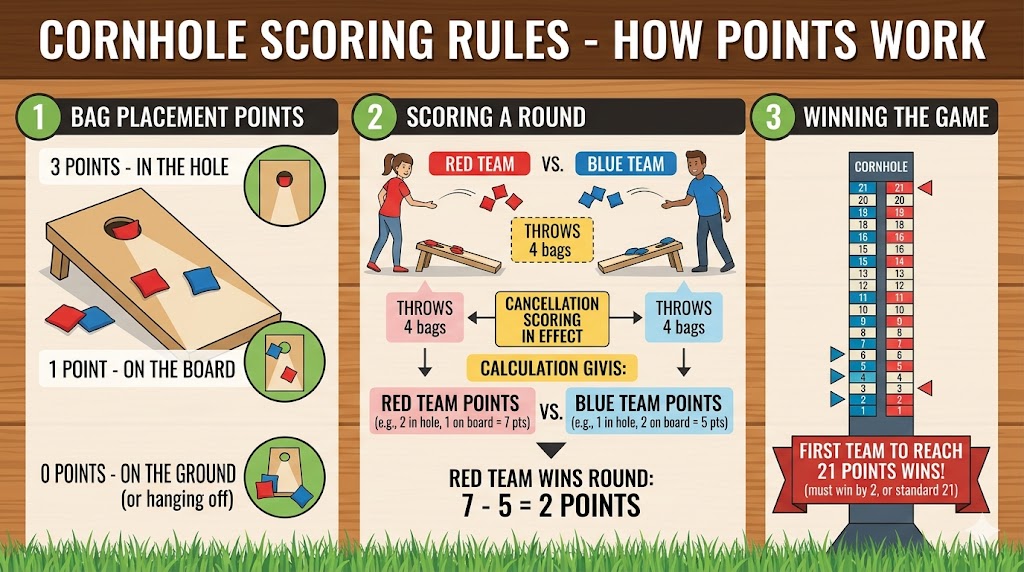
Cornhole scoring follows a simple point structure. Every thrown bag earns one of three possible outcomes.
Each bag scores:
- 3 points if it goes through the hole
- 1 point if it lands on the board and stays there
- 0 points if it misses the board or slides off
Although these values look simple, the way they combine during each round makes the game more strategic.
Players must consider how their bags interact with opponents’ bags and how the cancellation system affects the final score.
What Is a Cornhole?
In cornhole terminology, a bag that goes through the hole is called a cornhole.
Each cornhole scores 3 points.
This throw represents the highest scoring play in the game.
Competitive players aim to land multiple cornholes during a round because several successful throws can produce large scoring swings.
However, experienced players understand that consistency often matters more than occasional perfect shots.
What Is a Woody?
A bag that lands on the board and stays there scores 1 point.
Players call this result a woody.
Although a woody scores fewer points than a cornhole, it still plays an important role in scoring strategy.
Board bags can:
- Block the hole
- Push other bags forward
- Protect your scoring position
Because of these benefits, many experienced players intentionally aim for the board instead of the hole.
Bags That Score Zero Points
Not every throw produces points.
A bag scores zero points if it:
- Lands on the ground
- Slides completely off the board
- Hits the ground before landing on the board
These bags are removed from play at the end of the round.
Zero-point throws create opportunities for opponents to gain scoring advantages.
Therefore, minimizing missed throws becomes one of the most important skills in cornhole.
Understanding Cancellation Scoring
Cornhole uses a cancellation scoring system.
This system differs from many sports because both teams may score during the same round, but only the difference between the scores counts.
This rule keeps games competitive and prevents scoring from escalating too quickly.
How Cancellation Scoring Works
At the end of each round, both teams add their points.
Then the lower score gets subtracted from the higher score.
Only the difference becomes the official score for that round.
Example of Cancellation Scoring
Consider this situation.
Team A throws:
- 2 bags in the hole = 6 points
- 1 bag on the board = 1 point
Total = 7 points
Team B throws:
- 1 bag in the hole = 3 points
- 2 bags on the board = 2 points
Total = 5 points
Now apply cancellation scoring:
7 – 5 = 2 points for Team A
Only Team A receives points for the round.
This system prevents both teams from scoring at the same time.
Why Cancellation Scoring Is Important
Cancellation scoring changes how players approach the game.
In many sports, the goal simply involves scoring as many points as possible.
Cornhole requires a more thoughtful approach.
Sometimes preventing your opponent from scoring becomes just as valuable as scoring yourself.
For example, a defensive throw that blocks the hole might reduce your opponent’s score by several points.
This defensive mindset plays a major role in competitive cornhole strategy.
The Score Needed to Win
Most cornhole games end when a team reaches 21 points.
The first team to reach or exceed 21 wins the match.
However, many leagues require teams to win by two points.
This rule prevents games from ending on lucky final throws.
For example:
- 21–19 ends the game
- 21–20 requires another round
Win-by-two rules make competitive matches more exciting.
What Happens When Both Teams Score the Same Points?
Occasionally, both teams finish a round with identical scores.
When this happens, cancellation scoring removes all points.
The round becomes a wash.
No team receives points, and the scoreboard remains unchanged.
However, the team that threw first in the previous round continues to throw first in the next round.
Although no points appear on the scoreboard, these rounds still influence momentum and strategy.
Hanging Bags and Their Scoring
Sometimes a bag lands partially over the hole.
Players often call this a hanger.
If any part of the bag hangs over the hole without touching the ground, it counts as 1 point while resting on the board.
However, if the bag eventually drops through the hole during the round, it becomes a 3-point cornhole.
These unpredictable moments often create dramatic swings in scoring.
Bags That Get Knocked Into the Hole
Cornhole bags frequently collide with each other.
A thrown bag may strike another bag and push it into the hole.
When this happens, the pushed bag still counts as a 3-point cornhole.
This rule creates opportunities for powerful scoring rounds.
Experienced players intentionally use push shots to score multiple points with one throw.
Bags Knocked Off the Board
The opposite situation can also occur.
A thrown bag might knock an opponent’s bag off the board.
When this happens, the removed bag scores zero points.
This defensive play can dramatically change the scoring outcome of a round.
For example, knocking off two opponent bags could reduce their score by two points while improving your own scoring position.
Bounce Bags and Invalid Scoring
Sometimes a bag hits the ground before bouncing onto the board.
Official rules consider this an invalid bag.
These bags must be removed from the playing surface before the next throw.
They do not score points even if they remain on the board afterward.
Removing bounce bags ensures fairness and prevents accidental scoring advantages.
Example of a Full Cornhole Round
Understanding scoring becomes easier when you see a complete round example.
Team A Throws
- Bag 1: Board (1 point)
- Bag 2: Hole (3 points)
- Bag 3: Miss (0 points)
- Bag 4: Board (1 point)
Total = 5 points
Team B Throws
- Bag 1: Hole (3 points)
- Bag 2: Board (1 point)
- Bag 3: Board (1 point)
- Bag 4: Miss (0 points)
Total = 5 points
Apply cancellation scoring:
5 – 5 = 0
This round becomes a wash.
Neither team scores.
How Scoring Strategy Wins Games
Many beginners chase only the 3-point hole shots.
However, experienced players focus on controlling the board.
Consistent 1-point throws often outperform risky attempts at cornholes.
A player who lands four board bags scores 4 points.
Meanwhile, a player who attempts four aggressive throws might hit only one cornhole and miss the rest.
That player scores 3 points, which is actually worse.
Because of this math, consistency often beats aggression.
Defensive Scoring Strategies
Defense plays a major role in cornhole scoring.
Sometimes the best scoring decision involves preventing the opponent from scoring.
Blocking the Hole
Landing a bag directly in front of the hole blocks the easiest scoring path.
Opponents must either:
- Throw around the bag
- Push through it
- Attempt a difficult airmail shot
This strategy reduces their scoring chances.
Board Control
Filling the center of the board creates obstacles.
Opponents now face crowded throwing lanes.
This congestion leads to mistakes and missed shots.
Strong board control often wins competitive games.
Offensive Scoring Strategies
Although defense matters, strong offensive play still drives victories.
The Push Shot
A push shot lands on another bag and drives both bags forward.
If executed properly, both bags may fall into the hole.
This shot can turn one throw into six points.
The Airmail Shot
The airmail throw sends the bag directly into the hole without touching the board.
Players often use this shot when the hole becomes blocked.
Although difficult, successful airmail shots produce dramatic scoring swings.
Score Awareness During a Game
Experienced players constantly track the score during a match.
This awareness influences every throwing decision.
For example:
- If your team leads comfortably, defensive throws become more valuable.
- If your team trails late in the game, aggressive cornhole attempts may become necessary.
Understanding the score helps players choose the smartest shot for each situation.
The Importance of Consistency
Consistency remains the most important factor in cornhole scoring.
Players who regularly land bags on the board build steady scoring pressure.
This pressure forces opponents to attempt riskier throws.
Over time, consistent players win more games simply because they make fewer mistakes.
Practicing controlled, repeatable throws dramatically improves scoring reliability.
How Professional Players Approach Scoring
Professional cornhole players treat scoring like a chess match.
Every bag serves a purpose.
Sometimes they aim for the hole.
Other times they deliberately block the hole or position bags strategically.
Professional matches often feature rounds where both teams score multiple cornholes.
However, even elite players rely heavily on defensive positioning.
Strategic scoring decisions separate champions from casual competitors.
Common Beginner Scoring Mistakes
New players often misunderstand several scoring situations.
Recognizing these mistakes helps you avoid them.
Ignoring Cancellation Scoring
Some beginners think both teams add their full points each round.
This misunderstanding leads to incorrect scorekeeping.
Chasing the Hole Too Often
Beginners often aim only for the hole.
However, missed shots frequently score zero points.
Consistent board shots usually produce better scoring results.
Forgetting Bag Interactions
Players sometimes forget that bags can push or remove other bags.
Using these interactions strategically can produce major scoring advantages.
Practicing Scoring Awareness
You can improve scoring skills even during practice sessions.
Instead of simply throwing bags, simulate real rounds.
Track scores and apply cancellation scoring after each set of throws.
This practice helps you develop instinctive scoring awareness.
Eventually, you will recognize scoring opportunities during live games without needing to think about the math.
Why Scoring Knowledge Improves Strategy
Understanding the scoring system unlocks smarter gameplay.
Players who know how scoring works can:
- Protect leads
- Create scoring swings
- Limit opponent opportunities
- Manage risk more effectively
These strategic advantages often matter more than raw throwing ability.
A slightly less accurate player with better strategy can still win games.
Final Thoughts on Cornhole Scoring Rules
Cornhole scoring rules may look simple at first glance. Bags on the board score one point, bags in the hole score three points, and missed throws score zero.
However, the cancellation scoring system transforms those basic numbers into a deeper strategic challenge.
Players must consider not only their own throws but also how those throws interact with opponents’ bags and how each round affects the overall score.
When beginners understand these scoring mechanics, they start making smarter decisions during games.
They block holes, push bags strategically, and focus on consistent board placement instead of risky throws.
Mastering scoring awareness takes time, but it dramatically improves your chances of winning.
Once you combine scoring knowledge with solid throwing technique, you begin to see why cornhole has grown into one of the most competitive backyard sports in the world.
Additional Cornhole Articles
- Official Cornhole Rules Explained: A Complete Guide for Beginners
- Cornhole Equipment Guide: Boards, Bags, and Court Setup Explained
- How to Throw a Cornhole Bag Like a Pro: Techniques and Form Tips
- Winning Cornhole Strategies: Offensive and Defensive Tactics That Work
- Common Cornhole Mistakes Beginners Make and How to Fix Them
- How to Build a Backyard Cornhole Court: Layout, Distance, and Setup
- Cornhole Tournaments and Leagues: How Competitive Cornhole Works