
Rock Climbing Equipment Guide
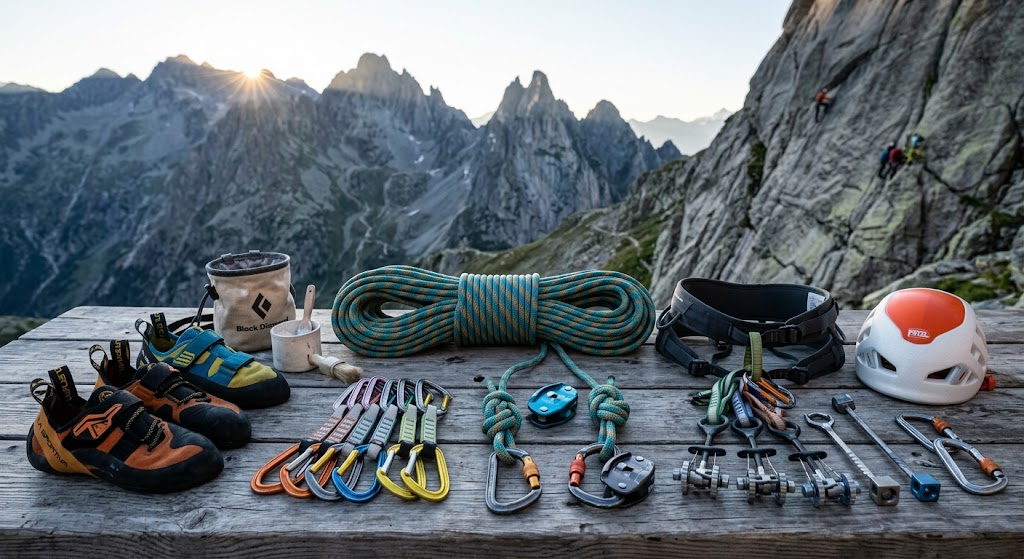
but beginners often discover something surprising: you do not need to buy a truckload of climbing gear to get started.
A climbing gym can provide much of what a new climber needs. Rental shoes, harnesses, chalk, and other equipment make it possible to try the sport before spending significant money. As your experience grows, however, owning your own equipment can make climbing more comfortable, convenient, and personalized.
The challenge is knowing what to buy, when to buy it, and how to choose equipment that actually matches the kind of climbing you want to do.
A pair of climbing shoes that works beautifully for an experienced boulderer may be completely unnecessary for someone taking their first climbing lesson. Likewise, a trad climber needs an equipment collection that is dramatically different from what an indoor boulderer carries to the gym.
This guide explains the major categories of rock climbing equipment, what each item does, how equipment differs among climbing disciplines, and how beginners can avoid wasting money on gear they do not yet need.
If you are completely new to climbing, you may also want to begin with Rock Climbing for Beginners: How to Start, What to Expect, and Your First Climbing Experience, which explains what your first climbing session is actually like.
Why Rock Climbing Equipment Matters
Climbing equipment serves several different purposes.
Some equipment helps you climb better.
Some equipment protects you when something goes wrong.
Some equipment allows you to climb in a particular discipline.
And some equipment simply makes climbing more comfortable.
Understanding those differences is important because climbing equipment is not one-size-fits-all.
A person who spends most of their time bouldering might own climbing shoes, chalk, a chalk bag, and a crash pad.
A top-rope climber might add a harness and belay device.
A sport climber who climbs outdoors may need a rope, helmet, belay device, locking carabiners, quickdraws, and additional equipment.
A traditional climber may carry substantially more gear, including removable protection and equipment for building anchors.
That means the first question should not be:
“What climbing gear should I buy?”
The better question is:
“What kind of climbing am I going to do?”
Your answer determines almost everything else.
The Basic Rock Climbing Equipment Every Beginner Should Know
Although climbing disciplines require different equipment, several items appear again and again.
The most familiar pieces include:
- Climbing shoes
- Harness
- Climbing rope
- Chalk
- Chalk bag
- Helmet
- Belay device
- Carabiners
- Quickdraws
- Slings
- Climbing protection
- Crash pads
- Appropriate clothing
- Gear bags
Not every climber needs every item.
In fact, buying everything immediately is one of the most common equipment mistakes beginners make.
Let’s examine each category.
Climbing Shoes
Climbing shoes are probably the first piece of equipment most new climbers think about purchasing.
They are also one of the most important.
Climbing shoes are specifically designed to help your feet interact with climbing holds and rock surfaces. Unlike ordinary athletic shoes, they have specialized rubber soles and a close-fitting construction designed to improve precision.
Why Climbing Shoes Are Different
A climbing shoe allows you to:
- Stand on small footholds
- Edge on narrow surfaces
- Smear against rock
- Maintain better contact with holds
- Place your feet more precisely
- Transfer your body weight through your feet
Good climbing technique depends heavily on your feet.
Beginners sometimes assume climbing is mostly about pulling with the arms. In reality, learning to use your feet effectively is one of the biggest breakthroughs a new climber can make.
That is why proper climbing shoes matter.
Should Beginners Buy Climbing Shoes?
Not necessarily.
If you are attending your first few sessions at a climbing gym, rental shoes are perfectly reasonable.
Renting lets you determine:
- Whether you actually enjoy climbing
- What type of climbing you prefer
- How frequently you intend to climb
- What shoe characteristics you like
- What size and shape work for your feet
Once you know you want to continue climbing, buying your own shoes makes more sense.
How Should Climbing Shoes Fit?
Climbing shoes should fit closely, but pain is not a requirement for good climbing.
There is a persistent misconception that climbing shoes should be brutally tight.
That is not necessarily true.
Different climbing styles and shoe designs call for different fits.
Beginners generally benefit from a snug, secure fit that does not allow excessive movement inside the shoe while remaining manageable enough to wear during an entire climbing session.
Your toes should be positioned securely without being subjected to unnecessary pain.
A shoe that is so uncomfortable that you cannot concentrate on climbing is not helping you.
Neutral vs. Aggressive Climbing Shoes
Climbing shoes generally range from relatively flat, neutral designs to strongly downturned aggressive models.
Neutral Shoes
Neutral shoes are often excellent choices for beginners.
They tend to be:
- More comfortable
- Better suited to longer sessions
- Versatile
- Easier to wear for extended periods
They work well for many forms of indoor climbing and general climbing.
Aggressive Shoes
Aggressive shoes have a more pronounced downturn.
They are designed for specialized performance, particularly on certain steep routes and difficult footholds.
They can be extremely useful for experienced climbers, but beginners usually do not need them.
Buying the most aggressive shoe available does not automatically make someone a better climber.
Technique matters far more.
Harnesses
A climbing harness connects the climber to the rope system.
Harnesses are essential for many forms of roped climbing but are unnecessary for bouldering.
A climbing harness typically includes:
- Waist belt
- Leg loops
- Buckles
- Gear loops
- Tie-in points
The exact design varies by manufacturer and intended use.
When Do You Need a Harness?
You generally need a harness for climbing activities involving a rope attachment to the climber.
Examples include:
- Top-rope climbing
- Lead climbing
- Sport climbing
- Traditional climbing
- Multi-pitch climbing
- Many forms of outdoor roped climbing
You do not wear a harness for normal bouldering.
How Should a Harness Fit?
A climbing harness should fit securely around your waist and legs according to the manufacturer’s instructions.
It should not be excessively loose.
You should always understand how the harness buckles and how it is intended to be worn before climbing.
A climbing gym instructor can teach a beginner how to put on and check a harness correctly.
This is one area where guessing is a bad idea.
Rental Harnesses vs. Buying Your Own
Rental harnesses are completely reasonable for beginners.
If you regularly climb at a gym, however, purchasing your own harness can provide:
- Better personal fit
- Familiarity
- Convenience
- Easier equipment management
Harnesses are relatively affordable compared with some other climbing equipment, so they are often among the first pieces of personal gear a regular climber purchases.
Climbing Ropes
Ropes are among the most important safety components in roped climbing.
But there is an important distinction:
A boulderer does not need a climbing rope.
A top-rope, sport climber, or other roped climber may.
Climbing ropes are specially manufactured for climbing applications and are not interchangeable with ordinary rope.
Never substitute hardware-store rope, utility cord, or another improvised material for climbing equipment.
Dynamic vs. Static Rope
Climbing ropes come in different categories.
Dynamic Rope
Dynamic ropes are designed to stretch under load.
That elasticity is extremely important in climbing because it helps absorb energy during a fall.
Dynamic ropes are commonly used for:
- Lead climbing
- Sport climbing
- Top-rope climbing
- Traditional climbing
Static and Low-Stretch Rope
Static or low-stretch ropes are designed for different applications.
They may be used for:
- Rappelling systems
- Rescue applications
- Ascending systems
- Certain specialized climbing tasks
They are not simply interchangeable with dynamic climbing ropes.
Beginners should learn which rope is appropriate for their particular climbing activity rather than assuming all climbing ropes are equivalent.
Rope Diameter and Length
Climbing ropes come in different diameters and lengths.
A thicker rope may offer durability and handling characteristics that differ from a thinner rope.
Thinner ropes can reduce weight but may require equipment specifically rated for their diameter and can involve additional considerations for belaying.
Rope length is equally important.
An indoor gym may have different requirements from an outdoor climbing area.
Before purchasing an outdoor rope, determine the requirements of the places where you expect to climb.
Buying an extremely long rope that you rarely need can create unnecessary weight and expense.
Buying one that is too short can create an obvious and potentially serious problem.
Chalk
Chalk is another extremely common piece of climbing equipment.
Climbing chalk helps reduce moisture on the hands and can improve friction between your skin and climbing holds.
It is especially useful when your hands become sweaty.
Climbers commonly use chalk made primarily from magnesium carbonate.
Why Do Climbers Use Chalk?
Sweaty hands can make holds feel slippery.
Chalk can help absorb moisture and give climbers a more consistent grip.
However, chalk is not magic.
Applying more chalk will not compensate for:
- Poor technique
- Excessive gripping
- Incorrect body position
- Weak footwork
- Poor route strategy
A beginner should think of chalk as a tool rather than a substitute for learning how to climb.
Chalk Bags
A chalk bag gives you convenient access to chalk while climbing.
A typical chalk bag attaches around the waist and has an opening large enough for the climber to reach inside.
For bouldering and gym climbing, chalk bags are extremely common.
Some climbers use larger chalk buckets, particularly for bouldering.
Chalk Bag vs. Chalk Bucket
A traditional chalk bag is convenient for roped climbing because it stays attached to you.
A chalk bucket is larger and can be particularly useful for bouldering, where you can leave it on the ground near your problem.
Neither is universally better.
Your climbing style determines which is more convenient.
Climbing Helmets
A climbing helmet protects the head from certain hazards.
Helmets are particularly important outdoors.
Outdoor climbing introduces hazards that may not exist in the same form inside a gym, including:
- Falling rock
- Loose equipment
- Unexpected impacts
- Contact with rock during a fall
- Certain hazards associated with rappelling and climbing terrain
A helmet cannot make climbing completely safe, but it can provide an important layer of protection.
Should You Wear a Helmet Indoors?
Climbing gyms generally have controlled environments and different safety considerations than outdoor crags.
Whether a helmet is required or appropriate indoors depends on the facility and activity.
For outdoor climbing, however, wearing an appropriate climbing helmet is an important part of responsible equipment use.
Climbing Helmet vs. Bicycle Helmet
Do not assume that every helmet is appropriate for every activity.
Climbing helmets are designed and tested for climbing-related hazards.
Use equipment designed for the activity you are performing and follow the manufacturer’s instructions.
Belay Devices
A belay device is used to help control the climbing rope.
It is a critical component of many roped climbing systems.
The belayer uses the device to manage rope movement and help control a climber during climbing and falls.
Different belay devices have different designs and characteristics.
Tube-Style Belay Devices
Tube-style devices are common and versatile.
They can be used in a variety of climbing situations and are widely taught to beginners.
They are relatively simple mechanically, but that does not mean they should be used without proper instruction.
Assisted-Braking Belay Devices
Some belay devices incorporate assisted-braking characteristics.
These devices can provide additional assistance in certain situations, but they do not eliminate the need for proper belay technique.
A device should never be treated as an automatic safety system.
A belayer still needs training, attention, correct hand positioning, and appropriate equipment.
Carabiners
Carabiners are metal connectors used throughout climbing systems.
They come in numerous shapes, sizes, and designs.
One of the most important distinctions is between locking and non-locking carabiners.
Locking Carabiners
Locking carabiners have a mechanism designed to help prevent the gate from opening unintentionally.
They are commonly used in applications where additional security is important, such as certain belay and anchor configurations.
Non-Locking Carabiners
Non-locking carabiners are commonly used where quick clipping is important.
Sport climbers, for example, encounter non-locking carabiners as components of quickdraws.
Carabiners are not interchangeable simply because they all look similar.
Always understand the intended use and ratings of the equipment.
Quickdraws
Quickdraws are essential equipment for sport climbing.
A quickdraw generally consists of:
- Two carabiners
- A short connecting sling
One carabiner clips into protection or a bolt.
The other clips into the climbing rope.
Quickdraws allow sport climbers to connect the rope to protection placed along a route.
How Many Quickdraws Do You Need?
The answer depends on the routes you intend to climb.
Sport climbers commonly carry multiple quickdraws, and longer routes may require more.
However, a beginner climbing indoors under supervision does not necessarily need to purchase a large collection immediately.
Many climbing gyms provide the equipment used for their introductory programs.
Slings and Runners
Slings are lengths of specialized webbing used for various climbing applications.
They can be used for:
- Anchors
- Extending protection
- Connecting components
- Organizing systems
- Reducing rope drag in certain situations
Slings come in different lengths and materials.
They are simple-looking pieces of equipment, but their correct use requires knowledge.
A sling is not simply “a strong strap.”
Climbers need to understand how the sling is designed to be used and how different configurations affect the climbing system.
Traditional Climbing Protection
Traditional climbing, commonly called trad climbing, introduces an entirely different category of equipment.
Instead of relying solely on permanently installed bolts, trad climbers can place removable protection into cracks and other features in the rock.
Examples include:
- Nuts
- Hexes
- Camming devices
- Specialized protection
This equipment can be complex and requires substantial training.
A beginner should not purchase a rack of trad gear and attempt to learn trad climbing by trial and error.
Trad climbing involves advanced equipment placement, anchor construction, route assessment, protection evaluation, and risk management.
Learn these skills from qualified instruction and experienced climbers before relying on them outdoors.
Crash Pads
Crash pads are primarily associated with bouldering.
Bouldering takes place without ropes, usually at relatively low heights compared with roped climbing.
A crash pad provides a more forgiving landing surface beneath a bouldering problem.
What Does a Crash Pad Do?
A crash pad can:
- Cover uneven ground
- Cushion falls
- Help protect landing zones
- Make certain bouldering areas safer
But crash pads do not eliminate the risk of injury.
Their effectiveness depends on:
- Placement
- Terrain
- Pad design
- Fall direction
- Number of pads
- Spotting
- The climber’s ability to land safely
Do You Need a Crash Pad?
If you only climb indoors, probably not.
Indoor bouldering facilities generally have purpose-built flooring.
Outdoor bouldering is different.
If you eventually begin bouldering outdoors, a crash pad may become one of your most important purchases.
Climbing Clothing
You do not need a special wardrobe to begin climbing.
Comfort and freedom of movement are more important than fashion.
Good climbing clothing should generally allow you to:
- Raise your legs
- Bend your knees
- Move your hips
- Reach overhead
- Stretch
- Avoid excessive restriction
For indoor climbing, ordinary athletic clothing often works perfectly well.
Outdoor climbing requires additional consideration because weather and terrain can change quickly.
Climbing Gear Bags
Once you own multiple pieces of equipment, a gear bag becomes extremely useful.
A climbing gear bag can hold:
- Rope
- Harness
- Shoes
- Chalk
- Helmet
- Belay device
- Carabiners
- Quickdraws
- Clothing
- Accessories
Outdoor climbers often use specialized rope bags that allow the rope to be transported and deployed efficiently.
A dedicated bag also helps prevent important equipment from being misplaced.
Rental Gear vs. Buying Your Own
One of the biggest questions beginners face is:
“When should I stop renting and start buying?”
There is no universal answer.
However, a practical approach is to buy equipment gradually.
What Beginners Can Usually Rent
Climbing gyms commonly offer rental equipment such as:
- Shoes
- Harnesses
- Chalk
- Belay equipment
Availability varies by facility.
This makes rental gear ideal for someone who is still deciding whether climbing is for them.
What to Buy First
For a beginner who decides to climb regularly, a sensible purchasing progression might look like this:
First Purchase: Climbing Shoes
Shoes provide a personal fit and are used during nearly every climbing session.
Second Purchase: Chalk and Chalk Bag
These are relatively inexpensive and easy to personalize.
Third Purchase: Harness
If you regularly climb on ropes, your own harness becomes useful.
Later Purchases: Specialized Equipment
As your climbing becomes more specialized, you may consider:
- Helmet
- Belay device
- Rope
- Quickdraws
- Crash pad
- Additional carabiners
- Slings
- Other discipline-specific gear
The exact order depends on how you climb.
What Beginners Should Not Buy Too Soon
One of the easiest ways to waste money in climbing is to buy equipment based on what experienced climbers carry.
An experienced outdoor climber may have an enormous collection of gear.
That does not mean a new climber needs the same collection.
Beginners usually do not need to immediately purchase:
- Large trad racks
- Multiple specialized ropes
- Dozens of carabiners
- Expensive aggressive shoes
- Several belay devices
- Multiple crash pads
- Advanced anchor equipment
- Specialized rescue equipment
Buy equipment because you have a legitimate use for it.
Equipment by Climbing Discipline
Your climbing discipline has a major influence on your equipment needs.
Bouldering
Typical equipment:
- Climbing shoes
- Chalk
- Chalk bag or bucket
- Crash pad for outdoor climbing
No rope or harness is normally required.
Indoor Top-Rope Climbing
Typical equipment:
- Climbing shoes
- Harness
- Chalk
- Chalk bag
The gym usually supplies ropes and belay equipment.
Sport Climbing
Outdoor sport climbing commonly involves:
- Climbing shoes
- Harness
- Dynamic rope
- Helmet
- Belay device
- Locking carabiner
- Quickdraws
- Chalk
- Chalk bag
- Gear bag
Additional equipment may be appropriate depending on the route and climbing area.
Traditional Climbing
Trad climbing may require:
- Climbing shoes
- Harness
- Dynamic rope
- Helmet
- Belay device
- Locking carabiners
- Quickdraws
- Slings
- Nuts
- Cams
- Additional protection
- Anchor equipment
- Other specialized gear
Trad climbing requires significantly more knowledge than simply owning the equipment.
Multi-Pitch Climbing
Multi-pitch routes can require an even broader equipment selection.
Depending on the route, climbers may need:
- Rope system
- Harnesses
- Helmets
- Belay devices
- Protection
- Slings
- Carabiners
- Anchor equipment
- Rappelling equipment
- Route-finding equipment
- Communication methods
- Emergency equipment
The equipment requirements should be determined by the specific route and the skills of the climbing team.
How to Choose Climbing Equipment
Buying climbing equipment should not be a race to acquire the most expensive products.
Instead, consider several factors.
1. What Do You Climb?
Bouldering equipment is different from sport climbing equipment.
Sport climbing equipment is different from trad equipment.
Your discipline should drive your purchases.
2. How Often Do You Climb?
Someone climbing twice a week has different needs from someone climbing twice a year.
Frequent climbers generally benefit more from owning personal equipment.
Occasional climbers may find rentals more practical.
3. Where Do You Climb?
Indoor gyms provide many pieces of equipment.
Outdoor climbing creates additional equipment requirements.
If you live near climbing areas and regularly climb outdoors, your equipment needs will probably expand.
4. Does It Fit Correctly?
Fit is particularly important for:
- Shoes
- Harnesses
- Helmets
Never purchase safety equipment based solely on appearance.
5. Is It Designed for Climbing?
Climbing equipment should be designed and rated for its intended use.
Do not improvise with ordinary hardware simply because it looks strong.
Climbing equipment is engineered as part of a system.
How to Inspect Your Climbing Equipment
Owning climbing equipment means accepting responsibility for maintaining it.
Before climbing, inspect your equipment.
Look for:
- Cuts
- Abrasion
- Fraying
- Unusual wear
- Damaged stitching
- Cracks
- Deformation
- Corrosion
- Malfunctioning buckles
- Damaged carabiner gates
- Problems with belay devices
Different equipment has different inspection requirements.
If you are uncertain whether an item is safe to use, consult the manufacturer’s instructions or an appropriately qualified climbing professional.
When in doubt about critical safety equipment, replacing it is generally preferable to gambling with your safety.
Caring for Climbing Ropes
Ropes deserve special attention.
Keep ropes away from unnecessary:
- Dirt
- Chemicals
- Extreme heat
- Sharp edges
- Abrasive surfaces
- Contamination
Avoid storing ropes in conditions that can damage their materials.
Inspect them regularly and follow the manufacturer’s care and retirement guidance.
A climbing rope is not something to keep forever simply because it still looks like a rope.
Caring for Climbing Shoes
Climbing shoes eventually become worn.
The rubber can lose performance, and the shoe construction can deteriorate.
Keep them reasonably clean and allow them to dry naturally after use.
Avoid exposing climbing shoes to unnecessary heat.
When the rubber becomes excessively worn, you may have the option of professional resoling, depending on the shoe and its condition.
Resoling can extend the life of quality climbing shoes.
Caring for Harnesses
Harnesses should be inspected regularly for:
- Frayed webbing
- Damaged stitching
- Worn tie-in points
- Buckle problems
- Unusual deterioration
Harnesses have finite service lives.
Follow the manufacturer’s retirement recommendations rather than assuming a harness is safe simply because it appears intact.
Caring for Helmets
Helmets should be protected from unnecessary impacts and extreme conditions.
If a helmet experiences a significant impact, follow the manufacturer’s instructions regarding inspection and replacement.
Do not assume that an impact-resistant helmet is automatically safe for continued use after a serious event.
Why Climbing Equipment Has Expiration and Retirement Guidelines
Climbing equipment can deteriorate even when it is not being used.
Materials can be affected by:
- Age
- Ultraviolet exposure
- Moisture
- Chemicals
- Heat
- Abrasion
- Repeated loading
- General wear
Manufacturers establish service-life recommendations because climbing equipment is part of a safety system.
The precise retirement period varies by product and manufacturer.
Always consult the instructions for your specific equipment.
Common Beginner Equipment Mistakes
Equipment mistakes can be expensive, inconvenient, or dangerous.
Here are some of the most common.
Buying Everything Immediately
You do not need an entire rack of equipment after your first climbing session.
Learn what you enjoy first.
Buying Shoes That Are Too Small
Pain does not equal performance.
A properly fitted climbing shoe should help you climb rather than distract you.
Buying Equipment for a Climbing Discipline You Do Not Practice
If you only climb indoors, you probably don’t need a trad rack.
If you only boulder indoors, you probably don’t need a rope.
Let your actual climbing determine your equipment.
Ignoring Manufacturer Instructions
Climbing equipment is not generic.
Read the instructions.
Learn what each piece of equipment is designed to do.
Understand its limitations.
Assuming Expensive Means Better
The most expensive equipment is not automatically the best equipment for you.
The right equipment is equipment that:
- Fits properly
- Matches your activity
- Meets appropriate standards
- Is maintained correctly
- You understand how to use
A Practical Beginner Climbing Gear Checklist
If you are just starting indoor climbing, your equipment list can be remarkably simple.
First Sessions
You may only need:
- Comfortable athletic clothing
- Rental climbing shoes
- Rental harness if climbing ropes
- Rental chalk if desired
- Water
- Personal belongings
The gym can provide much of the rest.
Regular Indoor Climber
Once you decide you enjoy climbing, consider purchasing:
- Climbing shoes
- Chalk
- Chalk bag
- Harness if you rope climb
You can continue using gym-provided ropes and other equipment.
Beginning Outdoor Sport Climber
After proper instruction and experience, your equipment needs may expand to include:
- Climbing shoes
- Harness
- Helmet
- Dynamic rope
- Belay device
- Locking carabiner
- Quickdraws
- Chalk
- Chalk bag
- Gear bag
- Appropriate outdoor clothing
The exact equipment required depends on the climbing area and routes.
Equipment Is Only as Good as the Person Using It
This may be the most important lesson in the entire equipment guide.
A rope does not know how to belay.
A harness does not know whether it is fitted correctly.
A carabiner cannot determine whether it is being used in an appropriate configuration.
A helmet cannot assess rockfall hazards.
Equipment is part of a larger system.
That system includes:
- Training
- Knowledge
- Communication
- Judgment
- Partner checks
- Equipment inspection
- Appropriate route selection
- Risk management
This is why learning proper climbing skills is more important than simply buying better gear.
For a deeper look at these issues, see Rock Climbing Safety: Essential Rules, Common Hazards, Risk Management, and How Climbers Stay Safe.
When Should You Upgrade Your Equipment?
Equipment upgrades should usually happen because your needs have changed.
You might upgrade because:
- You climb more frequently
- Your shoes no longer fit
- Your climbing style has changed
- You begin climbing outdoors
- You start lead climbing
- You begin sport climbing
- You start bouldering outdoors
- You need different equipment for a new discipline
- Existing equipment has reached the end of its service life
Upgrading simply because an experienced climber has newer gear is not necessary.
Building Your Gear Collection Gradually
A good climbing equipment collection develops over time.
A beginner might start with shoes and chalk.
Later, that climber may add a harness.
Eventually, they may learn to belay and purchase a belay device.
Then perhaps they transition outdoors and add a helmet and rope.
If they become a sport climber, quickdraws may follow.
If they become interested in trad climbing, an entirely new category of protection enters the picture.
This gradual progression is normal.
It also gives climbers time to learn why they need each piece of equipment before buying it.
The Equipment Learning Curve
Climbing has an interesting relationship with equipment.
The more experienced you become, the more you understand that equipment matters—but also that equipment has limits.
A beginner may think:
“I need better shoes.”
An intermediate climber may realize:
“I need better footwork.”
An experienced climber often understands that both can matter, but knows when each one is actually the limiting factor.
The same principle applies to ropes, harnesses, chalk, and other equipment.
Equipment should support your climbing rather than become a substitute for learning.
Frequently Asked Questions About Rock Climbing Equipment
What equipment do I need to start rock climbing?
For indoor climbing, you may only need comfortable clothing and rental equipment. Depending on the type of climbing, the facility may provide shoes, harnesses, ropes, and belay equipment.
Do I need to buy climbing shoes as a beginner?
No. Rental shoes are perfectly acceptable while you are learning. Once you know you enjoy climbing, buying your own pair can provide better fit and consistency.
Do I need a harness for bouldering?
Normally, no. Bouldering is generally performed without ropes and harnesses.
Do I need a helmet for climbing?
Helmet use depends on the climbing environment and activity. Helmets are particularly important considerations for outdoor climbing because of hazards such as rockfall and impacts.
How much climbing equipment does a beginner need?
Usually much less than you might think. A beginner can start with rental equipment and gradually purchase personal gear as their interests develop.
Are expensive climbing shoes better?
Not necessarily. Fit, design, climbing style, and comfort are more important than price alone.
Can I use regular rope for climbing?
No. Use rope specifically designed and appropriate for climbing applications. Ordinary rope is not an acceptable substitute for climbing rope.
How often should climbing gear be replaced?
There is no single replacement schedule for every item. Inspect equipment regularly and follow the manufacturer’s service-life and retirement recommendations.
Can I buy used climbing equipment?
Some used equipment may be appropriate, but safety-critical equipment deserves particular caution because you may not know its complete history.
Equipment that has been damaged, heavily worn, improperly stored, or subjected to significant loading may not be safe even if it looks acceptable.
Do I need all of this equipment to become a good climber?
Absolutely not.
In fact, many beginners will improve substantially before they ever need an extensive equipment collection.
Technique, movement, route reading, consistency, and experience matter enormously.
How Your Equipment Needs Will Change as You Improve
Your equipment journey will probably look something like this:
Stage 1: Curious Beginner
You use rental equipment at a gym.
Your focus is simply learning whether you enjoy climbing.
Stage 2: Regular Indoor Climber
You purchase your own shoes, chalk, and perhaps a harness.
You begin developing preferences.
Stage 3: More Experienced Climber
You learn more advanced techniques and perhaps begin lead climbing.
Your equipment collection becomes more specialized.
Stage 4: Outdoor Climber
You add equipment appropriate for outdoor environments, including a helmet and other discipline-specific gear.
Stage 5: Specialized Climber
You may eventually specialize in:
- Bouldering
- Sport climbing
- Trad climbing
- Multi-pitch climbing
- Alpine climbing
- Big-wall climbing
- Competition climbing
At this point, your equipment becomes much more closely tied to your chosen discipline.
That progression is one reason it makes little sense for a beginner to purchase everything at once.
Equipment Should Make Climbing Better, Not More Complicated
Rock climbing equipment can appear intimidating when you see an experienced climber unpacking a massive gear collection.
Don’t let that discourage you.
You can start very simply.
A new indoor climber may need little more than rental shoes and comfortable clothing.
As your experience grows, you can gradually learn about:
- Harnesses
- Belay devices
- Ropes
- Helmets
- Carabiners
- Quickdraws
- Slings
- Protection
- Crash pads
- Specialized equipment
Each new piece of equipment should come with new knowledge.
That is the healthiest way to build a climbing gear collection.
The goal is not to own the most equipment.
The goal is to understand the equipment you own and use it correctly.
Final Thoughts
Rock climbing equipment can be as simple or as sophisticated as the type of climbing you choose.
That is one of the things that makes the sport so interesting.
A beginner walking into a climbing gym may use nothing more than rented shoes and a harness. An experienced outdoor climber may carry a carefully organized collection of ropes, protection, carabiners, slings, quickdraws, helmets, and other specialized equipment.
Neither approach is inherently better.
The right equipment is the equipment that matches your experience, climbing style, environment, and goals.
If you are just getting started, do not feel pressured to buy everything.
Rent equipment.
Learn the basics.
Try different forms of climbing.
Pay attention to what you enjoy.
Then purchase gear gradually as your needs become clearer.
Most importantly, remember that climbing equipment is part of a safety system—not a replacement for knowledge and training.
Once you understand what equipment you actually need, the next logical question is what kind of climbing you want to pursue. Types of Rock Climbing Explained: Bouldering, Sport Climbing, Trad Climbing, Top-Rope, and More explores the major disciplines and explains how they differ in equipment, technique, difficulty, and risk.
That distinction can save you a lot of money—and help you build a climbing gear collection that actually makes sense for the climber you are becoming.



1 Response
[…] and Your First Climbing Experience. And if you’re unfamiliar with the equipment involved, Rock Climbing Equipment Guide: Shoes, Harnesses, Ropes, Chalk, Helmets, and Essential Gear is an important […]