
Ping Pong Equipment Guide
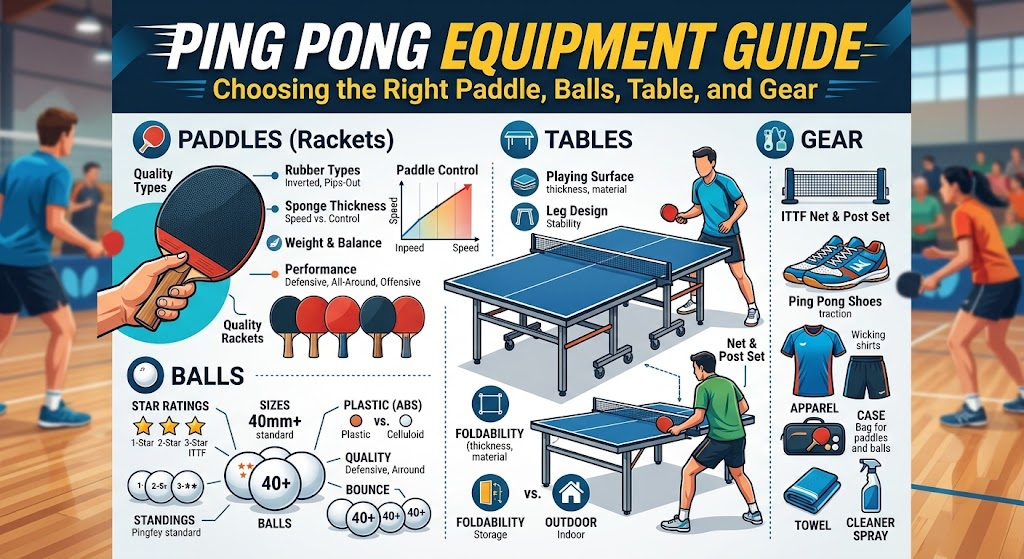
Ping Pong Equipment Guide: Choosing the Right Paddle, Balls, Table, and Gear
Getting started with ping pong does not require a garage full of expensive equipment.
At its most basic level, all you need is a table, net, paddle, ball, and an opponent.
However, as you become more interested in the sport, you quickly discover that ping pong equipment can become surprisingly sophisticated. Paddles are made from different types of wood and composite materials. Rubber comes in different styles and thicknesses. Balls have different ratings and construction. Tables vary dramatically in quality and price. Even shoes can affect your ability to move around the playing surface.
For beginners, this can create a problem.
Walk into a sporting-goods store or start browsing online and you may find hundreds of paddles, tables, balls, cases, shoes, nets, and accessories. Without understanding what actually matters, it is easy to spend too much money on equipment you don’t need—or buy equipment that makes learning more difficult.
The good news is that choosing ping pong equipment does not have to be complicated.
The key is matching your equipment to your current skill level, playing environment, goals, and budget.
This comprehensive ping pong equipment guide explains everything a beginner needs to know about choosing a paddle, table, balls, net, shoes, clothing, cases, training equipment, and accessories. It also explains which upgrades are worth considering as your skills improve.
If you are completely new to table tennis, start with The Ultimate Beginner’s Guide to Ping Pong, which covers the fundamentals of the sport, including rules, skills, strategy, and getting started.
What Equipment Do You Need to Play Ping Pong?
The basic equipment required for ping pong is surprisingly short.
You need:
- A ping pong table
- A net
- A paddle
- A ping pong ball
- Adequate playing space
That’s it.
You do not need specialized clothing, expensive shoes, a professional paddle, or sophisticated training equipment to start.
Those items can become useful later, but beginners should focus on learning the fundamentals first.
In fact, purchasing expensive advanced equipment before developing proper technique can sometimes make learning more difficult.
Ping Pong Equipment at a Glance
Here is a simple breakdown of the major equipment categories.
| Equipment | Importance for Beginners | What to Look For |
|---|---|---|
| Paddle | Very High | Control and comfortable grip |
| Table | High | Consistent bounce and sturdy construction |
| Net | High | Proper height and secure attachment |
| Balls | High | Consistent bounce and durability |
| Shoes | Moderate | Grip, stability, and lateral movement |
| Clothing | Moderate | Comfort and freedom of movement |
| Paddle Case | Low to Moderate | Protection and storage |
| Training Equipment | Optional | Practice goals and skill development |
You don’t have to buy everything at once.
Start with the essentials and add equipment as your interest and skill level increase.
Choosing the Right Ping Pong Paddle
The paddle is arguably the most important piece of equipment you personally own.
The paddle directly affects:
- Speed
- Spin
- Control
- Feel
- Shot placement
- Serving
- Returning
- Defensive ability
- Offensive ability
Yet one of the biggest mistakes beginners make is assuming the most expensive paddle must be the best.
It isn’t.
The best paddle for you is the one that matches your skill level and playing style.
Pre-Made vs. Custom Ping Pong Paddles
There are two broad approaches to buying a paddle.
Pre-Made Paddles
Pre-made paddles are assembled by the manufacturer and sold as complete units.
They are generally the easiest option for beginners.
Advantages include:
- Convenience
- Predictable performance
- Lower complexity
- Often lower cost
- No need to choose individual components
A good recreational paddle can be an excellent starting point.
Custom Paddles
More experienced players often build paddles by selecting a blade and individual rubber sheets.
This allows players to customize performance.
They can choose different combinations of:
- Blade construction
- Rubber
- Sponge thickness
- Speed
- Spin
- Control
Custom equipment can be extremely useful for serious players, but it is usually unnecessary for someone just learning the sport.
What Is a Ping Pong Paddle Blade?
The blade is the main body of the paddle beneath the rubber.
It is typically constructed from wood, although composite materials may also be incorporated.
Blade construction can affect:
- Speed
- Feel
- Weight
- Flexibility
- Vibration
- Control
Different blades are designed for different playing styles.
A defensive player may prefer a very different blade from an aggressive topspin attacker.
Beginners generally benefit from a blade that emphasizes control rather than maximum speed.
How Many Layers Should a Ping Pong Blade Have?
Ping pong blades are commonly described by the number of layers or plies.
You may encounter blades described as:
- 5-ply
- 7-ply
- Composite constructions
- Carbon-fiber combinations
- Other specialty designs
The number of plies alone does not determine whether a paddle is good.
Two five-ply blades can behave very differently.
The materials, thickness, construction, flexibility, weight, and intended playing style all matter.
For beginners, do not choose a blade solely because it has more layers.
What Is Ping Pong Rubber?
The rubber is the material covering the playing surfaces of the paddle.
This is where equipment becomes considerably more technical.
Different rubber types can affect:
- Spin
- Speed
- Control
- Trajectory
- Ball contact
- Serving
- Blocking
- Attacking
The rubber is one of the most important components of a serious player’s paddle.
Smooth Rubber vs. Other Rubber Types
Most offensive and all-around players use smooth rubber.
Smooth rubber allows players to generate significant spin through the interaction between the ball and the rubber surface.
Other specialized rubber types are also available, particularly for defensive or unusual playing styles.
Examples include:
- Short pips
- Long pips
- Anti-spin rubber
These specialized surfaces can dramatically change the behavior of the ball.
Beginners generally should not worry about them until they understand the basic game.
What Is Sponge Thickness?
Underneath the rubber is a layer of sponge.
Sponge thickness can affect the paddle’s performance.
Thicker sponge can generally provide greater potential for:
- Speed
- Spin
- Offensive shots
Thinner sponge may provide greater:
- Control
- Touch
- Defensive capability
However, the relationship is more complicated than simply “thicker equals better.”
A beginner may actually benefit from equipment that is easier to control.
How Much Should a Beginner Spend on a Paddle?
There is no single correct amount.
You can find inexpensive recreational paddles, mid-range paddles, and highly specialized professional equipment.
The most important principle is this:
Do not spend professional-level money before you have professional-level needs.
A beginner should prioritize:
- Comfortable grip
- Control
- Reasonable durability
- Appropriate speed
- Consistent performance
As your skills improve, you can identify what you like and dislike about your current paddle.
That information is far more useful than simply buying the most expensive equipment available.
Choosing the Right Paddle Grip
Paddle handles come in different shapes and styles.
Common handle styles include:
- Flared
- Straight
- Anatomical
- Penhold
For many beginners, a flared handle is comfortable because it gradually widens toward the bottom.
A straight handle provides a different feel and can be preferred by certain players.
Penhold grips are associated with particular playing techniques and traditions.
The most important thing is comfort.
A paddle should feel secure without requiring excessive squeezing.
Shakehand vs. Penhold Grip
Two major grip traditions are the shakehand grip and penhold grip.
Shakehand Grip
The paddle is held similarly to shaking someone’s hand.
This is extremely common among modern players.
It provides access to both forehand and backhand strokes using the two sides of the paddle.
Penhold Grip
The paddle is held more like a writing instrument.
This grip has historically been particularly popular in parts of Asia and can produce distinctive playing styles.
Neither grip is inherently “the correct grip.”
Beginners should choose a technique that they can learn comfortably and consistently.
If you want to improve the way you use your equipment, our guide to Ping Pong Tips for Beginners: How to Improve Your Forehand, Backhand, and Footwork will be an important next step.
Why Paddle Weight Matters
Paddle weight affects how the racket feels during play.
A heavier paddle can provide stability and power, while a lighter paddle may feel easier to maneuver.
However, weight is highly personal.
Two players can use paddles with similar specifications and prefer completely different setups.
Beginners should avoid choosing equipment solely based on weight.
Comfort and control are more important.
Should Beginners Buy a Fast Paddle?
Generally, no.
This is one of the most important equipment lessons for new players.
Very fast equipment can make it harder to keep the ball on the table.
A beginner needs to develop:
- Timing
- Stroke mechanics
- Paddle angle
- Touch
- Placement
- Consistency
If the paddle is excessively fast, small technical errors can become large mistakes.
A controllable paddle allows you to develop your technique.
Speed can be added later.
Choosing a Ping Pong Table
The table is the second major equipment decision.
Tables vary dramatically in:
- Price
- Thickness
- Construction
- Weight
- Portability
- Bounce consistency
- Indoor/outdoor suitability
- Storage requirements
The best table depends heavily on where you intend to use it.
Before buying one, ask:
Where will this table live?
That question should influence nearly every other decision.
Indoor Ping Pong Tables
Indoor tables are designed for controlled indoor environments.
They are often constructed to provide a consistent playing surface and predictable bounce.
If you have a dedicated recreation room, basement, garage, or sports area that remains dry and reasonably climate-controlled, an indoor table can provide excellent performance.
However, moisture and temperature changes can damage some tables.
Outdoor Ping Pong Tables
Outdoor tables are designed to withstand environmental conditions better than standard indoor tables.
They may use materials specifically selected for resistance to:
- Moisture
- Sunlight
- Temperature changes
- Corrosion
Outdoor tables can be ideal for patios, porches, community areas, or other exposed locations.
However, “outdoor” does not mean indestructible.
A quality outdoor table should still be protected and maintained appropriately.
How Thick Should a Ping Pong Table Be?
Table thickness is an important consideration because it can affect bounce quality.
Thicker playing surfaces generally tend to provide more consistent bounce and can feel more like competition-quality tables.
Very thin recreational tables may still be perfectly acceptable for casual play, particularly when portability and price are more important than tournament-style performance.
If serious practice is your goal, investing in a table with a quality playing surface can be worthwhile.
Does Table Thickness Matter for Beginners?
Yes, but context matters.
A beginner does not necessarily need a tournament-grade table.
If your goal is occasional family recreation, a portable recreational table may be completely adequate.
If you plan to practice several times a week and potentially compete, spending more on a quality table may make sense.
Think about how often you will use it.
A table that gets used hundreds of times may justify a larger investment than one that comes out of storage a few times each year.
Folding Ping Pong Tables
Many recreational tables are designed to fold.
This is an enormous advantage when space is limited.
Folding tables can make it easier to:
- Store the table
- Move it
- Set it up
- Clear the room after playing
Some tables can even be folded into a position that allows one side to be used for solo practice.
When shopping for a folding table, pay close attention to the quality of the locking mechanism and wheels.
A table that is difficult to move or unstable when unfolded can become frustrating quickly.
Table Size
A full-size competition table is significantly larger than many people realize.
Before purchasing one, measure your available space.
And do not measure only the table itself.
You need room around the table for players to move.
If the table fits perfectly into a room but leaves only a few inches on each side, you may technically own a ping pong table but have nowhere to actually play.
How Much Space Do You Need Around a Ping Pong Table?
Casual players can get away with less space than competitive players.
However, players need room to:
- Move laterally
- Step backward
- Reach wide shots
- Swing freely
- Retrieve balls
Competitive players often move much farther away from the table than beginners.
If you plan to develop your game seriously, give yourself as much room as reasonably possible.
Choosing a Ping Pong Net
A net may seem like a minor piece of equipment, but a poor-quality net can affect your playing experience.
Look for a net that:
- Attaches securely
- Maintains proper height
- Does not sag excessively
- Is easy to install
- Is durable
Clamp-style nets are convenient for many recreational setups.
Some tables come with permanent or integrated net systems.
If you purchase a separate net, make sure it is compatible with your table.
Ping Pong Net Height
A regulation table tennis net is approximately 15.25 centimeters high.
That measurement is important for serious players.
A net that is too high or too low can alter the way the game feels.
For casual games, small variations may not matter much.
For serious practice, consistency matters more.
Choosing Ping Pong Balls
Ping pong balls have changed considerably over the years.
Modern competition balls are generally made from plastic materials and designed to provide consistent performance.
You will see balls categorized by star ratings.
Higher-quality balls generally offer:
- Better consistency
- More predictable bounce
- Improved roundness
- Greater durability
Beginners can practice with lower-cost balls, but serious players should use quality balls for meaningful training.
One-Star, Two-Star, and Three-Star Balls
Ball ratings are commonly used to indicate quality.
One-Star Balls
These are generally intended for basic recreational or training use.
Two-Star Balls
These occupy a middle ground and can be useful for practice.
Three-Star Balls
These are generally the highest-quality balls intended for serious or competitive play.
If you are simply hitting around with friends, you do not necessarily need the most expensive balls.
If you are preparing for competition, practicing with high-quality balls makes more sense.
Why Ping Pong Balls Break
Ping pong balls are lightweight and can crack when they hit:
- The edge of the table
- The floor
- Paddles
- Walls
- Other hard surfaces
High-quality balls tend to be more consistent, but no ball is indestructible.
Keep spare balls nearby.
There is nothing worse than having a great rally interrupted because the only ball in the room suddenly cracks.
Ping Pong Shoes
Footwear becomes increasingly important as your skill level rises.
Casual players can often play in ordinary athletic shoes.
However, dedicated table tennis shoes are designed specifically for the movement patterns associated with the sport.
They typically emphasize:
- Grip
- Stability
- Low profile
- Lateral movement
- Lightweight construction
- Court feel
Ping pong involves frequent side-to-side movement, rapid starts, and sudden stops.
The right footwear can help you move confidently.
Why Running Shoes May Not Be Ideal
Running shoes are designed primarily for forward movement.
Ping pong requires substantial lateral movement.
A shoe designed for running may not provide the same type of stability and court feel that a table tennis or indoor court shoe provides.
This does not mean beginners cannot play in running shoes.
It simply means that dedicated footwear can become worthwhile if you play frequently.
Ping Pong Clothing
You do not need a special uniform to play recreational ping pong.
Comfortable athletic clothing is usually sufficient.
Look for clothing that allows unrestricted movement.
Avoid overly loose clothing that could interfere with your swing or movement.
Competitive players often wear sport-specific shirts and shorts designed for ventilation and mobility.
Do You Need a Ping Pong Paddle Case?
A paddle case is not essential, but it can be useful.
A quality case protects your paddle from:
- Dust
- Dirt
- Scratches
- Accidental impacts
- Excessive moisture
- General wear
If you have invested in a custom paddle, a protective case becomes particularly worthwhile.
Paddle Care and Cleaning
Your paddle’s rubber surfaces need to be maintained.
Dirt and dust can reduce the rubber’s ability to interact with the ball.
Players should clean their rubber appropriately and store the paddle in a protective environment.
Avoid using inappropriate household cleaners or harsh chemicals.
Manufacturers often provide specific recommendations for maintaining their rubber products.
Follow those instructions whenever possible.
Why Paddle Storage Matters
Heat, moisture, dust, and direct sunlight can damage equipment over time.
Avoid leaving a paddle:
- In direct sunlight
- In extreme heat
- In a damp environment
- Unprotected in a bag
- Where the rubber can be scratched
A paddle can be an investment.
Treat it like one.
Ping Pong Training Equipment
Once you begin practicing seriously, additional equipment can help.
Optional training equipment includes:
- Ball baskets
- Ball machines
- Training robots
- Target sheets
- Rebound boards
- Practice nets
- Multi-ball training equipment
You do not need any of these to become a competent player.
A partner and a bucket of balls can provide tremendous training value.
Ping Pong Ball Machines
A ball machine can deliver repeated shots without requiring another person to feed the balls.
Depending on the model, machines can simulate:
- Different speeds
- Different placements
- Different frequencies
- Different spins
- Different trajectories
This can be particularly useful for structured practice.
However, ball machines can be expensive.
Beginners should consider them optional rather than essential.
Training Robots
Some table tennis players use sophisticated robots to practice specific shots.
A robot can repeatedly deliver balls to a predetermined location.
This allows players to work on:
- Footwork
- Forehands
- Backhands
- Blocks
- Topspin
- Returns
- Movement patterns
Robots are most useful when the player already understands proper technique.
Repetition of poor technique will not magically make that technique good.
Ball Baskets
A ball basket can be a surprisingly useful investment.
It allows you to keep a large supply of balls nearby during practice.
This is especially useful for:
- Serve practice
- Footwork drills
- Multi-ball training
- Repetitive stroke practice
If you are practicing alone or with a coach, a basket can save a lot of time.
Do You Need a Table Cover?
A table cover can help protect your table when it is not being used.
This is particularly useful for:
- Dusty environments
- Garages
- Outdoor tables
- Multi-purpose rooms
A cover cannot replace proper storage and maintenance, but it adds another layer of protection.
Choosing Equipment Based on Your Skill Level
Your equipment needs should evolve.
Beginner
Focus on:
- Control-oriented paddle
- Reliable balls
- Stable table
- Comfortable footwear
Intermediate
You may begin considering:
- More specialized rubber
- Custom paddle setup
- Better shoes
- Higher-quality balls
- Training equipment
Advanced
You may want:
- Customized blade
- Specialized rubber
- Multiple paddles
- Competition-quality balls
- Professional footwear
- Ball machines
- Training robots
The goal is not to own the most equipment.
The goal is to own equipment that helps you play better.
Equipment for Defensive Players
Defensive players may choose equipment emphasizing:
- Control
- Placement
- Variation
- Spin manipulation
- Defensive consistency
Specialized defensive rubbers may become relevant at higher levels.
However, beginners should not rush into highly specialized setups.
Developing an all-around foundation first gives you a much better understanding of what your equipment needs to accomplish.
Equipment for Offensive Players
Offensive players often prioritize:
- Speed
- Spin
- Aggressive topspin
- Counterattacking
- Powerful strokes
Advanced attacking setups can be extremely fast.
But again, beginners should not assume that maximum speed automatically means better performance.
A paddle that is too fast can make basic development harder.
Equipment for All-Around Players
Many beginners are best served by an all-around setup.
An all-around paddle provides a balance between:
- Speed
- Spin
- Control
This gives new players room to experiment.
As your style develops, you can determine whether you prefer aggressive attacking, defensive play, or a balanced approach.
How Your Equipment Affects Spin
Equipment can influence how much spin you can generate.
But equipment does not create great spin by itself.
Your technique matters enormously.
The paddle must interact with the ball correctly.
Your:
- Swing path
- Paddle angle
- Contact point
- Timing
- Acceleration
all affect spin.
If you want to understand the technical side of this, read How to Put Spin on a Ping Pong Ball: Topspin, Backspin, Sidespin, and More.
Don’t Blame Your Paddle for Everything
This may be the most important equipment lesson of all.
When beginners struggle, they sometimes assume they need better equipment.
“I need a faster paddle.”
“I need more spin.”
“I need expensive rubber.”
“I need a professional table.”
Sometimes equipment really is holding a player back.
But more often, the issue is technique.
Before buying another paddle, ask:
Have I actually mastered the equipment I already have?
If the answer is no, additional equipment may not solve the problem.
When Should You Upgrade Your Paddle?
There is no fixed number of months or games after which you should upgrade.
Instead, upgrade when you understand what you need that your current paddle cannot provide.
For example:
You may discover that you want more spin.
You may want more control.
You may want a different grip.
You may want a lighter setup.
You may have developed an attacking style.
You may begin competing and need equipment designed for serious play.
Those are meaningful reasons to upgrade.
“I saw a more expensive paddle” isn’t.
Buying Used Ping Pong Equipment
Used equipment can be a good way to save money.
This is particularly true for:
- Tables
- Ball baskets
- Nets
- Training equipment
However, inspect used paddles carefully.
Check for:
- Damaged rubber
- Warped blade
- Loose handle
- Cracks
- Excessive wear
- Missing components
Used tables should also be inspected for:
- Warping
- Damaged wheels
- Broken locking mechanisms
- Uneven surfaces
- Water damage
A cheap table that requires major repairs may not actually be a bargain.
Buying Ping Pong Equipment Online
Online shopping provides an enormous selection.
However, specifications can sometimes be confusing.
When shopping online, look beyond marketing phrases such as:
- Professional
- Tournament style
- Extreme spin
- Ultra fast
- Competition quality
Instead, look for actual specifications.
Consider:
- Table thickness
- Table construction
- Paddle blade composition
- Rubber type
- Sponge thickness
- Weight
- Warranty
- Replacement availability
Specific information is more useful than marketing language.
Equipment and Your Playing Style
Your equipment should eventually reflect the way you play.
A player who loves aggressive topspin may want different equipment from someone who prefers defensive rallies.
A player who stays close to the table may have different needs from someone who plays several feet away.
But don’t worry about defining your permanent style on day one.
Your playing style will evolve naturally.
Equipment Is Only One Piece of the Puzzle
The best equipment in the world cannot replace:
- Practice
- Footwork
- Timing
- Technique
- Strategy
- Concentration
- Experience
A player with an inexpensive but appropriate paddle and excellent fundamentals can easily defeat someone with a very expensive paddle and poor technique.
Equipment should support skill development.
It should not become a substitute for it.
A Beginner’s Ping Pong Equipment Checklist
If you are starting from scratch, use this checklist.
Essential
- Ping pong table
- Net
- Paddle
- Balls
- Playing space
Helpful
- Paddle case
- Table cover
- Athletic shoes
- Comfortable sports clothing
- Extra balls
Optional
- Ball basket
- Training robot
- Ball machine
- Rebound board
- Target equipment
Start with the essentials.
Add other equipment only when you have a reason to use it.
Frequently Asked Questions About Ping Pong Equipment
What is the best ping pong paddle for beginners?
The best beginner paddle is generally one that emphasizes control, comfort, consistency, and moderate speed rather than maximum performance.
How much should I spend on a beginner paddle?
There is no universal price point. Buy a quality paddle appropriate for your skill level rather than automatically purchasing the most expensive option.
Should beginners use a fast paddle?
Usually not. Excessive speed can make it harder to develop control and consistency.
Is a custom paddle necessary?
No. Custom paddles are generally more useful once players understand their playing style and equipment preferences.
Does paddle rubber matter?
Yes. Rubber significantly affects spin, speed, control, and the overall feel of the paddle.
Are expensive ping pong balls worth it?
For casual games, inexpensive balls may be fine. Serious players benefit from higher-quality balls with more consistent performance.
Are outdoor ping pong tables worth buying?
If you plan to keep the table outdoors, an outdoor-rated model is generally more appropriate than a standard indoor table.
Do I need special ping pong shoes?
Not for casual play. However, dedicated table tennis shoes can provide useful grip and stability for frequent players.
How often should I replace my paddle?
There is no fixed schedule. Replace or rebuild it when the rubber or blade has deteriorated or when your equipment no longer matches your needs.
Can I play ping pong with a cheap paddle?
Yes. A beginner can learn the fundamentals with relatively inexpensive equipment.
Final Thoughts: Buy Equipment That Helps You Learn
Choosing ping pong equipment should not be intimidating.
You do not need to become an equipment expert before you can start playing.
Begin with a reliable paddle, quality balls, a stable table, and enough room to move.
As you improve, pay attention to how your equipment feels.
Does your paddle have enough control?
Is it too fast?
Do you want more spin?
Is the grip comfortable?
Do you move confidently in your shoes?
Are you practicing on a table with a consistent bounce?
Those observations will eventually tell you when it is time to upgrade.
The most important thing to remember is that better equipment does not automatically make you a better player.
Technique still comes first.
If you are learning the fundamentals, spend your time developing a reliable forehand, backhand, serve, return, and footwork. Our guide to Ping Pong Tips for Beginners can help you develop those fundamentals.
Once you begin experimenting with spin, equipment becomes even more interesting. Understanding How to Put Spin on a Ping Pong Ball will help explain why different paddle surfaces behave differently.
And once you have developed enough skill to start thinking strategically, Ping Pong Strategies and Tactics will take you beyond equipment and into the mental side of winning points.
Ultimately, the best ping pong equipment is equipment that allows you to concentrate on playing instead of fighting your gear.
Start simple.
Learn the game.
Practice consistently.
Upgrade intelligently.
And let your equipment evolve with your skills.