
How to Put Spin on a Ping Pong Ball
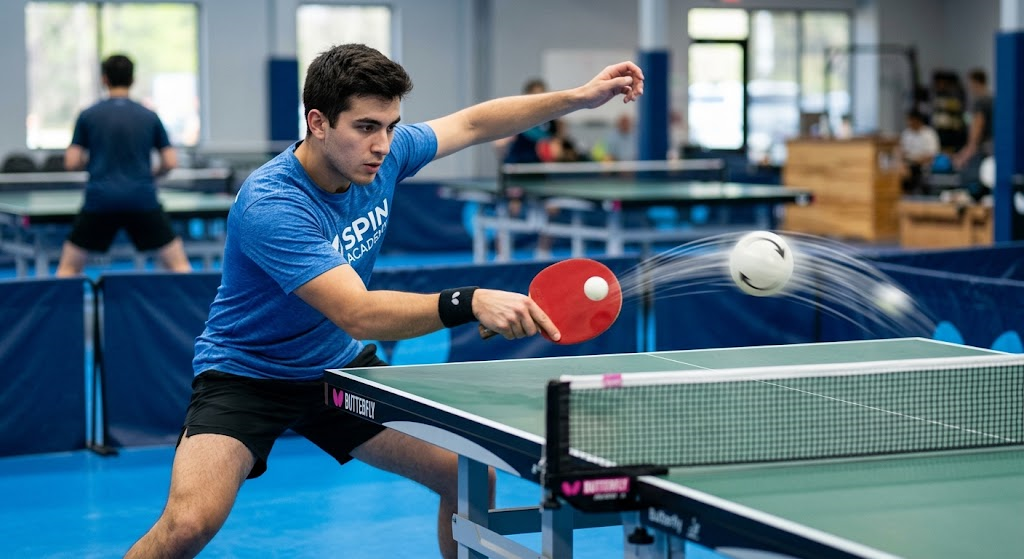
How to Put Spin on a Ping Pong Ball: Topspin, Backspin, Sidespin, and More
Spin is one of the most fascinating parts of ping pong.
A beginner can watch an experienced player hit what appears to be a simple shot and wonder why the ball suddenly dives onto the table, kicks sideways after bouncing, or shoots off the opponent’s paddle in an unexpected direction.
The answer is often spin.
Learning how to put spin on a ping pong ball can completely change the way you play. Spin can make your serves more difficult to return, help you control aggressive shots, create openings against opponents, and give you another way to change the speed and direction of a rally.
But spin can also be confusing.
There are several types of spin, and each affects the ball differently. The amount of spin, direction of spin, paddle angle, contact point, incoming ball, and type of rubber on your paddle can all influence what happens.
For beginners, the most important thing is not trying to master every advanced spin technique immediately.
Instead, start by understanding what spin is, how it works, how to recognize it, and how to produce basic topspin, backspin, sidespin, and no-spin shots.
Once you understand those fundamentals, spin becomes much easier to learn.
This guide will walk you through the subject step by step.
If you are completely new to the sport, you may also want to begin with The Ultimate Beginner’s Guide to Ping Pong (Table Tennis): Rules, Equipment, Skills, and How to Play. And if you’re still developing your basic strokes, our guide Ping Pong Tips for Beginners: How to Improve Your Forehand, Backhand, and Footwork can help you establish the foundation you need before adding advanced spin techniques.
What Is Spin in Ping Pong?
Spin occurs when the ping pong ball rotates as it travels through the air.
When your paddle contacts the ball, you can make the ball rotate by brushing across or around it rather than simply striking directly through it.
That rotation affects the ball’s flight and what happens when it contacts the table or your opponent’s paddle.
Think about throwing a football.
A football thrown with a spiral behaves differently from one thrown without rotation.
A ping pong ball works similarly.
The difference is that ping pong players can deliberately manipulate the ball’s rotation with the paddle.
The four basic categories you should understand are:
- Topspin
- Backspin
- Sidespin
- No-spin
You will also encounter combinations such as topspin with sidespin or backspin with sidespin.
Why Is Spin So Important?
Spin gives you control.
Without spin, ping pong would still be an exciting game, but players would have fewer ways to manipulate the ball.
Spin can influence:
- Ball trajectory
- Bounce
- Speed
- Shot safety
- Serve placement
- Return difficulty
- Opponent’s paddle angle
- Rally rhythm
- Attack opportunities
A well-executed spin shot can force your opponent to make an adjustment.
That adjustment may create an opening for your next shot.
This is why spin is closely connected to strategy.
Learning how to produce spin is important, but learning how to use spin intelligently is even more important.
The Four Basic Types of Spin
Before getting into technique, let’s establish the basic categories.
Topspin
The top of the ball rotates forward in the direction the ball is traveling.
Topspin generally causes the ball to dip downward more aggressively, allowing players to attack with greater forward speed while still bringing the ball down toward the table.
Topspin is extremely important in modern attacking ping pong.
Backspin
Backspin rotates in the opposite direction.
It can cause the ball to slow down and stay lower, particularly after bouncing.
Backspin is commonly used in defensive shots, pushes, chops, and serves.
Sidespin
Sidespin causes the ball to rotate sideways.
It can make the ball curve through the air and change direction after bouncing.
Sidespin is particularly useful on serves and can be combined with topspin or backspin.
No-Spin
No-spin means the ball has little intentional rotation.
It can be surprisingly effective because opponents sometimes prepare for spin and misread a ball that has very little rotation.
No-spin is therefore not necessarily a weak shot.
It can be a tactical weapon.
Understanding the Physics Without Getting Too Technical
You don’t need a physics degree to play ping pong.
The basic concept is enough.
When you brush the ball with your paddle, you create rotation.
The rubber on the paddle grips the ball during contact.
The direction in which your paddle moves across the ball determines the direction of the spin.
The faster and cleaner that brushing motion is, the more spin you can generally create.
This is one reason modern table tennis rubber is designed to produce substantial grip and spin.
For more information about choosing paddles and rubber, see Ping Pong Equipment Guide: Choosing the Right Paddle, Balls, Table, and Gear.
How to Create Topspin
Topspin is one of the first types of spin many players want to learn.
The basic concept is:
Brush up and forward on the ball.
That doesn’t mean you should simply swing straight upward.
Your stroke still needs forward movement.
The exact motion depends on whether you’re playing a forehand, backhand, loop, counter, or another shot.
But the fundamental idea remains the same.
You are creating forward rotation by contacting the ball with an upward-and-forward brushing motion.
Forehand Topspin for Beginners
Start in a balanced athletic position.
As the ball approaches, prepare your forehand.
Instead of trying to hit directly through the center of the ball, imagine brushing upward across the back of it.
Your paddle travels forward and upward.
Contact should be controlled.
Don’t attempt to generate maximum spin immediately.
Start with a moderate brushing motion.
The objective is to feel the ball grabbing against the rubber.
After contact, complete your follow-through and recover.
For beginners, it can help to think:
Low to high.
Your paddle begins relatively low and finishes higher.
Backhand Topspin
The backhand version uses the same fundamental concept, but the mechanics are different.
The stroke is generally more compact.
Start with your paddle in front of your body.
As the ball approaches, move the paddle forward and slightly upward while brushing the ball.
Your forearm and body contribute to the stroke.
Avoid trying to create the entire motion with your wrist.
A controlled backhand topspin stroke should feel relatively compact and repeatable.
Why Topspin Lets You Attack Harder
This is one of the reasons topspin is so important.
When you hit a flat ball extremely hard, you have to be careful about keeping it on the table.
Topspin helps the ball dip downward.
That allows an attacking player to strike aggressively while using rotation to bring the ball down.
This doesn’t mean topspin magically guarantees that every hard shot lands.
You still need proper technique, timing, height, and placement.
But topspin gives you a larger attacking toolbox.
What Happens When Topspin Bounces?
Topspin can cause the ball to kick forward and upward after bouncing.
That makes a heavily topspin ball difficult to handle if your opponent is not prepared.
It can also push the ball away from an opponent’s comfortable contact zone.
The faster the ball and heavier the topspin, the more difficult it can be to control.
This is one reason advanced rallies can become extremely fast.
How to Create Backspin
Backspin is created by brushing underneath the ball.
Think:
Forward and under.
Your paddle moves underneath the ball in a way that produces backward rotation.
Backspin is particularly important for:
- Serves
- Pushes
- Defensive play
- Short returns
- Controlling attacking balls
Beginners should start with a simple push.
The Beginner Backspin Push
Suppose your opponent sends you a ball with little or moderate speed.
Instead of hitting aggressively, you can make a controlled push.
Position your paddle slightly open.
Move forward and underneath the ball.
Brush the underside of the ball.
Keep the stroke controlled.
The objective is to create a low, short, or otherwise difficult ball rather than simply sending it back.
The amount of backspin depends on your contact and brushing motion.
Why Backspin Can Be Difficult to Attack
A player trying to attack a heavily backspinning ball must compensate for the rotation.
If they use the wrong paddle angle or stroke, the ball may go into the net.
This is why backspin can be an effective defensive or setup tool.
You are essentially giving your opponent a technical problem.
They have to solve the spin before they can attack effectively.
Backspin and the Short Game
Backspin can be especially useful when combined with short placement.
A short backspin serve or push may bounce near the net and make it difficult for an opponent to attack aggressively.
This forces the opponent to move forward.
That can change the rhythm of the point.
The ability to alternate between short and deep balls becomes an important tactical skill as you improve.
How to Create Sidespin
Sidespin is created by brushing across the ball from one side to another.
The exact direction of the paddle movement determines the direction of the rotation.
Sidespin can be difficult for beginners because the ball doesn’t simply move forward.
It can curve.
It can bounce sideways.
It can interact with another type of spin.
This makes sidespin particularly valuable for serving.
Forehand Sidespin
For a basic forehand sidespin motion, imagine brushing around the side of the ball rather than simply through it.
You can practice the motion without worrying about speed.
The objective is to feel the ball rotating sideways.
Once you can create sidespin consistently, experiment with combining it with forward or backward movement.
This creates mixed-spin serves and shots.
Sidespin Serve
Sidespin serves are among the most useful applications of sidespin.
A server can use sidespin to make the ball behave differently after the bounce.
The opponent must recognize not only where the ball is going but also how it is rotating.
A sidespin serve can therefore become much more effective when combined with:
- Short placement
- Long placement
- Backspin
- Topspin
- No-spin
- Deception
Serving is one of the best places to learn how spin creates tactical advantages.
For a complete serving guide, read How to Improve Your Ping Pong Serve: Techniques, Spin, and Placement.
Combining Spin Types
One of the biggest steps forward in ping pong occurs when you stop thinking about spin as four completely separate categories.
You can combine them.
For example:
- Topspin + sidespin
- Backspin + sidespin
These combinations can create complicated ball behavior.
A serve might have strong sidespin with backspin.
Another serve might look similar but contain sidespin with topspin.
If the opponent assumes the wrong type of spin, they may make an error.
This is where spin becomes closely connected to deception.
No-Spin Is a Real Weapon
Beginners sometimes assume that more spin is always better.
Not necessarily.
No-spin can be extremely effective.
Suppose you serve several balls with heavy backspin.
Your opponent starts adjusting their paddle angle accordingly.
Then you deliver a serve that looks almost identical but contains little spin.
The opponent may react as though heavy backspin is coming.
The result can be a poor return.
This is an example of spin variation.
Sometimes the best spin is less spin.
How to Tell How Much Spin Is on the Ball
Learning to read spin is just as important as producing it.
Watch your opponent’s paddle.
Pay attention to:
- Paddle direction
- Paddle angle
- Contact point
- Speed of the brushing motion
- Ball trajectory
- Bounce
The paddle often gives you an early clue.
For example, a player brushing strongly upward may be creating topspin.
A player brushing underneath may be creating backspin.
A player moving around the side of the ball may be producing sidespin.
Over time, these movements become easier to recognize.
The Bounce Can Reveal Spin
If you are unsure about the spin, watch what the ball does after it bounces.
The bounce can provide valuable information.
Does the ball:
- Kick forward?
- Slow down?
- Stay low?
- Move sideways?
- Change direction?
These clues can help you identify the spin.
However, don’t wait until the bounce to begin thinking.
Good players begin reading the ball during the opponent’s stroke.
Why Spin Causes So Many Beginner Errors
Spin changes how the ball reacts to your paddle.
Imagine receiving a ball with heavy topspin.
If you hold your paddle at exactly the same angle you would use against a no-spin ball, the return may behave very differently.
The same is true with backspin.
A beginner may think:
“I hit the ball the same way. Why did it go into the net?”
The answer is often incoming spin.
You must adjust your paddle angle and stroke based on the ball you receive.
How to Return Topspin
Against topspin, you generally need to account for the forward rotation.
A player may use a more closed paddle angle and a controlled forward stroke depending on the situation.
Blocking, countering, and looping all involve different techniques.
For a beginner, the most important concept is:
Don’t treat a topspin ball like a no-spin ball.
Pay attention to what the incoming ball is doing.
How to Return Backspin
Backspin usually requires a different response.
If you simply close the paddle and swing as though the ball has topspin, the ball may go into the net.
You generally need to open the paddle and/or create an upward component in your stroke.
Again, the exact adjustment depends on the amount of spin and the shot you’re attempting.
The important beginner lesson is that incoming spin affects outgoing spin.
How Sidespin Affects Your Return
Sidespin can cause the ball to move sideways off your paddle.
This surprises beginners constantly.
You aim toward one location.
The ball seems to go somewhere else.
That is often the result of sidespin.
When returning sidespin, your paddle angle and contact need to account for the sideways rotation.
With experience, you will begin making these adjustments instinctively.
The Most Important Spin Skill: Reading Incoming Spin
It is tempting to spend all your practice time trying to create spin.
But if you can’t recognize incoming spin, you’ll struggle against players who use it.
Therefore, divide your learning into two skills:
Producing spin
Learning how to brush the ball and create rotation.
Reading spin
Learning how to recognize and compensate for rotation created by your opponent.
You need both.
A Simple Spin Practice Exercise
Take a bucket of balls and practice creating different amounts of spin.
Start with topspin.
Hit controlled balls with moderate rotation.
Then try to produce more spin.
Then less.
Repeat with backspin.
Then sidespin.
The purpose is not to hit hard.
The purpose is to learn how different paddle movements change the ball.
Spin Without a Table
You can even practice some aspects of spin away from the table.
Hold the paddle and gently brush the ball upward.
Experiment with different contact directions.
You can practice:
- Upward brushing
- Downward brushing
- Side brushing
This won’t replace table practice, but it can help you develop a feel for the relationship between paddle movement and ball rotation.
Practice With a Partner Who Blocks
One excellent way to learn topspin is to have a partner block your attacks.
You produce moderate topspin.
Your partner returns the ball with a controlled block.
You repeat.
This creates a predictable environment where you can focus on your stroke.
Once you’re comfortable, increase the amount of spin gradually.
Practice Receiving Different Spins
Have your partner deliberately feed you different balls:
- No-spin
- Light topspin
- Heavy topspin
- Light backspin
- Heavy backspin
- Sidespin
Don’t worry about winning points.
Your job is to identify the spin and adjust your return.
This exercise can dramatically improve your awareness.
The Relationship Between Paddle Rubber and Spin
Your technique matters enormously.
But equipment matters too.
The rubber on a table tennis paddle can affect how much spin you can produce and how the ball reacts to incoming spin.
Modern offensive rubbers are designed to provide significant grip and spin potential.
However, more spin-friendly equipment can also make mistakes more noticeable.
For beginners, extremely fast or highly specialized equipment isn’t necessarily the best choice.
Control should remain a priority.
That’s why equipment selection should match your skill level.
Cleaning Your Paddle Matters
Dirt, dust, and debris can reduce the performance of paddle rubber.
If you want your equipment to perform consistently, take care of it.
Clean the rubber according to the manufacturer’s recommendations and protect the paddle during storage.
A good paddle can last much longer when properly maintained.
Again, our Ping Pong Equipment Guide: Choosing the Right Paddle, Balls, Table, and Gear covers equipment care in more detail.
Common Beginner Mistakes When Learning Spin
Trying to Hit Too Hard
Spin comes from brushing and proper technique, not simply from swinging harder.
Fix: Slow down and concentrate on clean contact.
Using Only the Wrist
The stroke becomes inconsistent.
Fix: Build the movement from proper body mechanics first.
Hitting Directly Through the Ball
You produce speed but little spin.
Fix: Brush across the ball.
Ignoring Incoming Spin
You treat every ball the same.
Fix: Watch the opponent’s contact and the ball’s bounce.
Trying to Learn Everything at Once
Too many techniques create confusion.
Fix: Master one type of spin at a time.
Assuming More Spin Is Always Better
Sometimes variation is more effective.
Fix: Learn to use heavy, light, and no-spin shots.
Topspin vs. Backspin
It helps to compare the two most important forms of spin.
| Feature | Topspin | Backspin |
|---|---|---|
| Basic brushing direction | Up and forward | Under and forward |
| Typical trajectory | Dips more aggressively | Tends to stay lower |
| Common uses | Attacking, looping, countering | Pushing, serving, defense |
| Bounce tendency | Kicks forward | Can slow and stay low |
| Beginner challenge | Timing and brushing | Paddle angle and lifting |
These are general principles rather than absolute rules.
The exact behavior depends on the amount of spin, speed, contact, table conditions, ball, rubber, and other factors.
Spin and Serving
Serving is perhaps the easiest place for a beginner to see the immediate value of spin.
A good serve doesn’t have to be fast.
It can be difficult because of:
- Spin
- Placement
- Height
- Length
- Deception
For example, you might serve a short backspin ball.
Your opponent must move forward and lift the ball.
Then you can attack the return.
Another serve might be long and fast with sidespin.
The opponent has less time to react.
The goal isn’t to use one magic serve.
It is to develop several reliable serves that produce different reactions.
Spin and the Third Ball
The third ball is your first shot after your opponent returns your serve.
Suppose you serve heavy backspin.
Your opponent pushes.
You receive a ball with predictable backspin.
Now you can prepare a topspin attack.
This is a classic example of using one type of spin to create an opportunity for another.
That is why learning spin should never be viewed as an isolated technical exercise.
It is part of point construction.
Spin Variation Makes You Harder to Play
Imagine an opponent knows exactly what is coming.
Every serve has heavy backspin.
Every forehand has the same topspin.
Every return goes to the same location.
Eventually, they adjust.
Variation creates uncertainty.
You can vary:
- Spin amount
- Spin direction
- Speed
- Placement
- Depth
- Contact
- Timing
You don’t have to become a trick-shot artist.
Small changes can make a significant difference.
Spin and Placement Work Together
A heavily spinning ball to the middle may be less effective than a moderately spinning ball placed perfectly into an opponent’s weakness.
Spin is one tool.
Placement is another.
Speed is another.
Deception is another.
The best players combine them.
For a deeper look at combining these elements, read Ping Pong Strategies and Tactics: How to Outsmart Your Opponent.
A Beginner’s Spin Training Plan
If you are new to spin, don’t try to learn everything in one afternoon.
Try a progression.
Stage 1: Understand the concepts
Learn what topspin, backspin, sidespin, and no-spin are.
Stage 2: Create basic topspin
Practice brushing upward and forward.
Stage 3: Create basic backspin
Practice brushing underneath the ball.
Stage 4: Add sidespin
Learn to brush across the side of the ball.
Stage 5: Vary spin
Practice heavy, medium, light, and no-spin versions.
Stage 6: Read spin
Have a partner give you different types of incoming spin.
Stage 7: Use spin tactically
Combine spin with placement, speed, and strategy.
This progression allows your skills to develop naturally.
A 20-Minute Spin Practice Session
You can also create a simple focused workout.
Minutes 1–5: Topspin
Practice controlled forehand topspin.
Focus on brushing rather than power.
Minutes 6–10: Backspin
Practice controlled pushes.
Focus on keeping the ball low.
Minutes 11–15: Sidespin
Practice serving or controlled side-brushing motions.
Minutes 16–20: Spin recognition
Have your partner vary the incoming spin.
Your job is to identify it and return it.
Short, focused sessions like this can be more productive than randomly hitting balls for an hour.
Don’t Let Spin Destroy Your Fundamentals
Spin is exciting.
But don’t forget the basics.
You still need:
- Good stance
- Good footwork
- Good timing
- Good balance
- Reliable forehand
- Reliable backhand
- Consistent serve
If your technique falls apart every time you try to add spin, simplify.
Return to the fundamentals.
Our article Ping Pong Tips for Beginners: How to Improve Your Forehand, Backhand, and Footwork is an excellent companion resource.
Spin Is About Feel
Eventually, spin becomes less about consciously calculating everything and more about feel.
Advanced players can often sense the amount and type of spin through:
- Paddle contact
- Ball trajectory
- Bounce
- Opponent’s motion
- Their own paddle response
Beginners shouldn’t expect this immediately.
At first, everything may feel confusing.
Then one day you’ll brush the ball correctly and suddenly realize:
“That’s it.”
That feeling is an important milestone.
How to Know You’re Improving
You don’t need to win every game to know your spin is improving.
Look for signs such as:
- Your topspin balls dip more consistently.
- Your backspin pushes stay lower.
- Your serves create more difficult returns.
- You can recognize incoming spin earlier.
- You make fewer errors against backspin.
- Your sidespin serves curve more noticeably.
- You can vary the amount of spin.
- You can combine spin with placement.
- Opponents begin making more mistakes from your serves.
Those are meaningful signs of progress.
Frequently Asked Questions About Ping Pong Spin
What is the easiest spin for a beginner to learn?
Basic topspin and backspin are good starting points. Topspin can be practiced through controlled forehand and backhand strokes, while backspin can be learned through simple pushes and serves.
How do you put topspin on a ping pong ball?
Brush the ball upward and forward with a controlled stroke. The exact mechanics depend on the shot, but the fundamental principle is creating forward rotation with an upward brushing component.
How do you put backspin on a ping pong ball?
Brush underneath the ball with an appropriate paddle angle and controlled forward motion. The goal is to create backward rotation.
How do you put sidespin on a ping pong ball?
Brush across the side of the ball. The direction of your paddle movement determines the direction of the sidespin.
Can you put more than one type of spin on the ball?
Yes. Players can combine sidespin with topspin or backspin, particularly on serves and advanced attacking shots.
Is no-spin useful?
Absolutely. No-spin can be an effective form of variation because opponents may prepare for a ball with more rotation than is actually present.
Does expensive equipment automatically create more spin?
No. Equipment can influence spin potential, but technique remains extremely important. A skilled player using appropriate equipment will generally produce much better results than a beginner using expensive equipment without proper technique.
Why does my topspin shot go into the net?
Possible causes include incorrect paddle angle, insufficient upward movement, poor timing, too much incoming backspin, or contacting the ball incorrectly.
Why does my backspin return go into the net?
You may not be compensating enough for the incoming backspin. Paddle angle, stroke direction, and the amount of incoming rotation all matter.
How long does it take to learn spin?
Everyone progresses differently. Basic spin can be introduced fairly early, but developing reliable spin against different incoming balls takes regular practice.
Final Thoughts: Spin Can Change Your Ping Pong Game
Learning how to put spin on a ping pong ball is one of the biggest steps you can take toward becoming a more complete player.
Topspin gives you an attacking tool.
Backspin gives you control and defensive options.
Sidespin creates movement and deception.
No-spin gives you variation.
But the real power of spin comes from combining these tools with placement, speed, footwork, and strategy.
Don’t rush.
Start with one type of spin.
Learn what the ball does.
Then learn how your opponent responds.
Once you can produce the spin, learn to recognize it when someone else produces it.
Eventually, you will begin seeing the game differently.
Instead of simply seeing a ping pong ball coming toward you, you’ll start seeing its rotation, trajectory, bounce, and potential.
That is when spin stops being a confusing advanced concept and becomes part of your natural game.
And remember: more spin isn’t always better. Better control is better.
Learn to produce spin.
Learn to read spin.
Learn to vary spin.
Then learn when to use it.
That’s how spin becomes a weapon instead of simply another trick in your ping pong toolbox.
Continue Exploring the Ping Pong Series
This article is part of The Sports Utopia’s comprehensive beginner-to-intermediate ping pong content cluster.
Continue learning with these related guides:
- The Ultimate Beginner’s Guide to Ping Pong (Table Tennis): Rules, Equipment, Skills, and How to Play
- Ping Pong Rules Explained: How to Play, Score Points, and Win Games
- Ping Pong Equipment Guide: Choosing the Right Paddle, Balls, Table, and Gear
- How to Improve Your Ping Pong Serve: Techniques, Spin, and Placement
- Ping Pong Tips for Beginners: How to Improve Your Forehand, Backhand, and Footwork
- Ping Pong Strategies and Tactics: How to Outsmart Your Opponent
- Common Ping Pong Mistakes Beginners Make and How to Fix Them
- Ping Pong Tournaments and Competitive Table Tennis: How Competition Works
The more you understand spin, the more you begin to understand what makes ping pong such a fascinating sport. What looks like a simple little ball traveling across a table can actually involve rotation, deception, timing, positioning, anticipation, and strategy—all happening in a matter of seconds.



1 Response
[…] Improve Your Forehand, Backhand, and Footwork. And if you’re unfamiliar with spin, our guide How to Put Spin on a Ping Pong Ball: Topspin, Backspin, Sidespin, and More will help you understand one of the most important tactical weapons in the […]