
Ping Pong Rules Explained
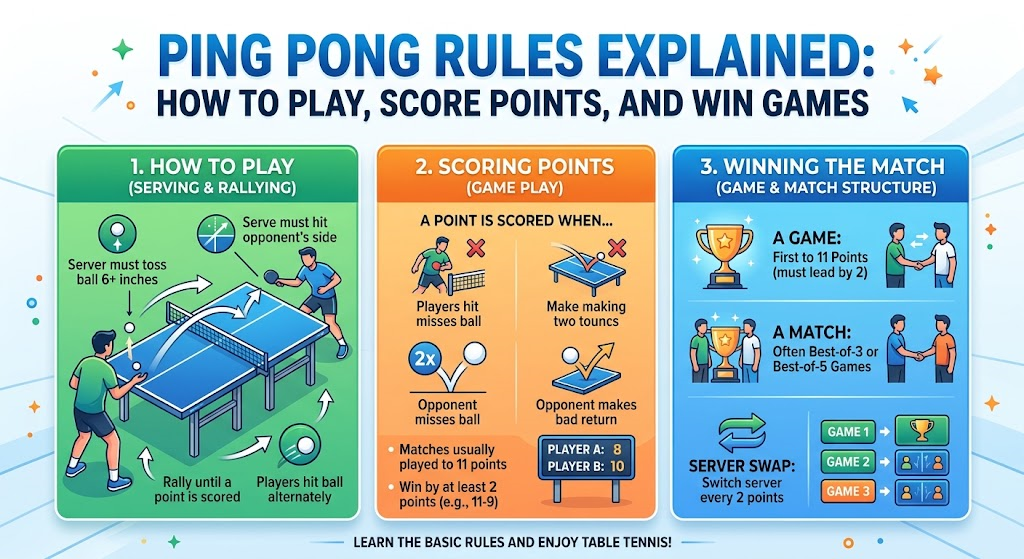
Ping Pong Rules Explained: How to Play, Score Points, and Win Games
Ping pong looks simple. Two players stand on opposite sides of a table, hit a lightweight ball back and forth, and try to keep their opponent from returning it.
But once you start playing seriously, you quickly discover that there are quite a few rules governing how the game is played.
How does a legal serve work? Where does the ball have to bounce? How does scoring work? When does the serve change? What happens at 10-10? What is different about doubles? Can you touch the table? What happens if the ball hits the net?
Understanding the answers to these questions makes ping pong much more enjoyable.
Whether you are playing in your basement, at a recreation center, with friends, or in an organized competition, knowing the rules gives you confidence and prevents arguments over whether a point was actually legal.
This guide explains the fundamental rules of ping pong, also officially known as table tennis. It covers serving, scoring, rallies, singles, doubles, lets, legal returns, common violations, equipment-related rules, and some of the differences between casual and competitive play.
If you are completely new to the sport, you may also want to begin with The Ultimate Beginner’s Guide to Ping Pong, our comprehensive introduction to equipment, skills, strategy, and getting started.
The Objective of Ping Pong
The objective of ping pong is simple:
Win more points than your opponent.
You win a point when your opponent fails to make a legal return.
During a rally, players hit the ball back and forth across the net. The ball must generally land on the opponent’s side of the table.
If your opponent:
- Misses the ball
- Hits the ball into the net
- Hits the ball off the table
- Fails to make a legal return
- Commits certain serving or playing violations
you win the point.
The first player to reach the required number of points while maintaining the required margin wins the game.
A match generally consists of multiple games.
Ping Pong Terms You Should Know
Before getting into the rules, it helps to understand some basic terminology.
Serve
The serve begins each rally.
The server must follow specific rules governing how the ball is held, tossed, struck, and bounced.
Receiver
The receiver is the player attempting to return the serve.
Rally
A rally begins with the serve and continues until a player wins the point.
Let
A let causes the rally to be replayed rather than awarding a point.
The most familiar example is a legal serve that touches the net but otherwise lands correctly.
Game
A game is an individual scoring contest, generally played to 11 points.
Match
A match consists of a predetermined number of games.
Singles
One player competes against one player.
Doubles
Two players compete against two players.
Deuce
In casual conversation, players often use “deuce” to describe a tied score late in the game, particularly 10-10.
At that point, a player must win by two points.
How a Ping Pong Game Starts
Before play begins, players typically determine who serves first.
In casual play, this may be decided by:
- A coin toss
- A paddle spin
- A random choice
- An agreement between players
In organized competition, the procedure is governed by the applicable rules.
Once the first server has been determined, the match begins.
The server must then execute a legal serve.
The Basic Ping Pong Serve Rules
The serve is one of the most heavily regulated parts of table tennis.
That is because the server has an inherent advantage.
Without rules governing the serve, a player could potentially hide the ball, disguise the contact point, or create an unfair advantage.
A legal serve begins with the ball resting freely on the open palm of the server’s stationary free hand.
The ball must then be tossed upward before being struck.
The serve must be performed in a way that allows the opponent and officials to see the ball appropriately.
The ball must first bounce on the server’s side of the table.
It must then pass over or around the net assembly and bounce on the receiver’s side.
In singles, the serve does not have to land in a particular half of the table.
In doubles, however, the serving pattern is different.
Why the Ball Must Be Tossed
The toss is an important part of a legal serve.
A player cannot simply hold the ball and drop it onto the paddle.
The purpose of the toss requirement is to make the serve more visible and prevent a player from gaining an unfair advantage through concealment or manipulation.
Competitive players develop very precise serving motions, but beginners should focus first on making sure the basic sequence is correct.
How High Does the Serve Toss Need to Be?
Under the standard rules of table tennis, the ball must be tossed nearly vertically upward from the open palm and rise at least 16 centimeters.
That requirement exists to provide the receiver with a reasonable opportunity to see the ball before it is struck.
The ball should not be tossed sideways deliberately or manipulated in a way that conceals the serving action.
The Ball Must Start in the Open Palm
Another important rule concerns how the ball is held before the serve.
The ball begins on the open palm of the server’s free hand.
The hand should be stationary before the toss.
This prevents players from gaining an advantage by beginning the serve with the ball already moving or hidden in some way.
Can You Serve Anywhere in Singles?
Yes.
In singles, the ball can generally be served from one side of the table to any part of the opponent’s side, provided the serve otherwise meets the requirements.
The ball does not have to travel diagonally.
This is different from doubles.
Understanding this distinction is important because many beginners learn the doubles serving rule and mistakenly apply it to singles.
Ping Pong Doubles Serving Rules
Doubles introduces additional rules.
In doubles, the serve must travel diagonally.
The server must serve from the right half of their side of the table to the right half of the receiver’s side.
The ball must therefore cross the table diagonally.
This creates an important distinction between singles and doubles.
Doubles also requires players to hit the ball in an alternating sequence.
That means the order of play matters tremendously.
How Often Does the Serve Change?
In standard table tennis scoring, service generally changes after every two points.
For example:
- Player A serves for two points.
- Player B serves for two points.
- Player A serves for two points.
- Player B serves for two points.
This continues throughout the game.
However, when the score reaches 10-10, the service changes after every point.
That rule continues until someone wins by two points.
What Happens at 10-10?
A score of 10-10 is one of the most important situations to understand.
Once the score reaches 10-10, players must win by two points.
For example:
- 11-10 is not enough.
- 12-10 wins the game.
- 13-11 wins the game.
- 14-12 wins the game.
At deuce, the players alternate serves after every point.
This can make the final portion of a close game extremely intense.
A player who was trailing early can suddenly find themselves just two points away from winning.
How Many Points Win a Ping Pong Game?
A standard game is played to 11 points.
However, simply reaching 11 is not always enough.
You must win by at least two points.
So a game can finish:
11-7
or:
11-9
But if the score reaches 10-10, play continues.
This is why scores such as 12-10, 15-13, and 20-18 are possible.
There is no fixed maximum score in a standard game as long as the two-point margin has not been achieved.
What Is a Rally?
A rally begins when the server legally puts the ball into play.
The receiver then attempts to return it.
The players continue hitting the ball back and forth.
A legal return generally requires the ball to:
- Travel over or around the net assembly.
- Touch the opponent’s playing surface.
- Do so without committing another violation.
The rally ends when one player fails to make a legal return or commits a fault.
The opposing player then receives the point.
What Counts as a Legal Return?
A legal return occurs when a player strikes the ball so that it passes over or around the net assembly and touches the opponent’s court.
The ball does not necessarily have to travel directly over the top of the net.
It may pass around the side of the net assembly, provided the conditions of a legal return are otherwise satisfied.
This can occasionally produce spectacular angles during advanced play.
Can You Hit the Ball Before It Bounces?
Generally, no.
A player must allow the ball to bounce on their side of the table before returning it.
If you strike the ball before it has bounced on your side, you can be considered to have obstructed the ball.
This is particularly important when a player is standing close to the table.
A fast shot may appear to be heading off the table, tempting a player to hit it early.
Wait for the ball to complete its legal bounce before attempting the return.
What Is Obstruction?
Obstruction occurs when a player interferes with the ball before it has bounced on their side of the table.
For example, imagine your opponent hits the ball toward you, but you reach over the table and strike it before it bounces.
That is not a legal return.
Your opponent wins the point.
What Happens If the Ball Hits the Net During a Rally?
This is one of the most misunderstood aspects of ping pong.
If the ball hits the net during a rally but still travels onto the opponent’s side and makes a legal bounce, play continues.
The net does not automatically end the rally.
The ball can clip the net and still be perfectly playable.
If the ball hits the net and fails to reach the opponent’s side, however, the player who hit the ball loses the point.
What Happens When a Serve Hits the Net?
A legal serve that touches the net and still lands correctly on the receiver’s side is called a let.
The serve is replayed.
No point is awarded.
For example:
The server tosses the ball correctly, strikes it legally, and the ball clips the net before landing in the correct part of the receiver’s court.
The rally is stopped.
The server serves again.
What Is a Let?
A let is essentially a situation where the rally does not count and is replayed.
The most common example is the net-touching serve described above.
There can be other circumstances in organized play that result in a let, including certain interruptions or situations where play is disturbed.
A let is different from a fault.
A fault can result in a point for the opponent.
A let means the rally is replayed.
What Happens If the Ball Hits the Edge of the Table?
The edge of the table is part of the playing surface.
If the ball touches the top edge and then bounces away, it can be a legal shot.
This can create some extremely difficult returns because the ball may change direction unexpectedly.
However, the vertical sides of the table are not part of the playing surface.
A ball that hits the side rather than the top surface does not count as a legal bounce.
This distinction can cause plenty of arguments during recreational games.
If you are unsure, learning to recognize the difference between the tabletop and the vertical edge will save you a lot of disputes.
What Happens If the Ball Hits the Side of the Table?
If the ball contacts only the vertical side of the table rather than the top playing surface, it is not a legal bounce.
The player who hit the ball has therefore failed to make a legal return if that was the intended landing.
This is one reason the angle and height of a shot matter.
A ball that barely catches the edge can be extremely difficult for the opponent to return.
Can You Touch the Table?
Players sometimes wonder whether touching the table is automatically a fault.
It is not simply the act of touching the table that matters.
A player can make incidental contact with the table under circumstances that do not necessarily end the point.
However, there are important restrictions concerning touching the playing surface with the free hand while the ball is in play.
If a player touches the playing surface with their free hand, the opponent can be awarded the point.
Players also should not move the table during play.
This is another reason proper footwork and balance are so important.
Can Your Body Touch the Net?
Players should not touch the net assembly during play.
Contact with the net can result in a point for the opponent.
This rule exists partly because touching the net could provide a player with an unfair advantage or interfere with the playing equipment.
If you are moving aggressively around the table, maintain awareness of your surroundings.
Can You Lean on the Table?
Leaning against the table can create balance problems and potentially move the table.
Players should maintain their own balance rather than using the table as support.
In competitive play, deliberately moving the table or otherwise interfering with the playing conditions can result in a penalty.
Does the Paddle Have to Hit the Ball?
Yes.
A player must use the racket or an acceptable part of the racket to make the return.
The ball cannot simply be caught, carried, or thrown.
A legal stroke involves striking the ball.
This sounds obvious, but unusual situations can occur during fast rallies.
Can You Hit the Ball With Your Hand?
The rules distinguish between the racket and the hand holding it.
The racket includes the racket held in the hand, and under the rules, the ball can make contact with the racket hand below the wrist in certain circumstances.
However, intentionally striking or carrying the ball with other parts of the body is not a legal alternative to making a proper return.
For beginners, the easiest rule to remember is:
Use the paddle to play the ball.
What Happens If the Ball Hits You?
If the ball hits you before you make a legal return, the situation depends on exactly what occurred.
If you obstruct the ball before it has bounced on your side of the table, you can lose the point.
This is another reason not to reach across the table prematurely.
After the ball has legally bounced, your objective is to return it before it bounces a second time.
How Many Times Can the Ball Bounce?
On your side of the table, the ball should be returned after its first legal bounce.
If it bounces twice on your side before you return it, you lose the point.
There is no requirement for you to let it bounce twice.
In fact, allowing that to happen means the rally is over.
Can the Ball Bounce on the Net?
The net itself is not part of the playing surface.
A ball cannot simply bounce on top of the net and count as a normal return.
During a rally, however, the ball can strike the net and continue into the opponent’s court.
The outcome depends on whether the ball subsequently makes a legal landing.
Singles Rules vs. Doubles Rules
The basic principles of ping pong remain the same in singles and doubles.
However, doubles introduces additional requirements.
The major differences involve:
- Serving
- Service order
- Hitting order
- Positioning
- Team strategy
Singles players can focus entirely on their own movement and opponent.
Doubles players must coordinate with a partner.
That makes doubles a completely different tactical challenge.
Ping Pong Doubles Hitting Order
One of the most important doubles rules is that players must alternate hitting the ball.
For example:
Player A1 serves to Player B1.
Player B1 returns to Player A2.
Player A2 returns to Player B2.
Player B2 returns to Player A1.
The sequence continues.
Players cannot simply take turns whenever they want.
The required order must be maintained throughout the rally.
Failure to follow the correct order results in a point for the opposing team.
Why Doubles Requires Better Communication
Doubles players must know who is taking the next shot.
If two players move toward the same ball, they can collide.
If both assume the other player will take it, nobody may hit the ball.
Good doubles teams develop movement patterns and communication habits.
They also learn to move efficiently after hitting so that their partner has room to play the next shot.
Changing Ends
Players change ends at certain points in a match.
This helps ensure that neither player receives a persistent advantage from environmental conditions such as:
- Lighting
- Air movement
- Background distractions
- Room conditions
In a game that reaches a deciding point after the score reaches 10-10, players also change ends when one player or team first reaches 5 points in that game.
The exact procedures can vary depending on the competition format, so serious tournament players should familiarize themselves with the rules being used by their governing organization.
Match Format
A ping pong match is made up of individual games.
The number of games required to win a match can vary depending on the competition.
For example, a match might be played as:
- Best of three games
- Best of five games
- Best of seven games
In a best-of-five match, the first player to win three games wins the match.
In a best-of-seven match, the first player to win four games wins.
Recreational players can establish whatever format they prefer, but organized competitions generally specify the format in advance.
What Is a Match Point?
A match point occurs when a player is one game-winning point away from winning the overall match.
For example, imagine a best-of-five match where one player already has two game victories.
If that player wins the current game, they win the match.
If they reach a score where one more point would secure the game and therefore the match, they are playing a match point.
Match points can create enormous pressure.
What Is Game Point?
Game point occurs when a player is one point away from winning the current game.
For example, if the score is 10-8, the player with 10 points has game point.
However, because a two-point margin is required, the player must still win the game properly.
If the opponent wins the next point, the score becomes 10-9.
Why You Should Learn the Rules Before Playing Competitively
Casual players can often get away with a relaxed interpretation of the rules.
Competitive play is different.
Once you enter a league or tournament, you should understand:
- Serving requirements
- Scoring
- Service order
- Doubles rotation
- Lets
- Equipment requirements
- Legal returns
- End changes
- Match format
- Conduct rules
A misunderstanding that is harmless during a family game can become a significant problem during organized competition.
Common Ping Pong Rule Mistakes
Beginners commonly make several mistakes.
Serving From a Closed Hand
The ball should begin on an open palm.
Hiding the Serve
Players should not deliberately conceal the ball during the service motion.
Serving Directly Without a Toss
The ball must be tossed appropriately before being struck.
Serving Diagonally in Singles
The diagonal requirement applies to doubles, not standard singles play.
Forgetting the Two-Point Margin
Reaching 11 does not automatically end a game if the opponent has 10.
Hitting the Ball Before It Bounces
The ball must generally bounce on your side before you return it.
Forgetting Doubles Rotation
Doubles requires alternating hits between teammates.
Calling Every Net Contact a Let
A net contact during a normal rally does not automatically result in a replay.
Counting the Table’s Side as the Playing Surface
The top surface counts. The vertical side does not.
Understanding these mistakes will help you avoid confusion and arguments during play.
Casual Ping Pong Rules vs. Official Rules
One important thing to understand is that many recreational players develop their own house rules.
You might encounter people who:
- Play to 21
- Change servers every five points
- Allow unconventional serves
- Ignore certain serving requirements
- Allow “let” serves to continue
- Use informal scoring
- Play sudden-death points
There is nothing inherently wrong with creating house rules for a casual game.
The key is to agree on the rules before beginning.
Problems arise when players assume everyone is following the same rules.
If you are playing competitively, however, you should follow the applicable official rules.
The Importance of Agreeing on Rules Before a Casual Game
If you are playing with friends or family, take 30 seconds to establish the basics.
Decide:
- How many points per game?
- Win by two?
- How often does the serve change?
- Singles or doubles?
- Are standard serving rules being followed?
- How many games constitute a match?
Doing this beforehand can eliminate arguments later.
Learning the Rules Makes You a Better Player
Knowing the rules isn’t just about avoiding penalties.
It can actually improve your game.
When you understand how serving works, you can begin developing better serves.
When you understand the scoring system, you can make smarter decisions during close games.
When you understand the legal return requirements, you can position yourself better.
When you understand doubles rotation, you can coordinate more effectively with your partner.
Rules provide the framework within which strategy develops.
Rules and Ping Pong Strategy
Once you understand the rules, the next step is learning how to use the legal framework to your advantage.
For example, serving rules do not prevent you from developing:
- Heavy spin
- Light spin
- Sidespin
- Short serves
- Long serves
- Fast serves
- Deceptive placement
Similarly, legal returns can be used to target different areas of the table.
If you want to take this next step, our guide to Ping Pong Strategies and Tactics will explore how players use placement, spin, consistency, and opponent weaknesses to win points.
Rules and the Importance of the Serve
The serve deserves particular attention because it begins every rally.
Understanding the rules is the first step.
Developing an effective serve is the next.
A strong player doesn’t simply serve legally.
They use the serve to create an advantage.
They may vary:
- Spin
- Speed
- Depth
- Placement
- Height
- Direction
To learn more, read How to Improve Your Ping Pong Serve: Techniques, Spin, and Placement.
Rules and Spin
Spin does not change the basic scoring system, but it dramatically changes how the ball behaves.
A player who understands the rules but cannot recognize spin will still struggle against experienced opponents.
Topspin, backspin, and sidespin all require different responses.
Learning How to Put Spin on a Ping Pong Ball is therefore an important next step after mastering the basic rules.
How Rules Change in Competitive Ping Pong
The fundamentals remain the same, but competitive table tennis introduces a much greater emphasis on strict enforcement.
Officials may monitor:
- Legal serves
- Service sequence
- Scoring
- Equipment
- Conduct
- Time limits
- Interruptions
- Player behavior
Competitive players need to understand more than simply how to hit the ball.
They need to understand the environment in which the sport is officially played.
Our guide to Ping Pong Tournaments and Competitive Table Tennis will explain that side of the sport in greater detail.
Frequently Asked Questions About Ping Pong Rules
How many points do you need to win ping pong?
A standard game is played to 11 points, but you must win by two points.
What happens at 10-10?
Play continues until one player leads by two points. Service changes after every point during this period.
Does the serve have to be diagonal?
Not in singles. A diagonal serve is required in doubles.
How often does the serve change?
Normally, service changes after every two points. At 10-10 and beyond, service changes after every point.
What happens if the serve hits the net?
If the serve is otherwise legal and lands correctly on the receiver’s side, it is a let and the serve is replayed.
Can the ball hit the net during a rally?
Yes. If it goes over the net and makes a legal bounce, play continues.
Can you hit the ball before it bounces?
No. Doing so can result in obstruction and loss of the point.
Does the ball have to land on the opponent’s side?
Yes. A legal return must ultimately touch the opponent’s court.
Does hitting the edge count?
Yes, if the ball touches the top playing surface or its edge.
Does hitting the side count?
No. The vertical side is not part of the playing surface.
Can you touch the table?
There are restrictions. In particular, touching the playing surface with your free hand while the ball is in play can result in a point for the opponent.
How many games are in a ping pong match?
It depends on the competition format. Common formats include best of three, best of five, and best of seven.
Are ping pong and table tennis different sports?
No. They are generally two names for the same sport.
A Simple Rulebook for New Ping Pong Players
If all of the details seem overwhelming, start with these basic rules:
- A game is generally played to 11 points.
- You must win by two points.
- The serve begins each rally.
- The server must make a legal serve.
- The ball must bounce on the server’s side first.
- The ball then must reach the receiver’s side.
- Players alternate returning the ball.
- A player loses the point if they fail to make a legal return.
- Service normally changes after every two points.
- At 10-10, service changes after every point.
- Singles and doubles have different serving requirements.
- Doubles players must alternate hits.
- A legal serve that touches the net and lands correctly is replayed.
- A net contact during an ordinary rally does not automatically mean a replay.
- The top of the table is part of the playing surface; the vertical sides are not.
- Players must not obstruct the ball before it legally bounces.
- Good sportsmanship is always part of the game.
Learn these fundamentals first.
The more you play, the more naturally the rest of the rules will become.
Final Thoughts: Learn the Rules, Then Learn the Game
Ping pong is easy to play casually, but understanding the official rules gives you a much stronger foundation.
Once you know how scoring works, you won’t have to stop in the middle of a close game to figure out whether you won.
Once you understand serving, you can begin developing serves that create actual advantages.
Once you understand legal returns, you can start thinking about placement.
Once you understand doubles rotation, you can work with your partner instead of getting in each other’s way.
And once you understand the basic framework of the sport, you can begin exploring the more sophisticated elements that separate casual players from serious competitors.
The rules are the foundation.
Technique builds on that foundation.
Strategy builds on technique.
And experience brings everything together.
If you are just getting started, don’t worry about memorizing every technical detail immediately. Learn the basic scoring and serving rules, play some games, and gradually become more familiar with the finer points.
Then continue building your knowledge with The Ultimate Beginner’s Guide to Ping Pong, followed by our guides to Ping Pong Equipment, Ping Pong Serves, Ping Pong Tips for Beginners, Ping Pong Spin, Ping Pong Strategies and Tactics, Common Ping Pong Mistakes, and Ping Pong Tournaments and Competitive Table Tennis.
The more you understand about the sport, the more you will appreciate just how much skill, strategy, and athleticism can fit on a table only nine feet long.
Now grab a paddle, find an opponent, and put the rules into practice.



1 Response
[…] before practicing advanced serving techniques, make sure you understand Ping Pong Rules Explained: How to Play, Score Points, and Win Games. A spectacular serve is useless if it is not […]