
The Ultimate Beginner’s Guide to Ping Pong
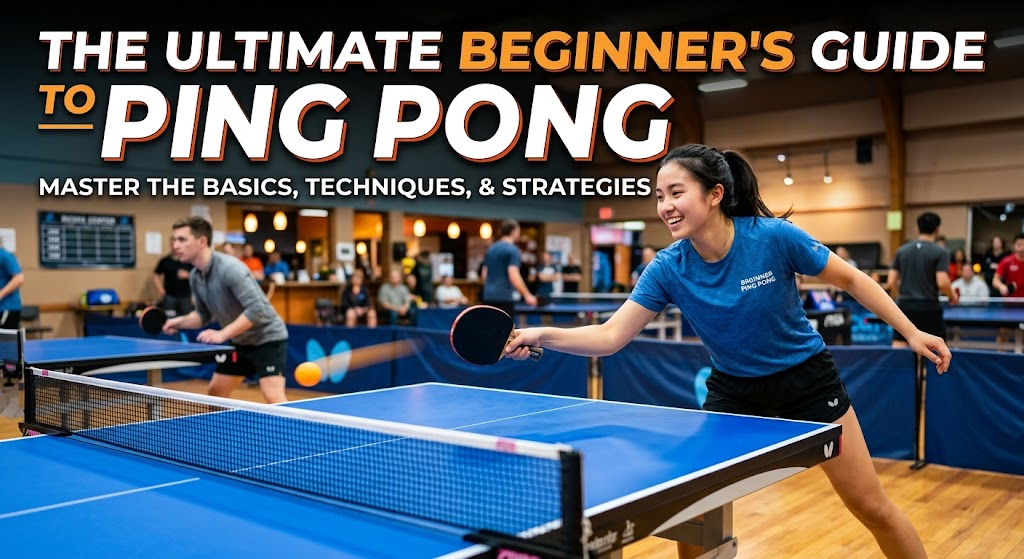
The Ultimate Beginner’s Guide to Ping Pong (Table Tennis): Rules, Equipment, Skills, and How to Play
Ping pong is one of those sports that almost everyone has encountered at some point. You may have played it in a basement, recreation center, school gym, community center, college dorm, garage, or even on a vacation. It is easy to pick up a paddle, hit a ball back and forth, and have fun within minutes.
But there is much more to ping pong than simply keeping a little plastic ball in the air.
Known officially as table tennis, ping pong is a fast, technical, strategic sport that can be played recreationally or at an extremely high competitive level. Players must combine hand-eye coordination, quick reactions, footwork, balance, timing, spin, placement, and strategy. A rally that looks simple to a casual observer can involve tremendous amounts of skill.
The good news for beginners is that you do not need to master everything at once.
Learning the basic rules, getting the right equipment, developing a reliable serve, practicing your strokes, and understanding a few fundamental strategies can dramatically improve your game.
This comprehensive beginner’s guide to ping pong will introduce you to the sport from the ground up. Whether you have never held a paddle before or have played casually and want to understand the game better, this guide will help you develop a solid foundation.
Along the way, we’ll cover the history of the sport, equipment, rules, scoring, serves, strokes, spin, footwork, strategy, practice techniques, common mistakes, competitive play, and ways to continue improving.
What Is Ping Pong?
Ping pong is the common name for the sport officially called table tennis.
The game is played on a rectangular table divided into two sides by a net. Players use small paddles, sometimes called rackets or bats, to strike a lightweight ball back and forth across the net.
The objective is straightforward: hit the ball onto your opponent’s side of the table in a way that prevents your opponent from successfully returning it.
A point is awarded whenever a player fails to make a legal return.
Ping pong can be played as:
- Singles, with one player on each side
- Doubles, with two players on each side
- Recreational games
- Organized leagues
- Local tournaments
- National competitions
- International championships
- Olympic competition
Although the basic concept is easy to understand, advanced table tennis is remarkably complicated.
Players can manipulate the ball with different types of spin, alter the speed of their shots, change placement, attack weaknesses, and use deceptive serves to create opportunities.
That combination of accessibility and technical depth is one of the reasons ping pong remains popular around the world.
Ping Pong vs. Table Tennis: Is There a Difference?
For most practical purposes, ping pong and table tennis refer to the same sport.
“Table tennis” is the formal name generally used by governing organizations and in competitive settings. “Ping pong” is the casual term commonly used in everyday conversation.
You will hear people use both terms interchangeably.
There are some historical and cultural reasons for the different terminology, but a beginner does not need to worry about making a distinction. If you say you want to play ping pong, people will know what you mean.
Throughout this guide, we’ll primarily use “ping pong” because that is the term many recreational players use, while also referring to table tennis when discussing formal competition.
A Brief History of Ping Pong
The origins of table tennis can be traced to England during the late nineteenth century.
The sport developed as an indoor version of lawn tennis. People wanted a game that could be played indoors, particularly during poor weather.
Early versions were considerably different from the modern sport.
Players experimented with makeshift equipment and tables. Books could serve as nets, and household objects were sometimes used as paddles. Balls and playing surfaces varied considerably.
As the game became more popular, manufacturers began developing specialized equipment.
The sport eventually spread beyond England and became increasingly organized internationally.
Modern table tennis underwent several major changes during the twentieth century, including improvements in equipment and playing techniques.
The development of rubber-covered paddles dramatically changed how players could control the ball. Spin became an increasingly important part of the game.
Table tennis eventually became an Olympic sport in 1988.
Today, it is played recreationally and competitively across the world.
Why Is Ping Pong So Popular?
Ping pong has several characteristics that make it an excellent sport for beginners.
It Is Easy to Start
You can learn the basic concept in a few minutes.
You do not need to memorize a complicated playbook before you can begin enjoying the game.
It Requires Relatively Little Space
Compared with many outdoor sports, table tennis can be played in a relatively compact area.
You still need adequate room around the table, particularly if players intend to move away from the table, but the overall footprint is manageable.
It Can Be Played by People of Different Ages
Children, teenagers, adults, and older players can all enjoy ping pong.
Competitive levels vary tremendously, allowing players to participate according to their interests and abilities.
It Provides a Serious Physical Challenge
Do not make the mistake of assuming that ping pong is not physically demanding.
Competitive players move constantly. They must react quickly, maintain balance, change direction, and repeatedly perform explosive movements.
It Is Social
Ping pong is also an excellent social activity.
A casual game can be played at a party or family gathering just as easily as it can at a club or tournament.
Understanding the Ping Pong Table
The table is the central piece of equipment.
A regulation table is rectangular and divided into two equal playing surfaces by a net.
The table surface is elevated above the floor and designed to provide a consistent bounce.
For serious play, the table should meet recognized standards for dimensions, construction, and playing characteristics.
Recreational tables come in many varieties, including full-size tables, compact tables, folding tables, and outdoor models.
If you are purchasing your first table, consider where you will use it before deciding what to buy.
A high-quality competition-style table can provide an excellent playing experience, but a recreational player may not need the most expensive model available.
Ping Pong Equipment for Beginners
You do not need a huge collection of equipment to start playing.
The basic equipment includes:
- A table
- A net
- A paddle
- Ping pong balls
- Appropriate playing space
The paddle is particularly important because it directly affects how the ball behaves when you hit it.
Beginners should avoid becoming obsessed with expensive equipment.
Developing proper technique is much more important than purchasing an advanced paddle.
If you want a more detailed breakdown of equipment, the cluster’s dedicated guide to ping pong equipment will go deeper into paddles, tables, balls, shoes, and other accessories.
Choosing Your First Ping Pong Paddle
A beginner’s paddle should allow you to develop control.
You may eventually want a paddle designed for aggressive attacking, defensive play, or a particular combination of speed and spin.
But beginners generally benefit from equipment that makes it easier to control the ball.
When choosing a paddle, consider:
- Grip
- Rubber type
- Sponge thickness
- Speed
- Spin potential
- Control
- Playing style
- Budget
A paddle that is too fast can actually make learning more difficult.
New players often need to learn how to consistently keep the ball on the table before worrying about maximizing speed.
Ping Pong Balls
Modern table tennis balls are lightweight and designed to provide a predictable bounce.
Competition balls are typically marked with a star rating indicating their quality and intended use.
For casual beginners, inexpensive practice balls are perfectly adequate.
As your skill improves, you may want to practice with higher-quality balls that provide more consistent performance.
Keep in mind that balls can crack or become damaged during play.
A cracked ball should be replaced.
Understanding the Basic Rules of Ping Pong
Before developing advanced skills, you need to understand how a legal rally works.
During a standard singles rally, one player serves the ball.
The ball must first bounce on the server’s side of the table and then travel over the net before bouncing on the receiver’s side.
The receiver must then return the ball so that it lands on the opponent’s side.
The players continue alternating shots until someone fails to make a legal return.
A point is then awarded.
Understanding the basic rules makes it much easier to play confidently.
For a much more detailed explanation, see our dedicated article on ping pong rules and scoring.
How Ping Pong Scoring Works
Modern table tennis games are generally played to 11 points.
However, winning by two points is required.
For example, if the score reaches 10-10, the game does not end when one player reaches 11.
Instead, play continues until one player has a two-point advantage.
Scores such as:
- 11-9
- 12-10
- 15-13
can therefore represent winning scores.
The serving sequence also changes during the game.
Understanding the serving rotation is particularly important in competitive play.
Beginners should learn the scoring system early because keeping score correctly prevents confusion and allows players to concentrate on improving their actual game.
The Importance of the Ping Pong Serve
The serve is one of the most important skills in table tennis.
Unlike many sports where the serve simply begins play, the ping pong serve can be an offensive weapon.
A skilled player can use the serve to:
- Generate spin
- Change speed
- Change placement
- Force a weak return
- Create an attacking opportunity
- Disrupt an opponent’s rhythm
- Hide intentions
Beginners should first focus on developing a legal and consistent serve.
Once consistency is established, start learning how to vary placement and spin.
Our dedicated article on how to improve your ping pong serve will examine serving technique in much greater detail.
Learning the Basic Ping Pong Strokes
There are several fundamental strokes that every beginner should learn.
The most important include:
- Forehand drive
- Backhand drive
- Push
- Block
- Serve
- Return of serve
- Smash
- Topspin shot
You do not need to master every stroke immediately.
Start with a dependable forehand and backhand.
Once those become comfortable, add more advanced techniques.
The Forehand
The forehand is one of the fundamental attacking strokes in ping pong.
For a right-handed player, the forehand is generally played on the right side of the body. Left-handed players use the opposite side.
A good forehand involves more than simply swinging the arm.
Players should coordinate:
- Legs
- Hips
- Torso
- Shoulder
- Arm
- Wrist
Beginners frequently make the mistake of trying to generate all of their power with their arm.
Instead, efficient technique involves the entire body.
The Backhand
The backhand provides an important counterbalance to the forehand.
A reliable backhand allows players to return balls directed toward their non-forehand side without constantly repositioning.
Modern table tennis places tremendous importance on the backhand.
Players can use the backhand for:
- Blocking
- Driving
- Topspin
- Pushing
- Returning serves
- Counterattacking
Developing both sides of your game will make you considerably more difficult to play against.
Why Footwork Matters
One of the biggest misconceptions among beginners is that ping pong is primarily about the hands.
Your hands obviously matter.
But your feet are equally important.
Good footwork helps you:
- Reach the ball
- Maintain balance
- Position your body correctly
- Prepare for the next shot
- Recover after hitting
- Move between forehand and backhand positions
A player with excellent strokes but poor positioning will struggle against someone who consistently reaches the ball in the right position.
The Ready Position
The ready position is your starting position between shots.
Generally, you want:
- Knees slightly bent
- Feet approximately shoulder-width apart
- Weight balanced
- Paddle held in front of your body
- Body relaxed
- Eyes focused on the ball
Do not stand completely upright with your feet planted.
That makes it much harder to react quickly.
A good ready position allows you to move in any direction.
Understanding Spin
Spin is one of the defining characteristics of advanced ping pong.
Players can make the ball rotate in different directions, dramatically changing its behavior after bouncing.
The primary types include:
- Topspin
- Backspin
- Sidespin
There are also combinations of these spins.
For beginners, spin can initially seem confusing.
However, once you understand the basic principles, it becomes much easier to recognize what an opponent’s shot is doing.
Our dedicated guide to putting spin on a ping pong ball will explore these techniques in depth.
Topspin
Topspin causes the ball to rotate forward as it travels.
It can cause the ball to dip downward more quickly, allowing an attacking player to hit aggressively while still keeping the shot on the table.
Topspin is a major component of modern offensive table tennis.
Players use it to:
- Attack
- Counterattack
- Control rallies
- Create pressure
- Produce heavy balls
Learning topspin takes practice, but it can dramatically improve an intermediate player’s game.
Backspin
Backspin causes the ball to rotate backward.
It can make the ball slow down and behave differently after bouncing.
Backspin is frequently used in:
- Defensive play
- Pushes
- Serves
- Short returns
- Setting up attacks
Recognizing backspin is especially important when receiving an opponent’s serve.
Sidespin
Sidespin causes the ball to curve or kick sideways after bouncing.
It is particularly effective when incorporated into serves.
A player who understands sidespin can create difficult angles and force an opponent to adjust their paddle angle.
How to Return Spin
One of the most important lessons for beginners is that you cannot simply swing at a spinning ball the same way every time.
You must recognize the spin and adjust.
For example, heavy topspin requires a different paddle response than heavy backspin.
Learning to read spin takes practice.
Watch your opponent’s:
- Paddle angle
- Contact point
- Swing direction
- Follow-through
- Ball trajectory
Over time, your ability to recognize spin will improve.
Ping Pong Strategy for Beginners
Once you understand the basic techniques, start thinking about strategy.
Ping pong is not simply a contest to see who can hit the ball hardest.
Placement and consistency often matter more than raw power.
A beginner strategy should emphasize:
- Keeping the ball on the table
- Reducing unforced errors
- Moving your opponent
- Attacking weak returns
- Varying placement
- Learning to recognize spin
- Maintaining good positioning
A player who makes fewer mistakes can beat a player who hits much harder.
Placement Is Often More Important Than Power
Beginners frequently try to hit every ball as hard as possible.
That is usually a mistake.
Instead, learn to place the ball.
Try hitting:
- To the forehand
- To the backhand
- Into the middle
- Short
- Deep
- Wide
- Into open space
Moving your opponent forces them to adjust their position.
That can create opportunities for your next shot.
The Importance of Consistency
Consistency is one of the most valuable skills in ping pong.
If you can repeatedly return the ball while your opponent makes mistakes, you can win many recreational matches without producing spectacular shots.
Practice rallying.
Try to keep the ball going for:
- 10 shots
- 20 shots
- 30 shots
- 50 shots
- 100 shots
Long controlled rallies teach timing, touch, placement, and consistency.
Common Beginner Mistakes
Almost every new player makes mistakes.
Some of the most common include:
Standing Too Upright
An upright stance makes movement difficult.
Watching Only Your Own Paddle
You need to watch the opponent and the ball.
Swinging Too Hard
Power without control produces errors.
Ignoring Footwork
Reaching for balls instead of moving properly creates poor positioning.
Failing to Learn Spin
Spin affects nearly every aspect of the game.
Using an Advanced Paddle Too Soon
Equipment cannot replace technique.
Trying to Win Every Point With One Big Shot
Patience is an important part of table tennis.
Our dedicated article on common ping pong mistakes beginners make will explore these problems and their solutions in much greater detail.
How to Practice Ping Pong
Simply playing matches is not always the fastest way to improve.
Structured practice can be much more effective.
Try dividing your practice into sections.
Warm-Up
Spend several minutes hitting controlled forehands and backhands.
Consistency Drills
Practice keeping the ball on the table.
Footwork Drills
Move between predetermined positions while maintaining proper form.
Serve Practice
Practice different placements and spins.
Return Practice
Have a partner serve different types of balls.
Match Play
Finish with actual games so you can apply what you learned.
Practice Your Weaknesses
It is natural to practice what you enjoy.
But improvement often comes from practicing what you dislike.
If your backhand is weak, practice your backhand.
If you struggle against backspin, practice returning backspin.
If you frequently miss serves, practice serving.
If your footwork breaks down during long rallies, work on movement.
Identify the biggest weaknesses in your game and address them deliberately.
Singles vs. Doubles Ping Pong
Ping pong can be played in singles or doubles.
Singles involves one player on each side.
Doubles involves two players on each side.
Doubles introduces additional rules and strategy.
Players must alternate hitting the ball, which means communication and positioning become extremely important.
A good doubles team must understand:
- Who takes which ball
- Where each player moves after hitting
- How to communicate
- How to serve legally
- How to exploit open space
Doubles can be extremely entertaining and is an excellent way to introduce new players to competitive-style play.
Playing Ping Pong Competitively
Recreational ping pong is only one side of the sport.
Competitive table tennis exists at numerous levels.
Players can participate in:
- School competitions
- Community leagues
- Club tournaments
- Regional tournaments
- National competitions
- International events
Competitive play introduces more structured rules, rankings, ratings, officials, and tournament formats.
If you become serious about the sport, learning how ping pong tournaments and competitive table tennis work can help you understand what lies beyond casual games.
How Good Can You Become?
Your potential depends on several factors.
These include:
- Practice time
- Coaching
- Athletic ability
- Coordination
- Technique
- Competitive experience
- Quality of practice
- Consistency
You do not need to become a tournament champion to benefit from learning the sport.
For many players, the goal is simply to become better than they were yesterday.
That is one of the great things about table tennis.
There is almost always another skill to learn.
Why Coaching Can Help
A coach can identify mistakes that you may not notice yourself.
A beginner might think a stroke feels comfortable when, technically, it contains several problems.
A qualified coach can help with:
- Grip
- Stance
- Footwork
- Stroke mechanics
- Serving
- Spin
- Strategy
- Match preparation
You can certainly learn a tremendous amount through practice and observation, but coaching can accelerate the learning process.
Choosing a Place to Play Ping Pong
You may be able to find tables at:
- Recreation centers
- Schools
- Community centers
- Sports clubs
- Gyms
- Parks
- Apartment complexes
- Colleges
- Dedicated table tennis clubs
Some facilities offer open play, while others organize leagues or tournaments.
A dedicated club can be especially useful if you want to improve because you can play against people with different skill levels.
Ping Pong Etiquette
Good sportsmanship is important.
Basic ping pong etiquette includes:
- Respect your opponent
- Do not intentionally distract players
- Retrieve balls promptly
- Avoid unnecessary delays
- Shake hands or acknowledge your opponent after matches
- Keep your equipment in good condition
- Follow facility rules
- Be honest when keeping score
Recreational sports are supposed to be enjoyable.
Treating opponents respectfully makes the experience better for everyone.
How to Improve Your Ping Pong Game
If you want to become a better player, focus on fundamentals.
A useful progression is:
Step 1: Learn the Rules
Understand serving, scoring, legal returns, and basic match structure.
Step 2: Develop a Comfortable Grip
Hold the paddle consistently.
Step 3: Learn the Forehand
Develop a repeatable stroke.
Step 4: Learn the Backhand
Build balance between both sides.
Step 5: Improve Footwork
Learn to position yourself rather than reaching.
Step 6: Develop Your Serve
Add placement and eventually spin.
Step 7: Learn to Read Spin
Pay attention to your opponent’s contact.
Step 8: Improve Placement
Stop thinking only about hitting hard.
Step 9: Develop Strategy
Start identifying patterns and weaknesses.
Step 10: Play Better Competition
Challenge yourself against players who force you to improve.
The Mental Side of Ping Pong
Physical technique is only part of the sport.
Mental toughness matters too.
Players must learn to:
- Stay calm after mistakes
- Avoid becoming frustrated
- Focus on the current point
- Adjust to opponents
- Maintain concentration
- Avoid rushing
- Trust their technique
A player can have excellent physical skills and still struggle because of poor concentration.
Do not allow one missed shot to ruin the next five points.
Every point begins a new opportunity.
Don’t Underestimate Recreational Ping Pong
One of the best things about ping pong is that it can be whatever you want it to be.
You can play for five minutes at a family gathering.
You can spend an hour playing with friends.
You can practice several times a week.
You can join a league.
You can enter tournaments.
You can dedicate years to mastering the sport.
The same basic game accommodates all of those possibilities.
Frequently Asked Questions About Ping Pong
Is ping pong the same as table tennis?
Yes. Ping pong is the common informal name for table tennis, the official name of the sport.
How many points do you need to win a ping pong game?
A standard game is generally played to 11 points, and a player must win by two points.
Is ping pong difficult to learn?
The basic game is easy to learn, but becoming highly skilled requires considerable practice.
Is ping pong a good sport for beginners?
Absolutely. It is accessible, social, relatively inexpensive to play, and can be enjoyed at virtually any skill level.
Do I need an expensive paddle?
No. Beginners should generally prioritize control and appropriate equipment rather than simply purchasing the most expensive paddle.
How often should I practice?
There is no single correct schedule. Even short, consistent practice sessions can produce improvement.
Is ping pong good exercise?
Yes. Recreational and competitive play can provide physical activity involving movement, coordination, balance, and quick reactions.
Can children play ping pong?
Yes. Children can learn the basic skills and enjoy the sport, with equipment and table height or playing conditions adjusted when appropriate.
Can older adults play ping pong?
Yes. Table tennis can be adapted to different physical abilities and is enjoyed by people across a wide range of ages.
Is ping pong an Olympic sport?
Yes. Table tennis has been part of the Olympic program since 1988.
Your Ping Pong Journey Starts With the Basics
Ping pong is deceptively simple.
At first glance, it appears to be nothing more than two people hitting a small ball over a net.
But the deeper you go, the more complicated and fascinating the sport becomes.
You begin by learning how to hold a paddle.
Then you learn how to serve.
You develop a forehand and backhand.
You learn footwork.
Then you discover spin.
Eventually, you begin recognizing your opponent’s tendencies and developing strategies to exploit them.
Before long, you realize that ping pong is not simply about reacting to the ball.
It is about anticipating what comes next.
The best way to begin is to resist the temptation to master everything immediately.
Learn the rules.
Develop your fundamentals.
Practice consistently.
Focus on control before power.
Learn to move your feet.
Pay attention to spin.
And most importantly, enjoy playing.
The more you play, the more comfortable you will become.
And once the fundamentals are in place, there is an enormous world of advanced table tennis waiting for you.
Continue Learning About Ping Pong
This beginner’s guide is the foundation for a much larger collection of ping pong resources here at The Sports Utopia.
Once you understand the basics, continue your journey with our specialized guides.
If you need to understand the rules in greater detail, explore Ping Pong Rules Explained: How to Play, Score Points, and Win Games.
If you are trying to decide what equipment you need, our Ping Pong Equipment Guide: Choosing the Right Paddle, Balls, Table, and Gear can help you make informed choices.
If you want to improve your serve, move on to How to Improve Your Ping Pong Serve: Techniques, Spin, and Placement.
Players looking to improve their overall fundamentals should explore Ping Pong Tips for Beginners: How to Improve Your Forehand, Backhand, and Footwork.
If spin has you confused, our guide to How to Put Spin on a Ping Pong Ball: Topspin, Backspin, Sidespin, and More provides a deeper look at one of the most important aspects of table tennis.
Once you begin thinking beyond individual shots, Ping Pong Strategies and Tactics: How to Outsmart Your Opponent will help you understand the strategic side of the sport.
Every beginner makes mistakes, so be sure to read Common Ping Pong Mistakes Beginners Make and How to Fix Them.
And if you are ready to move from casual games into organized competition, explore Ping Pong Tournaments and Competitive Table Tennis: How Competition Works.
Together, these resources provide a complete pathway from picking up your first paddle to understanding the fundamentals of competitive table tennis.
The journey begins with the basics.
Pick up a paddle, find a table, and start playing.