
Ping Pong Tips For Beginners
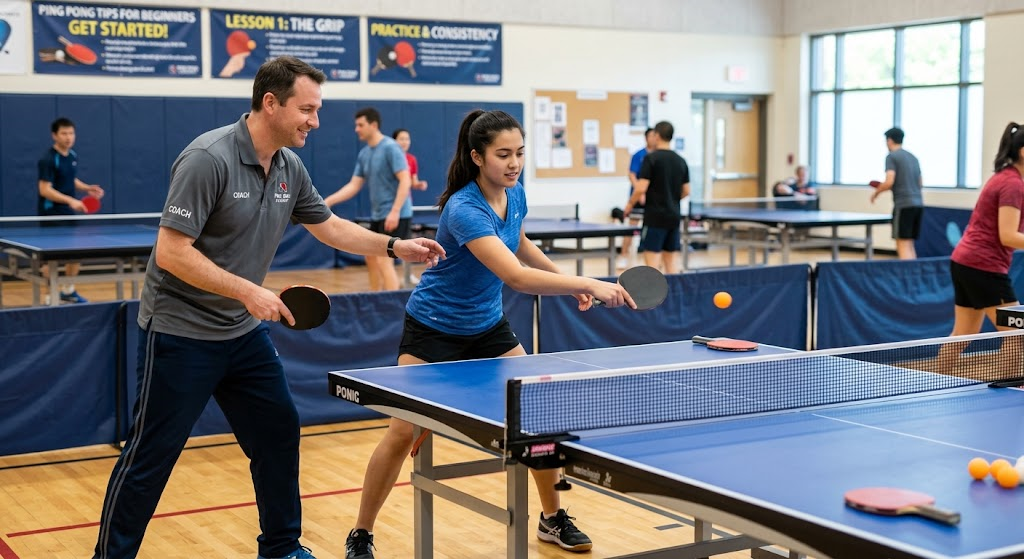
Ping Pong Tips for Beginners: How to Improve Your Forehand, Backhand, and Footwork
Learning how to play ping pong can be surprisingly easy. Learning how to play it well is a different story.
A beginner can pick up a paddle, hit a few balls back and forth, and start enjoying the game within minutes. But once you begin playing regularly, you quickly discover that good ping pong requires much more than simply getting the ball over the net. Your grip, stance, timing, footwork, swing, contact point, balance, and shot selection all work together.
The good news is that beginners do not need to master everything at once.
The fastest way to improve is to build a strong foundation and develop good habits before trying to hit spectacular shots. Consistency should come before power. Control should come before speed. Footwork should come before trying to reach difficult balls with your arm alone.
This guide focuses on three of the most important areas for developing players: the forehand, backhand, and footwork. It also explains how those skills work together, how to practice them, what mistakes beginners commonly make, and how to create a simple training routine that produces noticeable improvement.
If you are just getting started, you may also want to read our Ultimate Beginner’s Guide to Ping Pong, which provides a broader introduction to the sport, equipment, rules, techniques, and strategy.
Why Beginners Should Focus on Fundamentals
One of the biggest mistakes new ping pong players make is trying to improve by simply playing more games.
Playing games is fun, and it certainly helps. But playing without focusing on technique can reinforce bad habits.
For example, imagine a beginner who constantly reaches for balls with the paddle instead of moving their feet. They may successfully return many shots during casual games. However, they are also teaching themselves to rely on poor positioning.
Eventually, their opponents become better and hit balls farther away from them. Suddenly, the player’s lack of footwork becomes a major weakness.
The same thing happens with strokes.
A player who swings wildly at every ball may occasionally hit spectacular shots. Unfortunately, they are also practicing inconsistency hundreds of times.
Effective practice should have a purpose.
Rather than simply asking, “How many balls can I hit?” ask questions such as:
- Am I maintaining balance?
- Am I starting in a good ready position?
- Am I contacting the ball consistently?
- Am I moving toward the ball instead of reaching?
- Am I controlling my swing?
- Am I recovering after every shot?
- Am I watching the ball through contact?
- Am I making the same basic motion repeatedly?
Those habits create the foundation for future improvement.
The Three Foundations of Beginner Ping Pong
Although ping pong involves many different skills, beginners should concentrate heavily on three interconnected areas:
- Forehand technique
- Backhand technique
- Footwork and positioning
These skills are connected.
Good footwork puts your body in position to execute your forehand or backhand correctly. Good strokes allow you to control the ball once you reach it. Good recovery gets you back into position for the next shot.
Think of the process as:
Move → Position → Hit → Recover
If one part breaks down, the entire sequence becomes more difficult.
Start With the Right Ready Position
Before discussing the individual strokes, it is important to understand where your body should be before the ball comes toward you.
The ready position is your starting position for almost every rally.
Stand with your feet approximately shoulder-width apart, although the exact width can vary depending on your body type and playing style.
Keep your knees slightly bent.
Your weight should be toward the balls of your feet rather than sitting heavily on your heels.
Your upper body should lean slightly forward.
Keep your paddle in front of your body.
Your elbows should remain comfortably bent rather than locked.
Your shoulders should be relaxed.
You should feel prepared to move in either direction.
The ready position should not feel rigid.
You are essentially creating an athletic position from which you can quickly move, rotate, swing, or adjust.
One useful test is to imagine that someone could throw a ball toward either side of you at any moment. You should feel capable of moving in either direction without first having to completely reposition your body.
Ping Pong Forehand Basics
The forehand is one of the first shots most beginners learn, and it can become one of the most important weapons in a player’s game.
A good forehand combines several elements:
- Stance
- Rotation
- Arm movement
- Paddle angle
- Contact point
- Timing
- Recovery
The biggest mistake is thinking that a forehand comes primarily from the arm.
It doesn’t.
A good forehand uses the entire body.
Forehand Starting Position
Begin with your feet roughly shoulder-width apart.
For a traditional right-handed forehand, your right foot can sit slightly behind your left foot. Left-handed players can reverse the positioning.
Keep your knees slightly bent.
Turn your upper body slightly so that your playing side is prepared to rotate toward the ball.
Your paddle should be in front of your body.
Avoid standing completely square to the table and trying to use only your arm.
The Forehand Swing
As the ball approaches, your paddle moves backward slightly.
This is your preparation.
You do not need a huge backswing.
In fact, beginners often make the mistake of taking the paddle far too far backward.
A compact swing is easier to control.
As the ball approaches the correct contact zone, rotate your body toward the ball.
Your waist, hips, shoulders, arm, and forearm should work together.
The paddle moves forward and contacts the ball.
After contact, allow the paddle to continue naturally through the shot.
Then return toward your ready position.
The goal is not to make every forehand as powerful as possible.
The goal is to make the same basic motion repeatedly.
Where Should You Contact the Ball?
Timing is one of the most important aspects of a successful forehand.
Beginners often wait too long and allow the ball to get too close to their body.
Instead, try to make contact in front of your body.
The exact contact point depends on the type of shot and your individual technique, but the general principle is important:
Don’t let the ball get trapped beside you.
When the ball is comfortably in front of you, you have more room to swing and control the direction.
Contacting the ball too late often causes players to:
- Jam their swing
- Lose balance
- Hit the ball into the net
- Send the ball too far
- Lose control of placement
Timing improves through repetition.
Don’t Try to Crush Every Forehand
Power is exciting.
It is also one of the biggest traps for beginners.
A player hits one hard forehand and sees the ball fly across the table. They immediately want to hit every ball that way.
The problem is that maximum power requires excellent timing and control.
Instead, start by developing a reliable medium-speed forehand.
Your goal might be to successfully hit 20, 30, or 50 controlled forehands in a row during practice.
Once your technique becomes consistent, gradually increase speed.
Power should be the result of good technique, not a substitute for it.
Forehand Drill for Beginners
One of the simplest ways to improve is a controlled forehand-to-forehand rally.
Have a partner stand across the table and return the ball consistently to your forehand.
Your objective is not to win the point.
Your objective is to establish a rhythm.
Start slowly.
Focus on:
- Ready position
- Short preparation
- Body rotation
- Controlled contact
- Follow-through
- Recovery
Once you can maintain a steady rally, gradually increase the pace.
This drill teaches something that games often don’t: repetition.
Ping Pong Backhand Basics
The backhand is equally important.
Modern ping pong players frequently use the backhand for quick exchanges close to the table, aggressive attacks, blocks, returns, and topspin.
For beginners, the backhand can initially feel awkward because the stroke occurs directly in front of the body rather than beside it.
The solution is not to make the stroke complicated.
Keep it compact.
Backhand Starting Position
Start in your ready position.
Keep the paddle in front of your body.
Your elbows should remain comfortably bent.
Instead of taking the paddle far behind you, prepare with a relatively short movement.
The backhand generally requires less backswing than a beginner might expect.
Executing the Backhand
As the ball approaches, move your paddle into position.
Use a compact forward motion to contact the ball.
Your forearm and wrist can contribute to the shot, but beginners should avoid trying to generate everything with the wrist.
Your body should remain balanced.
After contact, recover the paddle toward your ready position.
Think of the motion as compact and efficient.
A good beginner backhand does not need to look dramatic.
The Importance of the Backhand Contact Point
Just as with the forehand, timing matters.
Try to contact the ball in front of your body rather than allowing it to get too far to the side.
If the ball gets too close to your body, your swing becomes restricted.
If you reach too far, you may lose balance.
The ideal contact zone will vary somewhat depending on your stroke and the incoming ball, but your objective should always be to position your body so that the ball is comfortable to play.
That is where footwork becomes essential.
Backhand Drill for Beginners
A simple backhand-to-backhand rally is an excellent starting exercise.
Have your partner consistently return balls toward your backhand.
Begin at a comfortable pace.
Try to keep your strokes compact and repeatable.
Don’t worry about winning points.
Count how many consecutive returns you can make.
Then try to beat your previous number.
For example:
- Day 1: 12 consecutive shots
- Day 2: 20
- Day 3: 27
- Day 4: 35
This gives you a measurable goal.
Forehand vs. Backhand: Which Should You Practice More?
The answer is both.
Beginners sometimes develop a favorite side and avoid their weaker stroke.
That is understandable.
It is also dangerous.
If you have a great forehand but a weak backhand, an opponent will eventually discover that weakness and target it.
You should therefore develop both strokes.
However, there is nothing wrong with eventually developing a preferred attacking side.
Many players build their game around a strong forehand while using the backhand for control, blocking, returning serves, or quick attacks.
The key is to make sure your backhand is reliable enough that opponents cannot easily exploit it.
Why Footwork Is More Important Than Beginners Think
A player can have beautiful strokes and still struggle badly because of poor footwork.
The reason is simple:
Your stroke can only be as good as your position allows it to be.
If the ball is too far away, you cannot execute your normal forehand properly.
If the ball is too close, your swing becomes cramped.
If the ball is behind you, you are already in trouble.
If your weight is on the wrong foot, you may not be able to move quickly enough.
Good footwork solves these problems before the stroke begins.
Stop Reaching for the Ball
This is one of the most important beginner lessons in ping pong.
When the ball moves toward the side of the table, beginners often stretch their arm toward it.
Sometimes they can reach it.
But reaching is not the same as positioning.
Whenever possible, move your body toward the ball and then execute your stroke.
This creates better balance and more consistent contact.
Think:
Feet first, paddle second.
That simple phrase can dramatically improve your game.
The Side-to-Side Shuffle
One of the first footwork patterns beginners should learn is the side-to-side shuffle.
Start in your ready position.
Move laterally toward the ball.
Keep your feet relatively close to the floor rather than taking huge steps.
Avoid crossing your legs unnecessarily during basic lateral movement.
After hitting the ball, recover toward your central playing position.
Then prepare for the next shot.
The movement should be quick but controlled.
Don’t Stand Flat-Footed
A flat-footed player is slow to react.
You don’t need to bounce constantly, but you should remain active.
Keep your knees slightly bent.
Maintain your weight toward the balls of your feet.
Stay mentally ready to move.
Think of yourself as an athlete rather than someone simply standing at a table.
This becomes increasingly important as rallies become faster.
Understanding Recovery
One of the most overlooked parts of ping pong technique is what happens immediately after you hit the ball.
Beginners often admire their shot.
They watch it travel across the table.
Then they realize the opponent has already returned it.
By then, they are out of position.
Every shot should include a recovery phase.
After you hit:
- Finish the stroke.
- Regain balance.
- Return toward your ready position.
- Watch your opponent.
- Prepare for the next ball.
You don’t necessarily have to return to exactly the same spot after every shot. Good players adjust their positioning based on the shot they just played.
But you should never mentally stop after contact.
The rally is still happening.
The Two-Step Habit
For beginners, it can be helpful to think about movement in terms of small steps rather than huge lunges.
If the ball is slightly outside your comfortable hitting zone, use a quick adjustment step.
If it is farther away, use multiple small movements.
This allows you to maintain balance.
Large lunges can work in emergencies, but relying on them constantly creates recovery problems.
Small, controlled movements are usually more efficient.
Combining Forehand, Backhand, and Footwork
Eventually, you need to stop practicing each skill separately.
Real rallies are unpredictable.
One ball may come to your forehand.
The next may go toward your backhand.
Then another may land directly in the middle.
This is called the transition between strokes.
A useful beginner drill is alternating forehands and backhands.
Have your partner feed one ball toward your forehand and the next toward your backhand.
Your goal is to:
- Move your feet
- Adjust your body
- Execute the appropriate stroke
- Recover
- Move again
This teaches your body to connect the three major skills.
The Crossover Point: Where Forehand and Backhand Meet
The area around the middle of your body can create confusion.
Beginners often don’t know whether they should use their forehand or backhand when a ball comes toward the center.
This area is sometimes referred to as the crossover point.
There is no universal rule saying that every ball in the middle must be played with one particular stroke.
Instead, you should learn to make quick decisions based on:
- Ball speed
- Ball placement
- Your position
- Spin
- Time available
- Your strengths
- Your opponent’s placement
Early in your development, don’t obsess over making the perfect choice every time.
Focus on recognizing the ball early and moving decisively.
Improve Your Timing by Watching the Ball
Many beginners watch the ball only until it bounces.
That’s not enough.
Try to track the ball through the entire sequence:
Opponent contact → Ball flight → Bounce → Your contact
Watching the opponent’s paddle can also provide valuable information.
You can sometimes detect:
- Direction
- Speed
- Spin
- Contact quality
- Intended placement
Developing good visual habits can make the game feel slower because you are recognizing information earlier.
Don’t Watch Your Own Paddle
This may sound obvious, but beginners sometimes look down at their paddle during the stroke.
Your attention should remain on the ball and your opponent.
You already know where your paddle is supposed to be.
Trust your technique.
Your eyes should gather information about the ball.
How Grip Affects Your Strokes
Your grip influences your forehand, backhand, control, and ability to transition between shots.
There are several recognized ping pong grips, including the shakehand grip and penhold grip.
For many beginners, the shakehand grip is the easiest starting point because it provides a relatively natural position for developing both forehand and backhand strokes.
Whatever grip you use, avoid squeezing the paddle excessively.
A death grip creates tension.
Excessive tension can make your movements slower and reduce your ability to make subtle adjustments.
Hold the paddle securely but comfortably.
For a deeper discussion of equipment and paddle selection, see our Ping Pong Equipment Guide: Choosing the Right Paddle, Balls, Table, and Gear.
Don’t Overuse Your Wrist
Beginners often believe they need a lot of wrist action to create spin.
Eventually, advanced players do use their wrists in sophisticated ways.
But beginners should first develop control through proper body positioning, swing mechanics, and contact.
If you try to generate everything with your wrist, your shots can become unpredictable.
Start with a stable stroke.
Then gradually learn how wrist movement influences spin and speed.
Our article How to Put Spin on a Ping Pong Ball: Topspin, Backspin, Sidespin, and More goes much deeper into this subject.
Learn to Control the Ball Before Adding Speed
One of the most valuable ping pong tips for beginners is simple:
Control beats power.
Imagine two players.
Player A can hit the ball extremely hard but makes a mistake every third shot.
Player B hits at moderate speed but keeps the ball on the table.
Player B will often win more points.
Consistency forces opponents to beat you.
Wild shots give opponents free points.
Your first goal should be reliable placement.
Then gradually add speed.
Practice Placement, Not Just Repetition
Hitting the ball back and forth is useful.
But eventually, you need to control where the ball goes.
Practice aiming for:
- Deep forehand
- Deep backhand
- Short forehand
- Short backhand
- Middle of the table
- Opponent’s crossover area
You don’t need perfect accuracy immediately.
Instead, create targets.
For example, place a piece of removable tape or another safe marker near an intended target area.
Try to hit that area repeatedly.
This turns practice into a skill-building exercise rather than simple ball hitting.
The Importance of the Middle
Many beginners think only about the corners.
Experienced players understand the value of the middle.
A ball directed toward an opponent’s crossover area can force them to make a decision.
Should they use their forehand?
Their backhand?
Should they move?
Can they reach it comfortably?
These decisions can create opportunities.
That doesn’t mean you should hit every ball toward the middle.
It means you should recognize that the middle can be an important tactical target.
Practice Against Different Ball Locations
A strong beginner practice session should eventually include several locations.
Ask a partner to feed balls:
- To your forehand
- To your backhand
- To your middle
- Wide to your forehand
- Wide to your backhand
- Alternating between sides
This teaches you to move instead of standing in one location and waiting.
Don’t Neglect the Short Ball
Beginners often practice only balls that come comfortably to them.
Real matches include short balls.
When a ball lands short, you may need to move forward rather than backward.
This requires quick footwork and balance.
Practice moving toward the table, playing the ball, and recovering.
Learning to move both forward and sideways will make you a much more complete player.
Beginner Footwork Drill: The Shadow Drill
You don’t always need a table or another player to practice footwork.
Shadow practice can be extremely useful.
Stand in your ready position.
Imagine a ball going toward your forehand.
Move into position.
Perform your forehand motion.
Recover.
Then imagine a ball going toward your backhand.
Move.
Perform the backhand.
Recover.
Repeat.
You can perform this exercise for several minutes.
The goal is to teach your body to connect movement and stroke mechanics.
Don’t rush.
Quality matters more than speed.
Beginner Footwork Drill: Random Placement
Once you become comfortable with basic movement, have a partner randomly place balls around the table.
They don’t need to hit them hard.
Your job is simply to move and return them.
This drill is valuable because you don’t know where the next ball will go.
That forces you to react rather than memorize a pattern.
Practice One Skill at a Time
A common problem with practice sessions is trying to work on everything simultaneously.
Instead, dedicate portions of your practice to individual skills.
For example:
First 10 minutes
Forehand consistency.
Next 10 minutes
Backhand consistency.
Next 10 minutes
Forehand/backhand transitions.
Next 10 minutes
Footwork and random placement.
Final 10 minutes
Controlled games.
This gives your practice structure.
A Simple 30-Minute Beginner Practice Routine
If you only have 30 minutes, try this:
Minutes 1–5: Warm-up
Perform light movement and easy rallies.
Focus on balance and relaxed technique.
Minutes 6–12: Forehand
Practice controlled forehand rallies.
Don’t chase maximum speed.
Minutes 13–19: Backhand
Practice controlled backhand rallies.
Focus on compact movement.
Minutes 20–25: Footwork
Alternate between forehand and backhand locations.
Concentrate on moving your feet.
Minutes 26–30: Points
Play controlled points.
But give yourself a specific goal.
For example:
- No unnecessary power shots
- Recover after every stroke
- Move before reaching
- Aim for a specific target
- Focus on serve and first attack
This turns games into purposeful practice.
Practice the First Three Shots
One of the best ways to transition from practice to competitive play is to work on the first three shots of the rally.
The sequence is:
- Your serve
- Opponent’s return
- Your next shot
Your objective is to understand what you want to do after serving.
This connects your serving technique with your forehand, backhand, footwork, and strategy.
For more information about developing your serve, see How to Improve Your Ping Pong Serve: Techniques, Spin, and Placement.
Use Your Stronger Stroke Without Ignoring Your Weakness
As your game develops, you will probably discover that one side feels more natural.
Maybe your forehand becomes your favorite shot.
Maybe your backhand feels more comfortable.
That’s perfectly normal.
Use your strengths.
But continue improving your weakness.
A smart player doesn’t simply ask:
“What is my best shot?”
They also ask:
“How can I prevent my opponent from attacking my weakest area?”
That distinction becomes increasingly important as you move into competitive play.
Common Beginner Mistakes With Forehands
Here are some of the most common forehand problems.
Swinging Too Hard
Power replaces control.
Fix: Reduce your swing speed and focus on clean contact.
Using Only the Arm
The stroke becomes stiff.
Fix: Incorporate your hips and torso.
Taking Too Large a Backswing
You run out of time.
Fix: Use a shorter preparation.
Contacting Too Late
The ball gets too close.
Fix: Move earlier and contact the ball in front.
Forgetting to Recover
You finish the shot and remain out of position.
Fix: Make recovery part of every repetition.
Common Beginner Mistakes With Backhands
Taking the Paddle Too Far Back
The stroke becomes slow.
Fix: Keep the preparation compact.
Overusing the Wrist
The paddle becomes difficult to control.
Fix: Stabilize the basic motion first.
Standing Too Upright
Movement becomes slower.
Fix: Bend your knees slightly and maintain an athletic stance.
Not Watching the Ball
Timing suffers.
Fix: Track the ball all the way into contact.
Common Beginner Footwork Mistakes
Reaching Instead of Moving
The player stretches their arm toward the ball.
Fix: Move your feet first whenever possible.
Standing Flat-Footed
The player reacts too slowly.
Fix: Stay balanced and ready.
Taking Huge Steps
Recovery becomes difficult.
Fix: Use smaller adjustment steps.
Watching the Shot
The player admires the return.
Fix: Recover immediately.
Moving Too Late
The player waits until the ball is already beside them.
Fix: Read the opponent’s contact earlier.
Our article Common Ping Pong Mistakes Beginners Make and How to Fix Them explores these and many other problems in greater detail.
How Long Does It Take to Get Better at Ping Pong?
There is no universal timeline.
Improvement depends on:
- How often you practice
- Quality of instruction
- Your athletic background
- Practice partners
- Equipment
- Starting skill level
- How deliberately you practice
Someone who practices thoughtfully three times a week can improve dramatically.
Someone who plays once every few months may improve much more slowly.
The important thing is consistency.
You don’t need to practice for hours every day.
Regular, focused practice is more valuable than occasional marathon sessions.
Track Your Progress
One of the best ways to stay motivated is to record measurable improvements.
Track things such as:
- Longest forehand rally
- Longest backhand rally
- Number of successful serves
- Number of successful returns
- Accuracy against specific targets
- Footwork drill completion
- Match results
- Unforced errors
You can also write down one technical goal after each practice session.
For example:
Today’s goal: Recover to ready position after every forehand.
Next session:
Today’s goal: Reduce late contact on backhands.
This creates a progression rather than simply playing without direction.
Don’t Judge Improvement Only by Wins and Losses
Winning is fun.
Losing is not necessarily evidence that you are getting worse.
If you’re working on a new technique, your performance may temporarily decline.
For example, suppose you are learning to use proper footwork.
At first, you might make more mistakes because you are consciously thinking about moving your feet.
That’s normal.
Eventually, the movement becomes automatic.
Judge improvement by technique as well as results.
Ask:
- Am I more consistent?
- Am I moving better?
- Am I making fewer unforced errors?
- Can I control placement?
- Can I return more serves?
- Can I maintain longer rallies?
Those improvements eventually show up on the scoreboard.
When Should You Start Learning Spin?
You should learn basic spin relatively early, but don’t let it replace your fundamentals.
A beginner who cannot consistently control a simple ball will struggle to control heavy spin.
Build the foundation first.
Then introduce:
- Topspin
- Backspin
- Sidespin
- No-spin
- Spin variation
Understanding spin will eventually transform your game.
It affects your serve, return, rally shots, placement, and strategy.
Our dedicated guide How to Put Spin on a Ping Pong Ball: Topspin, Backspin, Sidespin, and More provides a much deeper explanation.
Learn to Read Spin
Producing spin is only half the battle.
You also need to recognize the spin coming from your opponent.
A ball with heavy backspin behaves differently from a ball with topspin.
A sidespin ball may curve or bounce differently.
Learning to read the opponent’s paddle contact is therefore extremely valuable.
Watch:
- Paddle angle
- Swing direction
- Contact point
- Ball trajectory
- Bounce behavior
At first, this may feel confusing.
With experience, you will start recognizing patterns.
Strategy Comes After Fundamentals
Once your forehand, backhand, and footwork become more reliable, you can begin thinking more deeply about tactics.
That includes:
- Placement
- Tempo
- Spin variation
- Attacking weaknesses
- Changing direction
- Serving combinations
- Return placement
- Rally patterns
Our guide Ping Pong Strategies and Tactics: How to Outsmart Your Opponent goes further into the strategic side of the sport.
The important point is that strategy works best when your technique can execute the plan.
Knowing exactly where you want to hit the ball doesn’t help if you cannot control the shot.
Play Against Better Players
One of the best ways to improve is to play people who are better than you.
You may lose.
That’s okay.
Better players expose weaknesses.
They may force you to:
- Move more
- Return better serves
- Handle more spin
- Improve your consistency
- Recover faster
- Think about placement
Instead of becoming frustrated, treat those matches as lessons.
Afterward, identify one or two things you struggled with.
Then practice them.
Don’t Try to Fix Everything at Once
This may be the most important piece of advice in this entire article.
Ping pong contains an enormous number of technical details.
You cannot fix all of them simultaneously.
Choose one.
For example:
Week 1: Ready position
Week 2: Forehand consistency
Week 3: Backhand consistency
Week 4: Lateral footwork
Week 5: Forehand/backhand transitions
Week 6: Serve and third-ball attack
You don’t have to follow this exact schedule.
The point is to give yourself manageable objectives.
The Beginner’s Ping Pong Checklist
Before each practice session, remind yourself:
Stance
- Knees slightly bent
- Weight balanced
- Paddle in front
- Body relaxed
Forehand
- Compact preparation
- Rotate the body
- Contact in front
- Controlled follow-through
- Recover
Backhand
- Compact motion
- Stable paddle
- Contact in front
- Controlled acceleration
- Recover
Footwork
- Move before reaching
- Stay balanced
- Use small adjustment steps
- Watch the opponent
- Recover after every shot
Mental approach
- Don’t chase power
- Don’t panic after mistakes
- Practice deliberately
- Focus on consistency
- Learn from stronger players
The Most Important Ping Pong Tip for Beginners
If you remember only one thing from this article, remember this:
Get your body to the ball before asking your paddle to save you.
Good footwork makes good strokes possible.
Once you are positioned correctly, your forehand or backhand becomes much easier to execute.
That is why footwork should not be treated as an advanced skill that comes later.
It should be part of your game from the beginning.
How the Three Skills Work Together
Imagine a simple rally.
Your opponent hits toward your forehand.
You recognize the direction.
Your feet move.
Your body gets into position.
You execute your forehand.
The ball travels toward your opponent.
You recover.
Your opponent changes direction.
Now the ball is coming toward your backhand.
You move again.
You execute your backhand.
You recover.
That is ping pong.
The individual strokes are important, but the transitions between them are just as important.
Your ultimate objective isn’t to have a great forehand sitting in isolation.
It is to build a system in which your eyes, brain, feet, body, and paddle work together.
Final Thoughts
Getting better at ping pong doesn’t require you to become a power hitter immediately.
It doesn’t require expensive equipment.
It doesn’t require complicated techniques.
It requires a willingness to build good habits.
Start with your ready position.
Develop a controlled forehand.
Develop a reliable backhand.
Learn to move your feet.
Recover after every shot.
Practice placement.
Build consistency.
Then gradually introduce more speed, spin, deception, and strategy.
The best players make difficult movements look simple because they have built strong fundamentals through thousands of repetitions.
As a beginner, your goal isn’t to look like an advanced player.
Your goal is to become a better version of yourself every time you practice.
Once your fundamentals begin to click, the game becomes more enjoyable because you stop simply reacting to the ball and start controlling the rally.
And that is when ping pong really starts to become a game of skill, strategy, movement, and anticipation.
Continue Learning: The Ping Pong Beginner’s Cluster
This article is part of The Sports Utopia’s comprehensive ping pong learning series. Continue building your knowledge with these related guides:
- The Ultimate Beginner’s Guide to Ping Pong (Table Tennis): Rules, Equipment, Skills, and How to Play
- Ping Pong Rules Explained: How to Play, Score Points, and Win Games
- Ping Pong Equipment Guide: Choosing the Right Paddle, Balls, Table, and Gear
- How to Improve Your Ping Pong Serve: Techniques, Spin, and Placement
- How to Put Spin on a Ping Pong Ball: Topspin, Backspin, Sidespin, and More
- Ping Pong Strategies and Tactics: How to Outsmart Your Opponent
- Common Ping Pong Mistakes Beginners Make and How to Fix Them
- Ping Pong Tournaments and Competitive Table Tennis: How Competition Works
The more you understand the fundamentals, the easier it becomes to understand the more advanced aspects of table tennis.
Start with the basics.
Practice with purpose.
Move your feet.
Control the ball.
And most importantly, have fun.