
The Ultimate Beginner’s Guide to Rock Climbing
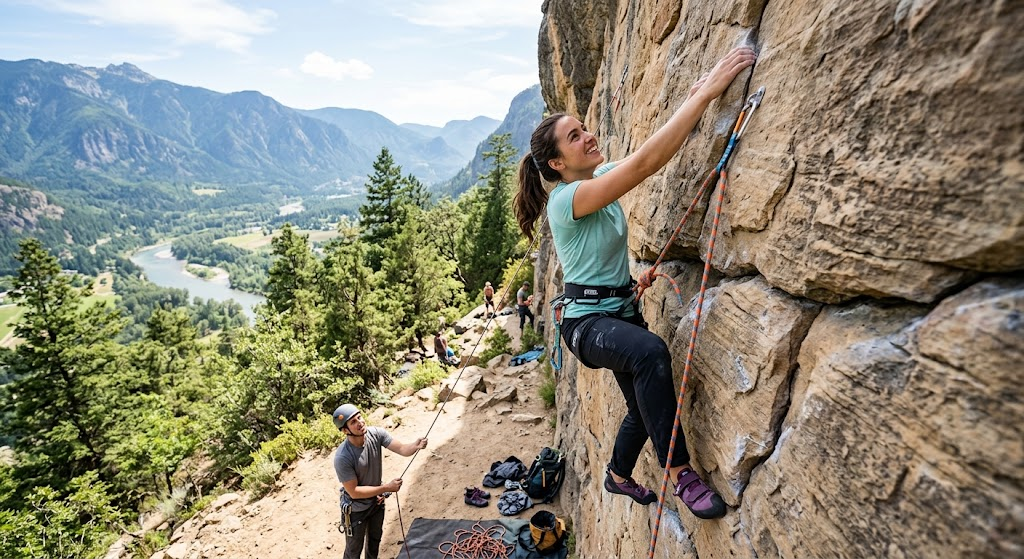
The Ultimate Beginner’s Guide to Rock Climbing: Types, Equipment, Techniques, Safety, and How to Get Started
Rock climbing looks intimidating when you have never done it before.
You may see climbers hanging from seemingly impossible positions, moving across steep walls, gripping tiny holds with their fingertips, and somehow making difficult movements look effortless. It is easy to assume that rock climbing is a sport reserved for exceptionally strong, fearless, or athletic people.
That assumption is wrong.
Rock climbing is a remarkably diverse sport. Some forms take place indoors on relatively short climbing walls. Others involve enormous outdoor cliffs and multi-pitch routes. Some require ropes and specialized equipment, while others involve climbing only a few feet above thick landing pads. Some climbers focus on strength and explosive movement, while others rely heavily on balance, technique, flexibility, and problem-solving.
That variety is one of the things that makes climbing so appealing.
You can climb recreationally, competitively, socially, or as a lifelong outdoor pursuit. You can start at a climbing gym without owning a single piece of equipment. You can climb alone on a bouldering wall or work with a partner on a roped route. You can concentrate on physical fitness, mental challenges, adventure, or some combination of all three.
But before you head to a climbing gym or outdoor crag, it helps to understand what you are getting into.
This Ultimate Beginner’s Guide to Rock Climbing explains the sport from the ground up, including the different types of climbing, essential equipment, basic techniques, training, route grading, safety, climbing terminology, indoor and outdoor climbing, and how to take your first steps into the sport.
If you are completely new to climbing, don’t worry about understanding everything immediately. Rock climbing has its own vocabulary and techniques, and becoming comfortable with them takes time.
The goal is to give you a solid foundation and show you where to go next.
What Is Rock Climbing?
Rock climbing is the activity of ascending a natural rock formation or an artificial climbing wall using physical movement, technique, equipment, or a combination of these.
The objective may simply be reaching the top of a route, completing a designated sequence of movements, or solving a particular climbing problem.
Unlike many traditional sports, climbing does not always have a single opponent.
Often, the challenge is the wall itself.
A climber has to determine:
- Where to put their hands
- Where to place their feet
- How to position their body
- When to move
- How to conserve energy
- How to manage fear
- How to solve difficult sections
- How to reach the finish
That combination of physical and mental challenges is a major reason climbing attracts people who may not consider themselves traditional athletes.
Why Is Rock Climbing So Popular?
Rock climbing has grown dramatically in popularity, particularly with the expansion of indoor climbing gyms.
Indoor facilities make climbing accessible to people who may live nowhere near mountains or natural cliffs.
A person living in a city can walk into a climbing gym and experience the sport without traveling into the wilderness.
Climbing also appeals to a wide range of people.
You do not have to be young, exceptionally muscular, or naturally fearless.
Good climbing involves much more than strength.
Technique, balance, body positioning, flexibility, timing, route reading, and patience can make an enormous difference.
For many people, climbing also provides a social environment.
You can climb with friends, meet other climbers, take lessons, join a club, or eventually travel to outdoor climbing destinations.
Is Rock Climbing a Sport or an Adventure Activity?
It can be both.
Competitive climbing is clearly a sport. Athletes train, compete, follow rules, and attempt to outperform other competitors.
Outdoor climbing can also be an adventure activity.
A climber may travel to a remote area, hike to a cliff, climb a route, and spend the day experiencing nature.
Some people are primarily interested in competition.
Others have no interest in competition whatsoever.
Some love indoor bouldering.
Others dream of climbing large outdoor walls.
There is no single “correct” way to enjoy climbing.
The Different Types of Rock Climbing
One of the first things beginners discover is that rock climbing is not one single activity.
There are several major disciplines, and understanding the differences is important before deciding what you want to try.
The most common forms include:
- Bouldering
- Top-rope climbing
- Sport climbing
- Lead climbing
- Traditional climbing
- Multi-pitch climbing
- Big-wall climbing
- Alpine climbing
- Aid climbing
- Free climbing
- Free soloing
These disciplines can vary dramatically in equipment, difficulty, environment, and risk.
Our upcoming guide Types of Rock Climbing Explained: Bouldering, Sport Climbing, Trad Climbing, Top-Rope, and More will examine these disciplines in much greater detail.
For now, the following overview provides the basic distinctions.
Bouldering
Bouldering involves climbing relatively short routes without using a rope system.
Instead, climbers typically use thick crash pads to help protect against falls.
Bouldering is common in climbing gyms and outdoors.
Indoor bouldering walls are generally designed with a variety of angles, holds, and problems.
Because routes are short, bouldering often emphasizes:
- Power
- Technique
- Balance
- Explosive movement
- Problem-solving
- Body control
Bouldering is one of the easiest ways for a beginner to experience climbing because you generally do not need to learn rope systems before getting started.
However, short does not mean easy.
Some bouldering problems can require extraordinary strength and technique.
Top-Rope Climbing
Top-rope climbing uses a rope that is generally anchored above the climber.
The rope runs from the climber to the anchor and back down to a belayer.
Because the rope is already positioned above the climber, top-rope climbing can provide a relatively controlled introduction to roped climbing.
It is common in climbing gyms and instructional settings.
Top-rope climbing allows beginners to concentrate heavily on learning movement and technique while becoming comfortable with height.
Sport Climbing
Sport climbing generally involves routes equipped with fixed protection points.
A lead climber clips the rope into protection as they ascend.
Sport climbing requires additional skills beyond top-rope climbing, including lead-climbing techniques and appropriate rope management.
It is practiced indoors and outdoors.
Traditional Climbing
Traditional, or “trad,” climbing involves placing removable protection into suitable cracks and other features in the rock.
The leader places protective equipment during the ascent and removes it afterward.
Trad climbing requires significant knowledge and experience.
It is not generally considered a beginner’s introduction to outdoor climbing.
Proper instruction is extremely important before attempting it.
Lead Climbing
Lead climbing means the climber is ascending while managing the rope and protection rather than having the rope already secured above them in the same manner as top-rope climbing.
Lead climbing may occur on sport routes or traditional routes.
It introduces additional responsibilities and requires training beyond basic climbing movement.
Multi-Pitch Climbing
Some outdoor routes are much longer than a single rope length.
These routes can require multiple sections, or pitches.
Climbers may establish or use belay stations along the route and continue upward in stages.
Multi-pitch climbing introduces additional considerations involving:
- Rope management
- Communication
- Anchors
- Route finding
- Time management
- Weather
- Retreat options
It is an advanced form of climbing and should be approached with appropriate experience.
Free Climbing vs. Free Soloing
These terms are sometimes confused.
Free climbing generally means using your hands and feet to make upward progress while climbing, while equipment is primarily used for protection rather than as a means of upward movement.
Free soloing is climbing without a rope or protective climbing system.
That distinction is extremely important.
Free soloing carries potentially catastrophic consequences from falls and is not appropriate as a beginner activity.
Indoor vs. Outdoor Rock Climbing
For most beginners, indoor climbing is the easiest place to start.
Indoor climbing gyms provide controlled environments, established routes, trained staff, rental equipment, and instructional opportunities.
Outdoor climbing introduces additional variables.
You may have to deal with:
- Weather
- Rock quality
- Route finding
- Natural hazards
- Wildlife
- Approach hikes
- Anchors
- Access restrictions
- Environmental concerns
- Limited services
Outdoor climbing can be incredibly rewarding, but beginners should not assume that outdoor climbing is simply indoor climbing moved outside.
It isn’t.
Our article Rock Climbing Outdoors: How to Transition From the Gym to Real Rock will explore that transition in detail.
What Equipment Do You Need for Rock Climbing?
One of the best things about starting indoor climbing is that you may not need to buy much equipment.
Many climbing gyms rent basic gear.
Depending on the type of climbing, equipment may include:
- Climbing shoes
- Harness
- Climbing rope
- Belay device
- Carabiners
- Helmet
- Chalk
- Chalk bag
- Quickdraws
- Slings
- Protection devices
- Crash pads
The equipment you need depends heavily on the discipline.
A beginner doing indoor bouldering does not need the same equipment as someone preparing for a multi-pitch traditional climbing expedition.
Climbing Shoes
Climbing shoes are specifically designed to provide traction and precision on climbing surfaces.
They generally fit much more closely than ordinary athletic shoes.
That does not mean they should be painfully tight.
Beginners sometimes assume that extreme discomfort is evidence of a good climbing shoe.
It isn’t.
A properly selected climbing shoe should provide the necessary support and sensitivity without causing unreasonable pain.
Harnesses
A climbing harness is used with roped climbing systems.
It connects the climber to the rope through the appropriate attachment points and helps distribute forces during a fall.
Harnesses come in different designs for different activities.
A beginner at a climbing gym can often rent one rather than immediately purchasing one.
Ropes
Climbing ropes are specialized equipment designed for climbing applications.
They are not ordinary household rope.
Different climbing activities require different rope systems and rope characteristics.
Rope care and inspection are extremely important.
A damaged or improperly used rope can have serious consequences.
Helmets
Helmets can protect climbers from certain impacts and falling objects.
They are particularly important in outdoor climbing environments where rockfall and other hazards may exist.
A climbing helmet is not simply a bicycle helmet used for climbing.
Climbing-specific equipment should be selected for its intended purpose.
Chalk
Chalk helps reduce moisture on the hands and can improve grip.
It is widely used in indoor and outdoor climbing.
You may see climbers carrying chalk in a small chalk bag around their waist or using chalk containers at bouldering areas.
Chalk is useful, but it does not replace proper technique.
Don’t Buy Everything at Once
A common beginner mistake is assuming that serious climbers need enormous collections of equipment.
They don’t.
If you are starting at a climbing gym, renting equipment can allow you to discover whether you actually enjoy climbing before investing heavily.
As your interests develop, your equipment needs will become clearer.
Our dedicated Rock Climbing Equipment Guide: Shoes, Harnesses, Ropes, Chalk, Helmets, and Essential Gear will cover equipment choices in much greater depth.
Basic Rock Climbing Techniques
Climbing technique is one of the most important subjects for beginners.
Many new climbers believe they need tremendous upper-body strength.
They soon discover that technique can be just as important.
Good climbers often use their legs and body position efficiently rather than attempting to pull themselves upward with their arms alone.
Important fundamentals include:
- Footwork
- Balance
- Body positioning
- Grip
- Hip movement
- Weight shifting
- Route reading
- Efficient movement
- Recovery
- Breathing
Use Your Legs
One of the first lessons many beginners learn is:
Your legs are extremely important.
New climbers often pull themselves upward with their arms while barely using their legs.
This quickly creates fatigue.
Your legs contain powerful muscles capable of supporting and moving your body efficiently.
Learning to stand on small footholds and push upward can dramatically change the way climbing feels.
Don’t Grip Everything as Hard as Possible
Another common beginner mistake is gripping every hold with maximum force.
That wastes energy.
Not every hold requires the same amount of grip.
Learning to recognize when you can relax your hands, straighten your arms, and shift your weight can dramatically increase endurance.
Climbing is often about using exactly as much effort as necessary rather than as much effort as possible.
Body Position Matters
Your body position can determine whether a move feels easy or impossible.
Small changes in:
- Hip position
- Shoulder position
- Foot placement
- Knee angle
- Center of gravity
can make a major difference.
A climber who understands body positioning can sometimes complete a move that initially seemed beyond their strength.
Footwork Is a Skill
Good footwork allows you to:
- Maintain balance
- Save energy
- Reach farther
- Reduce unnecessary movement
- Position your body correctly
- Transfer weight efficiently
Beginners should spend significant time learning to place their feet accurately.
Looking at where your feet go can be just as important as watching your hands.
Common Climbing Techniques
As you progress, you will encounter techniques with names such as:
- Edging
- Smearing
- Flagging
- Mantling
- Laybacking
- Gastons
- Underclings
- Heel hooks
- Toe hooks
- Drop knees
- Stemming
- Dynos
These techniques may sound complicated initially.
They become much easier to understand once you see how they solve specific movement problems.
Our dedicated article Rock Climbing Techniques: Footwork, Grip, Body Position, Balance, and Efficient Movement will break these techniques down and explain when they are useful.
How Strong Do You Need to Be to Rock Climb?
You do not need to be exceptionally strong to begin.
In fact, beginners can become much stronger simply by climbing regularly.
Climbing develops several physical qualities, including:
- Grip strength
- Forearm endurance
- Pulling strength
- Core strength
- Leg strength
- Balance
- Coordination
- Mobility
However, strength is only one part of the equation.
Technique can allow a less powerful climber to outperform someone who is significantly stronger but inefficient.
Fitness and Rock Climbing
Climbing can provide an excellent physical workout.
Depending on the discipline and intensity, climbing can challenge your:
- Arms
- Forearms
- Shoulders
- Back
- Core
- Legs
- Cardiovascular system
But climbing fitness is highly specific.
Someone can be generally fit and still struggle with climbing because the movement patterns are unfamiliar.
Likewise, an experienced climber may have exceptional climbing endurance without looking like a traditional strength athlete.
How Do You Get Better at Rock Climbing?
Improvement generally comes from a combination of:
- Climbing regularly
- Learning technique
- Practicing weaknesses
- Building appropriate strength
- Improving flexibility and mobility
- Studying routes
- Learning from experienced climbers
- Recovering adequately
- Avoiding unnecessary injuries
One of the biggest mistakes beginners make is believing that simply climbing harder routes every session is the fastest path to improvement.
Sometimes it is better to spend time practicing technique on easier routes.
Our guide How to Get Better at Rock Climbing: Training, Strength, Endurance, Flexibility, and Practice will explore how to build a climbing-specific training approach.
Don’t Ignore Recovery
Climbing can place substantial stress on the fingers, tendons, elbows, shoulders, and forearms.
More climbing is not automatically better.
Rest allows your body to recover and adapt.
Beginners should be particularly cautious about increasing training volume too quickly.
Pain should not simply be treated as something to ignore because you want to improve faster.
Learning to distinguish normal muscular fatigue from potentially concerning pain is an important part of becoming a responsible climber.
Understanding Rock Climbing Grades
Once you visit a climbing gym, you will probably notice that routes and problems have grades.
Grades provide a way of communicating difficulty.
However, grading systems vary depending on the type of climbing and region.
Different systems may be used for:
- Bouldering
- Sport climbing
- Traditional climbing
- Alpine climbing
Even within a particular system, grades can be subjective.
One route may feel easier or harder depending on your height, strengths, technique, flexibility, and experience.
Don’t become obsessed with the number.
Grades are useful information, not a measure of your worth.
What Is a Climbing Route?
A climbing route is a designated sequence or path intended to be climbed.
Indoor gyms often identify routes using:
- Colored holds
- Tape
- Route labels
- Starting markers
- Finishing holds
A route may require you to use specific holds while navigating a particular sequence.
Bouldering problems are often called “problems” because they function almost like movement puzzles.
What Is the Crux?
The crux is generally the most difficult portion of a climbing route.
It might involve:
- A difficult reach
- Small holds
- A powerful move
- Poor footholds
- An awkward body position
- A technical sequence
Identifying the crux before climbing can help you plan.
Instead of being surprised by the difficult section, you can think about how you intend to approach it.
Route Reading: Climbing Starts Before You Leave the Ground
Experienced climbers often study a route before beginning.
They look for:
- Handholds
- Footholds
- Rest positions
- Difficult sections
- Direction of movement
- Potential sequences
This is called route reading.
The ability to solve the route mentally before climbing can save energy and reduce hesitation.
Our dedicated article How to Read a Rock Climbing Route: Grades, Routes, Holds, Problems, and Climbing Strategy will explore this skill in much greater depth.
What Is a Climbing “Problem”?
In bouldering, a problem is essentially a climbing puzzle.
The goal is not merely to climb upward.
You have to determine how to complete a specific sequence.
A problem may require:
- A particular starting position
- Specific holds
- Unusual body positioning
- Dynamic movement
- Precise footwork
- A difficult final move
This problem-solving element is one of the reasons bouldering is so addictive.
Rock Climbing Safety
Safety is one of the most important subjects in climbing.
Rock climbing involves real risk.
No responsible climber should describe climbing as completely safe.
Instead, climbers manage risk through:
- Proper training
- Appropriate equipment
- Partner checks
- Good communication
- Understanding climbing systems
- Inspecting equipment
- Recognizing environmental hazards
- Staying within appropriate ability levels
- Making conservative decisions
The objective is not to eliminate every possible hazard.
The objective is to understand and manage the risks involved.
The Importance of Instruction
Beginners should seek appropriate instruction before attempting climbing systems they do not understand.
A climbing gym may offer:
- Introductory classes
- Belay instruction
- Lead-climbing courses
- Private coaching
- Youth programs
- Group lessons
Outdoor climbing instruction may involve professional guides or experienced instructors.
Do not assume watching a few videos is sufficient preparation for a complicated climbing system.
Hands-on instruction matters.
Partner Checks
For roped climbing, partner checks are an important safety practice.
Depending on the climbing system, climbers may verify things such as:
- Harness condition
- Harness fit
- Knot
- Rope connection
- Belay device
- Carabiner
- Rope path
- Communication
A consistent check reduces the likelihood of preventable mistakes.
Communication
Climbing partners need clear communication.
Outdoor environments can be noisy.
Wind, distance, other climbers, and natural terrain can make conversation difficult.
Climbers should establish appropriate communication methods and make sure both partners understand them.
Confusion is dangerous when managing climbing systems.
Falling Is Part of Climbing
Falling can happen.
The way a climber handles falling depends heavily on the type of climbing.
Bouldering falls are different from roped falls.
A beginner should learn appropriate falling techniques and understand how to use climbing mats and spotting practices where applicable.
Roped climbing requires understanding how the protection and belay system function.
Do not improvise.
Outdoor Climbing Has Additional Hazards
Once you leave a climbing gym, the environment itself becomes part of the challenge.
Outdoor climbers may encounter:
- Loose rock
- Falling objects
- Weather changes
- Lightning
- Heat
- Cold
- Water
- Wildlife
- Difficult approaches
- Route-finding problems
- Poor anchors
- Remote locations
- Communication difficulties
Outdoor climbing therefore requires more than knowing how to move on rock.
You need environmental awareness and sound judgment.
Our article Rock Climbing Safety: Essential Rules, Common Hazards, Risk Management, and How Climbers Stay Safe will take a much deeper look at these issues.
Rock Climbing Etiquette
Climbing communities generally place significant value on etiquette.
Good climbing etiquette includes:
- Respecting other climbers
- Waiting your turn
- Not walking beneath active climbers
- Keeping equipment organized
- Following gym rules
- Avoiding unnecessary noise
- Respecting outdoor areas
- Cleaning up after yourself
- Following access restrictions
- Protecting the natural environment
Outdoor climbing carries additional responsibilities because climbers share public and private lands with other users and with wildlife.
Leave No Trace and Outdoor Responsibility
Outdoor climbing areas are natural environments.
Climbers should avoid damaging vegetation, disturbing wildlife, leaving trash, or creating unnecessary impacts.
Some climbing areas have special access rules because of environmental concerns, land ownership, cultural significance, or seasonal restrictions.
Responsible climbers learn the rules before arriving.
Access to climbing areas depends heavily on climbers demonstrating that they can be good stewards of those places.
Indoor Climbing Gyms
For many people, the climbing gym becomes their introduction to the sport.
A typical climbing gym may contain:
- Bouldering walls
- Top-rope walls
- Lead walls
- Training boards
- Fitness equipment
- Rental equipment
- Changing areas
- Instructional spaces
The exact layout varies considerably.
Some gyms are enormous facilities.
Others are relatively small community-oriented spaces.
What Happens at Your First Climbing Gym Visit?
If you have never climbed before, the process may seem confusing.
Usually, you will:
- Check in.
- Complete any required registration or waiver.
- Receive an orientation.
- Rent equipment if necessary.
- Learn basic gym rules.
- Begin climbing in an appropriate area.
- Ask staff questions when necessary.
If you are using a roped area, additional instruction or certification may be required before you can belay.
Bouldering may have fewer equipment requirements, but you should still learn the facility’s safety procedures.
What Should You Wear Climbing?
Comfortable athletic clothing generally works well.
You want clothing that allows you to:
- Bend
- Stretch
- Reach
- Lift your legs
- Twist
- Move freely
Avoid clothing that restricts movement or creates unnecessary hazards.
You don’t need an elaborate climbing wardrobe when starting.
Comfort and mobility matter more than fashion.
Is Rock Climbing Scary?
It can be.
Fear of heights is common.
Even people who are comfortable standing on ladders may feel different when they are several feet above the ground and depending on climbing equipment.
The important thing is not to pretend fear doesn’t exist.
Instead, learn gradually.
Indoor climbing can provide controlled opportunities to become comfortable with height.
Bouldering also allows beginners to experience climbing movement without being high off the ground.
Mental Strength and Rock Climbing
Climbing challenges your mind as much as your body.
A route can create a problem that seems impossible until you find the correct sequence.
You may need to overcome:
- Fear
- Frustration
- Doubt
- Fatigue
- Hesitation
Climbing teaches patience.
Sometimes the solution isn’t becoming stronger.
It is changing your approach.
Why Climbing Is a Problem-Solving Sport
Imagine reaching a section of wall where your obvious handhold appears too far away.
You have several options.
You could:
- Move your feet
- Change your body angle
- Shift your hips
- Find a different handhold
- Use a different grip
- Generate momentum
- Rest
- Try another sequence
The wall has not changed.
Your solution has.
That problem-solving aspect makes climbing uniquely satisfying.
Competitive Rock Climbing
Rock climbing is also a competitive sport.
Competition can involve disciplines such as:
- Bouldering
- Lead climbing
- Speed climbing
Competitive climbing tests different combinations of ability.
Bouldering emphasizes short, difficult movement sequences.
Lead climbing tests a climber’s ability to progress upward on a route.
Speed climbing emphasizes rapid movement on standardized courses.
Competitive climbing is very different from a casual afternoon at a climbing gym, but the fundamentals remain connected.
Rock Climbing as a Social Activity
You don’t necessarily have to climb alone.
Climbing gyms can be highly social environments.
You can:
- Climb with friends
- Meet climbing partners
- Join clubs
- Take group classes
- Attend competitions
- Participate in community events
For people who enjoy activities that combine exercise and social interaction, climbing can be an excellent choice.
Climbing Partners
Roped climbing requires appropriate partner relationships and communication.
A climbing partner should be someone who takes safety seriously.
Trust matters.
You should be comfortable discussing:
- Experience
- Equipment
- Communication
- Safety procedures
- Comfort levels
- Goals
A great climbing partner is not simply someone who climbs at your level.
It is someone who makes good decisions.
How Much Does It Cost to Start Rock Climbing?
Costs vary considerably.
The least expensive way to experiment with climbing may be:
- Visiting a local climbing gym
- Renting equipment
- Taking an introductory class
- Climbing recreationally
Costs can increase substantially if you begin purchasing specialized equipment or traveling outdoors.
The important thing is to avoid spending heavily before you know which type of climbing interests you.
Common Beginner Mistakes
New climbers make mistakes.
That’s normal.
Some of the most common include:
Using Too Much Upper-Body Strength
Beginners often pull when they should be pushing with their legs.
Gripping Too Hard
This burns energy unnecessarily.
Ignoring Footwork
Poor footwork makes climbing much harder.
Looking Only at Handholds
Your feet are equally important.
Moving Too Quickly
Fast movement can waste energy.
Failing to Plan
Studying a route before starting can make a huge difference.
Climbing Above Your Ability
Ambition is good. Recklessness isn’t.
Ignoring Rest
Recovery is part of improvement.
Buying Too Much Gear
You don’t need a garage full of equipment to begin.
Comparing Yourself to Experienced Climbers
You’re watching the result of years of practice.
Don’t expect to reproduce it immediately.
How to Approach Your First Climbing Session
Your first session should be about learning, not proving yourself.
Start with easier routes.
Focus on:
- Foot placement
- Balance
- Relaxation
- Movement
- Breathing
- Body positioning
Pay attention to how your body feels.
You may be surprised by how quickly your forearms become tired.
That’s normal for a beginner.
How Often Should Beginners Climb?
There is no universal answer.
Your schedule should consider:
- Current fitness
- Recovery ability
- Climbing intensity
- Other training
- Age
- Experience
- Any existing injuries or physical limitations
For many beginners, consistency matters more than excessive frequency.
Several manageable sessions are generally more useful than one enormous session followed by a long period of soreness.
How Long Does It Take to Get Good at Rock Climbing?
This is another question without a universal answer.
Progress depends on:
- Frequency
- Technique
- Physical condition
- Coaching
- Previous athletic experience
- Body type
- Climbing discipline
- Quality of practice
- Recovery
You may improve quickly during your first months because you are learning basic movement patterns.
Eventually, progress often becomes slower.
That is normal.
Don’t Become Obsessed With Grades
Grades can provide motivation, but they can also become a trap.
If you become obsessed with climbing a particular grade, you may start ignoring technique, enjoyment, and long-term development.
A climber who completes a difficult route with poor movement isn’t necessarily progressing as effectively as someone who climbs an easier route beautifully.
Focus on becoming a better climber, not simply collecting higher numbers.
Rock Climbing and Different Body Types
Climbing is sometimes portrayed as a sport for extremely lean athletes with enormous upper-body strength.
The reality is more complicated.
Different body types can have different advantages and disadvantages.
Height, reach, flexibility, strength distribution, and body positioning can all influence climbing.
A shorter climber may solve a problem differently from a taller climber.
A strong climber may use one sequence.
A flexible climber may use another.
There is no single ideal climbing body.
Rock Climbing for Children and Families
Many climbing gyms offer youth programs.
Climbing can help children develop:
- Coordination
- Balance
- Confidence
- Problem-solving
- Physical strength
- Movement skills
Children should climb in age-appropriate environments with appropriate supervision and equipment.
Parents should follow the facility’s rules and instructor recommendations.
Rock Climbing for Older Adults
Climbing does not have to be exclusively a young person’s activity.
Adults can enjoy recreational climbing at many ages.
However, beginners should recognize that climbing places demands on joints, fingers, tendons, and muscles.
A gradual introduction is sensible.
There is no need to imitate the intensity of younger or more experienced climbers.
What Makes Rock Climbing Different From Other Sports?
Climbing combines several elements rarely found together.
It is:
Physical.
You need strength, coordination, mobility, and endurance.
Technical.
Small changes in body position can determine success.
Mental.
You must solve movement problems.
Psychological.
Fear and frustration can affect performance.
Social.
Many forms involve partners and communities.
Adventurous.
Outdoor climbing can take you into remarkable natural environments.
That combination gives climbing a distinctive identity.
The Path From Beginner to Experienced Climber
Your progression might look something like this:
Stage 1: Curiosity
You hear about climbing and decide to try it.
Stage 2: First Gym Visit
You learn basic movement and discover whether you enjoy it.
Stage 3: Regular Indoor Climbing
You begin developing technique and strength.
Stage 4: Learning Specific Skills
You improve footwork, route reading, movement, and climbing efficiency.
Stage 5: Roped Climbing
You learn appropriate systems and partner skills.
Stage 6: Outdoor Introduction
You climb outside with experienced and appropriately trained partners or professionals.
Stage 7: Specialization
You discover whether you prefer bouldering, sport climbing, trad climbing, competition, multi-pitch climbing, or another discipline.
Stage 8: Continued Development
You continue learning for years.
There is no finish line.
How the Rock Climbing Content Cluster Works
This parent article is designed to give you the complete foundation. The eight supporting articles will then allow us to explore specific subjects without turning this guide into an enormous encyclopedia.
If you’re wondering how to begin, the first supporting article will be Rock Climbing for Beginners: How to Start, What to Expect, and Your First Climbing Experience.
If you’re trying to figure out what gear you need, look for Rock Climbing Equipment Guide: Shoes, Harnesses, Ropes, Chalk, Helmets, and Essential Gear.
If you are confused about the different disciplines, Types of Rock Climbing Explained: Bouldering, Sport Climbing, Trad Climbing, Top-Rope, and More will break down the major forms of climbing.
For improving your actual movement, see Rock Climbing Techniques: Footwork, Grip, Body Position, Balance, and Efficient Movement.
If your goal is to become a stronger and better climber, How to Get Better at Rock Climbing: Training, Strength, Endurance, Flexibility, and Practice will focus specifically on improvement.
Safety deserves its own detailed treatment, which is why Rock Climbing Safety: Essential Rules, Common Hazards, Risk Management, and How Climbers Stay Safe will go much deeper into responsible climbing.
Once you understand the fundamentals, How to Read a Rock Climbing Route: Grades, Routes, Holds, Problems, and Climbing Strategy will teach you how climbers approach the wall as a puzzle rather than simply a collection of handholds.
Finally, if you want to move beyond the climbing gym, Rock Climbing Outdoors: How to Transition From the Gym to Real Rock will explain how outdoor climbing differs and how to approach that transition responsibly.
Frequently Asked Questions About Rock Climbing
Is rock climbing difficult for beginners?
It can be challenging, but beginners can start at an appropriate level. Climbing difficulty depends heavily on technique, body positioning, balance, and route selection rather than strength alone.
Do I need to be strong to start rock climbing?
No. You will develop climbing-specific strength as you practice. Technique is extremely important, particularly for beginners.
Is indoor climbing safer than outdoor climbing?
Indoor climbing environments are generally more controlled, but climbing still involves risk. Indoor and outdoor climbing have different hazards, and beginners should follow facility rules and obtain appropriate instruction.
How much equipment do I need?
Very little to start. Many climbing gyms rent shoes, harnesses, and other basic equipment. Your equipment needs will increase if you become involved in specialized outdoor disciplines.
Can I go rock climbing alone?
Some forms of climbing, particularly bouldering, can be practiced without a climbing partner. Roped climbing generally requires an appropriate partner or climbing system. Beginners should not attempt unfamiliar roped systems alone.
Is rock climbing good exercise?
Yes. Climbing can develop strength, endurance, coordination, balance, mobility, and body control.
What muscles does rock climbing work?
Climbing can involve the forearms, hands, arms, shoulders, back, core, hips, and legs. The exact physical demands depend on the discipline and climbing style.
Is rock climbing expensive?
It can be inexpensive to try at a local gym, particularly when renting equipment. Costs can become much higher as you purchase equipment, travel, or pursue specialized forms of outdoor climbing.
Can kids rock climb?
Yes. Many climbing facilities offer youth programs. Children should climb in age-appropriate environments under appropriate supervision.
Can older adults rock climb?
Many adults continue climbing well into later life. Beginners should start gradually and choose climbing activities appropriate for their physical abilities.
What should I wear rock climbing?
Wear comfortable athletic clothing that allows unrestricted movement. Specialized clothing is not necessary when you’re starting.
How often should I climb?
That depends on your experience, fitness, goals, and recovery. Consistent, manageable practice is generally more useful than pushing yourself excessively.
Is rock climbing dangerous?
Climbing involves real risk. Proper training, equipment, communication, judgment, and risk management are essential.
Should I start with indoor or outdoor climbing?
For most complete beginners, indoor climbing is the simplest introduction because facilities provide controlled environments, established routes, equipment rentals, and instructional opportunities.
Final Thoughts: Rock Climbing Is About More Than Reaching the Top
At first glance, rock climbing appears to be about one thing:
Getting to the top.
But spend enough time climbing and you realize that reaching the top is only part of the experience.
You learn how to move efficiently.
You learn how to use your feet.
You learn that strength isn’t everything.
You learn how to solve problems.
You learn to control your breathing when you’re nervous.
You learn to recognize when you need to rest.
You learn to accept failure and try another approach.
You learn that a route that looked impossible from the ground can sometimes become manageable once you understand the sequence.
And perhaps most importantly, you learn patience.
Rock climbing rewards people who are willing to learn.
You don’t need to arrive at your first climbing gym as an athlete. You don’t need expensive equipment. You don’t need to know every climbing term. You don’t need to be fearless.
You simply need to be willing to start at an appropriate level, learn from qualified instruction, respect the risks, and gradually develop your skills.
From there, the possibilities are enormous.
You may fall in love with bouldering.
You may become fascinated by sport climbing.
You may eventually want to explore traditional climbing or multi-pitch routes.
You may discover competitive climbing.
Or you may simply become someone who visits the local climbing gym every week because solving a new problem is more satisfying than you ever expected.
That’s the beauty of rock climbing.
The wall presents the problem. You figure out how to climb it.



3 Responses
[…] a broader overview of the sport, The Ultimate Beginner’s Guide to Rock Climbing: Types, Equipment, Techniques, Safety, and How … is the ideal place to begin. This article takes a more practical […]
[…] you are completely new to climbing, you may also want to begin with Rock Climbing for Beginners: How to Start, What to Expect, and Your First Climbing Experience, which explains what your first climbing session is actually […]
[…] you are new to the sport, this article works alongside The Ultimate Beginner’s Guide to Rock Climbing: Types, Equipment, Techniques, Safety, and How …, which provides the broader introduction to […]