
Cornhole Equipment Guide: Boards, Bags, and Court Setup Explained
Cornhole Equipment Guide: Boards, Bags, and Court Setup Explained
Cornhole may look like a simple backyard game, but the equipment plays a major role in how the game performs. The size of the boards, the weight of the bags, and the layout of the court all affect how accurately players can throw and how bags react when they land.
Many beginners start with inexpensive backyard sets. These work fine for casual games. However, players who want consistent performance or plan to join leagues should understand the official equipment standards.
Learning about equipment also helps players improve their skills. When you know how boards, bags, and surfaces behave, you can adjust your throwing style and strategy accordingly.
If you are new to the sport, begin by reading The Ultimate Beginner’s Guide to Cornhole to understand the basics of the game before diving into equipment details.
This guide explains everything you need to know about cornhole equipment, including regulation boards, bag specifications, and proper court setup.
Why Cornhole Equipment Matters
At first glance, cornhole equipment seems straightforward. Two boards face each other while players toss bags toward a hole.
However, small equipment differences can dramatically change gameplay.
For example:
A slick board surface may cause bags to slide quickly toward the hole.
A rough surface may cause bags to stop immediately.
Similarly, bag material can affect grip, spin, and sliding behavior.
Understanding these factors helps players control their throws more effectively.
It also prepares players for competitive environments where equipment follows strict standards.
If you want to learn the official rules governing gameplay, read Official Cornhole Rules Explained: A Complete Guide for Beginners.
Regulation Cornhole Boards
Cornhole boards form the center of the playing area. Every throw lands on or near these boards, so their construction matters.
Official boards follow strict measurements to maintain consistency during competition.
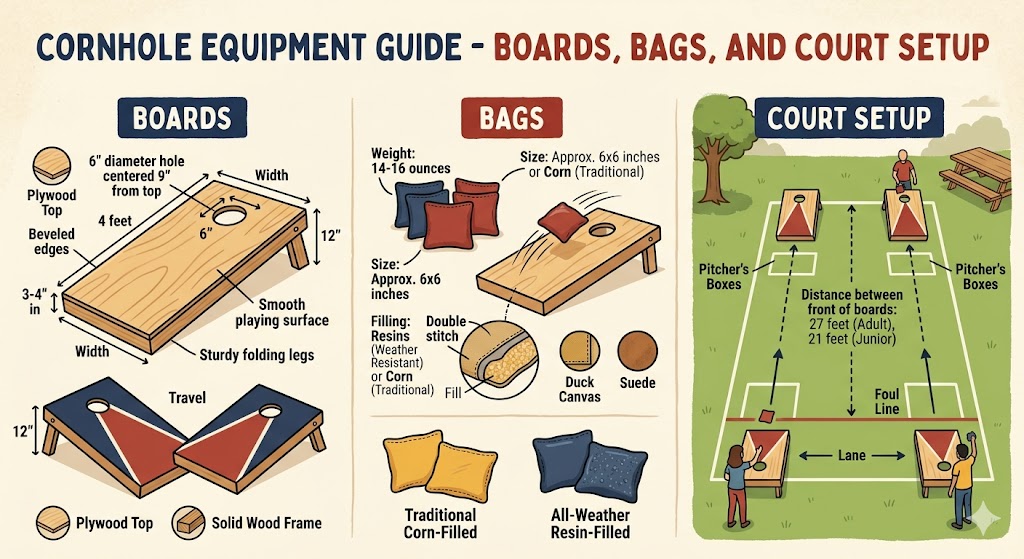
A regulation board measures:
- 48 inches long
- 24 inches wide
The front edge of the board sits 3 to 4 inches above the ground.
The back edge rises to 12 inches high.
This angled surface creates the distinctive slope that allows bags to slide toward the hole.
The hole itself measures 6 inches in diameter.
It sits 9 inches from the top edge of the board and remains centered from left to right.
When players practice with regulation boards, they develop muscle memory that translates well to tournament play.
Materials Used for Cornhole Boards
Most quality cornhole boards use plywood construction.
Professional boards typically use ½-inch or ¾-inch cabinet-grade plywood for the playing surface.
This material creates a strong and smooth throwing surface.
Some inexpensive boards use particle board or thin composite materials.
While these sets cost less, they may warp or break over time.
High-quality boards also include sturdy wooden frames underneath the playing surface.
These frames prevent bending and maintain stability during gameplay.
Smooth surfaces allow bags to slide naturally toward the hole.
Because of this, many competitive boards receive a protective finish or clear coat.
Board Surface and Slide Speed
The board’s surface finish directly affects how bags behave.
A slick finish allows bags to slide easily.
A rough finish causes bags to stop quickly.
Professional players often prefer boards with moderate slide speed. This balance allows bags to slide forward without flying off the back edge.
Surface conditions also change over time.
Dust, humidity, and temperature may affect sliding speed.
Experienced players adjust their throwing style depending on board conditions.
Developing these adjustments becomes easier when players understand their equipment.
Cornhole Bags Explained
Cornhole bags may appear simple, but their design plays a major role in gameplay.
Each team uses four bags during a game.
Official bags measure 6 inches by 6 inches.
They must weigh between 15 and 16 ounces.
These standardized measurements ensure fair competition.
If bags weigh too little, they may drift off course during flight.
If bags weigh too much, they may bounce or slide unpredictably.
Proper weight allows players to throw accurately and control bag movement on the board.
Corn-Filled vs Resin-Filled Bags
Traditional cornhole bags contain dried corn kernels.
However, many modern bags use plastic resin pellets instead.
Both options have advantages.
Corn-filled bags offer a classic feel and traditional gameplay experience.
However, they can absorb moisture over time.
Moisture may cause bags to swell or break down.
Resin-filled bags solve this problem.
Resin pellets resist moisture and maintain consistent weight.
Because of this durability, many competitive players prefer resin bags.
Understanding bag materials helps players choose the right equipment for their playing environment.
Dual-Sided Cornhole Bags
Many competitive cornhole bags feature two different fabric surfaces.
One side slides easily across the board.
The other side grips the surface and stops faster.
Players use these differences strategically.
For example:
A sliding side works well when players want the bag to move toward the hole.
A gripping side works well when players want to block the hole or stop the bag quickly.
Learning how to use both sides improves scoring opportunities.
To learn how players control these throws, read How to Throw a Cornhole Bag Like a Pro: Techniques and Form Tips.
Cornhole Court Setup
Equipment alone does not create a proper cornhole game.
The layout of the court also matters.
The standard distance between boards measures 27 feet from front edge to front edge.
This distance applies to adult competitive play.
Some recreational games shorten the distance to make the game easier for beginners.
However, practicing with the regulation distance prepares players for leagues and tournaments.
Each board also includes pitching boxes where players stand during their throws.
Proper court setup ensures both teams play under the same conditions.
If you want a detailed guide to building your own playing area, read How to Build a Backyard Cornhole Court: Layout, Distance, and Setup.
Choosing the Right Playing Surface
Cornhole courts can sit on several types of surfaces.
Common playing surfaces include:
- Grass
- Concrete
- Packed gravel
- Indoor flooring
Each surface affects gameplay slightly.
Grass absorbs impact and reduces bag bounce.
Concrete creates faster gameplay because bags bounce more easily.
Indoor courts often provide the most consistent playing conditions.
Serious players sometimes practice on multiple surfaces to prepare for different environments.
Cornhole Scoreboards and Accessories
While not required, many players use accessories to enhance gameplay.
Common cornhole accessories include:
Scoreboards that track points during matches.
Carrying cases for transporting bags.
Board lights for nighttime games.
Cup holders and drink shelves built into boards.
These accessories do not affect official gameplay, but they can improve convenience and organization.
Competitive tournaments often use digital scoreboards or referees to track scoring accurately.
If you want to understand how scoring works during official matches, see Cornhole Scoring Rules: How Points Work and How to Win Games Faster.
Portable Cornhole Sets
Many players prefer portable equipment because it allows them to bring the game to parties, parks, or tailgates.
Portable sets often include folding legs or lightweight construction.
Some boards even fold together like a suitcase.
Portable equipment makes cornhole one of the most travel-friendly games available.
However, players who plan to practice seriously should still train with regulation boards whenever possible.
Maintaining Cornhole Equipment
Proper maintenance extends the life of cornhole equipment.
Boards should remain dry whenever possible.
Moisture may warp wood surfaces or damage finishes.
Cleaning the board surface regularly removes dirt and debris that could affect bag sliding.
Bags also require occasional care.
Corn-filled bags should remain dry to prevent mold or breakdown.
Resin bags may be washed gently when they become dirty.
Maintaining equipment ensures consistent performance during games.
Equipment Differences in Backyard vs Tournament Play
Backyard cornhole sets vary widely in quality.
Some inexpensive sets use plastic boards or lightweight materials.
These sets work well for casual entertainment but may not follow official measurements.
Tournament equipment always follows strict specifications.
Regulation boards, official bag weights, and standard court distances ensure fair competition.
Players who want to compete should practice with regulation equipment whenever possible.
If you are interested in competitive play, read Cornhole Tournaments and Leagues: How Competitive Cornhole Works.
Understanding tournament environments helps players prepare for higher levels of competition.
Equipment and Strategy
Equipment does more than provide a playing surface.
It also influences strategy.
For example:
A fast board surface may encourage softer throws.
A slow board may require stronger pushes toward the hole.
Bag materials also affect shot selection.
Sliding bags work well for push shots and hole runs.
Gripping bags work well for defensive blocking.
Players who understand equipment behavior can adapt their strategies more effectively.
If you want to learn advanced tactics, read Winning Cornhole Strategies: Offensive and Defensive Tactics That Work.
Avoiding Common Equipment Mistakes
Many beginners make equipment mistakes that affect gameplay.
One common mistake involves using boards that are too small or too light.
These boards may shift during play and disrupt throwing accuracy.
Another mistake involves using bags with inconsistent weight.
Uneven bags can produce unpredictable throws.
Players also sometimes place boards too close together.
Shorter distances may feel easier but can harm skill development.
If you want to avoid other common beginner mistakes, read Common Cornhole Mistakes Beginners Make and How to Fix Them.
Final Thoughts on Cornhole Equipment
Cornhole equipment may seem simple at first glance, but every component plays an important role in the game.
Board size, bag weight, surface finish, and court layout all influence gameplay.
Understanding these elements helps players improve faster and enjoy more consistent matches.
Beginners can start with basic equipment, but learning regulation standards prepares them for more serious play.
Once players combine proper equipment with good throwing technique and strategy, their performance improves dramatically.
That is when cornhole transforms from a casual backyard game into a competitive and rewarding sport.
Continue Learning Cornhole
To continue building your cornhole knowledge, explore the rest of this learning series:
The Ultimate Beginner’s Guide to Cornhole
Official Cornhole Rules Explained: A Complete Guide for Beginners
Cornhole Scoring Rules: How Points Work and How to Win Games Faster
How to Throw a Cornhole Bag Like a Pro: Techniques and Form Tips
Winning Cornhole Strategies: Offensive and Defensive Tactics That Work
Common Cornhole Mistakes Beginners Make and How to Fix Them
How to Build a Backyard Cornhole Court: Layout, Distance, and Setup
Cornhole Tournaments and Leagues: How Competitive Cornhole Works