
Official Cornhole Rules Explained: A Complete Guide for Beginners
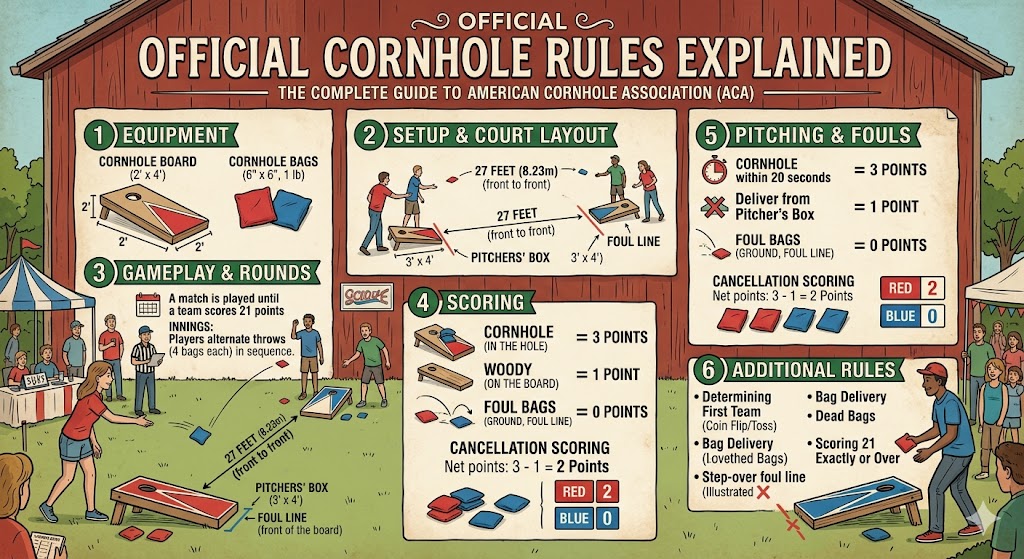
Official Cornhole Rules Explained: A Complete Guide for Beginners
Cornhole looks like one of the simplest lawn games you can play. Two boards face each other across a short distance while players toss small fabric bags toward a hole. The objective seems obvious—get the bag into the hole and score points.
However, once you begin playing regularly, you quickly realize the game follows a structured set of rules. These rules govern everything from court layout and equipment to throwing order and scoring.
Learning the official rules helps beginners avoid confusion and enjoy the game more. It also prepares players who want to compete in leagues or tournaments.
If you are new to the game, you should begin by reading The Ultimate Beginner’s Guide to Cornhole to understand the sport’s history, equipment, and basic gameplay.
This guide focuses specifically on official cornhole rules, explaining exactly how the game works from the first toss to the final point.
Why Official Cornhole Rules Matter
Many people first experience cornhole at backyard parties or tailgate events. In these settings, players often create their own house rules.
For example, some groups shorten the throwing distance or ignore certain fouls.
While these casual variations can be fun, they often lead to disagreements about scoring or gameplay.
Official rules solve that problem.
They establish consistent standards so that every player understands how the game works. When players follow the same rules, competitions remain fair and predictable.
In addition, learning the rules early helps beginners develop better habits.
For example, understanding the scoring system makes it easier to plan throws strategically. For a deeper explanation of scoring strategy, see Cornhole Scoring Rules: How Points Work and How to Win Games Faster.
Regulation Cornhole Court Layout
Every official cornhole game begins with a properly arranged court.
The layout includes two boards positioned directly across from each other on a flat playing surface.
The standard distance between the front edges of the boards is 27 feet.
This measurement applies to adult competitive play.
Some recreational games shorten the distance to make the game easier for beginners. However, official leagues almost always use the full regulation distance.
Players stand beside the boards while throwing.
Each side of the board includes a pitching box where players must remain during their throws.
If you want a detailed explanation of court dimensions and layout, read How to Build a Backyard Cornhole Court: Layout, Distance, and Setup.
Setting up the court correctly ensures fair gameplay for both teams.
Cornhole Board Specifications
Official cornhole boards follow very specific measurements.
Each board must measure:
- 48 inches long
- 24 inches wide
The front of the board stands 3 to 4 inches high.
The back of the board rises to 12 inches high.
This angled surface allows bags to slide toward the hole after landing.
The hole itself measures 6 inches in diameter and sits 9 inches from the top edge of the board.
Most competitive boards use smooth plywood surfaces that allow bags to slide easily during play.
If you want to learn more about board construction and materials, see Cornhole Equipment Guide: Boards, Bags, and Court Setup Explained.
Cornhole Bag Specifications
Cornhole bags also follow strict standards.
Each bag must measure 6 inches by 6 inches.
The weight must fall between 15 and 16 ounces.
Traditional bags contain dried corn kernels. However, many modern bags use plastic resin pellets instead.
Resin bags resist moisture and provide more consistent performance.
Many professional bags also include two different fabric sides.
One side slides easily across the board. The other grips the surface.
These features allow players to control how the bag behaves during different shots.
Understanding equipment differences helps players develop better strategies during games.
Starting a Cornhole Game
Before the game begins, players must determine which team throws first.
This decision usually comes from a coin toss or another random method.
The winning player may choose either:
- The pitching lane
- The first throw
Once the choice is made, the first round begins immediately.
Players alternate throws until each player has thrown four bags.
Then the round ends and scoring occurs.
The Structure of a Cornhole Round
Each cornhole round includes eight total throws.
Each team throws four bags.
The throwing order alternates between teams.
For example:
Player A throws one bag.
Then Player B throws one bag.
This pattern continues until both players have thrown all four bags.
After the final throw, players walk to the opposite boards to calculate the score.
Then the next round begins from that side of the court.
Cornhole Scoring Basics
Cornhole scoring follows a simple point structure.
Players earn:
- 3 points for a bag through the hole
- 1 point for a bag that lands on the board
- 0 points for a missed bag
However, the scoring process includes an important twist called cancellation scoring.
Instead of both teams keeping their full points, only the difference between the scores counts.
Because this system can confuse beginners, it helps to read Cornhole Scoring Rules: How Points Work and How to Win Games Faster for a full explanation.
Understanding scoring mechanics dramatically improves gameplay strategy.
Winning a Cornhole Game
Most cornhole games end when a team reaches 21 points.
The first team to reach or exceed this total wins.
However, many competitive leagues require teams to win by at least two points.
For example:
21–19 ends the game.
21–20 requires another round.
This rule prevents lucky final throws from ending games prematurely.
Instead, teams must clearly outperform their opponents to win.
Player Position and Throwing Rules
Players must remain within the pitching box while throwing their bags.
Stepping outside the box during the throw results in a foul.
Players must also release the bag before crossing the foul line, which sits at the front edge of the board.
If a player steps past the line before releasing the bag, the throw becomes invalid.
Despite these restrictions, players may move freely within the pitching box to find a comfortable throwing stance.
Cornhole Fouls
Fouls occur when players violate specific gameplay rules.
When a foul occurs, the thrown bag does not count.
Several actions may cause fouls.
These include:
Stepping over the foul line before releasing the bag.
Throwing out of turn.
Taking longer than the allowed time limit to throw.
Most competitive leagues allow 20 seconds per throw.
If a player exceeds this limit, the throw may be ruled invalid.
Understanding fouls helps players avoid unnecessary penalties.
Bags That Bounce Onto the Board
Sometimes a bag lands on the ground and then bounces onto the board.
Official rules consider these throws invalid.
These bags must be removed before the next throw.
They do not score points even if they remain on the board.
Removing bounce bags ensures fairness and prevents accidental scoring advantages.
Bags That Hang Over the Hole
Occasionally, a bag lands partially over the hole.
If part of the bag hangs into the hole without touching the ground, it counts as 1 point.
However, if the bag falls through the hole during the round, it becomes a 3-point cornhole.
These situations often produce dramatic moments during competitive matches.
Bag Interactions During Play
Cornhole bags often collide during play.
A thrown bag might push another bag into the hole.
If that happens, the pushed bag still counts as 3 points.
Players frequently use this tactic intentionally.
Push shots can create multiple scoring opportunities during a single round.
If you want to master advanced techniques like this, read How to Throw a Cornhole Bag Like a Pro: Techniques and Form Tips.
Developing accurate throws improves your ability to control bag movement on the board.
Singles vs Doubles Cornhole
Cornhole games can involve either two players or four players.
In singles play, one player stands on each side of the court.
Both players throw four bags per round and then walk to the opposite board for the next round.
In doubles play, teams consist of two players.
Teammates stand on opposite boards.
One teammate throws from each side during the round.
This format reduces walking and speeds up gameplay.
Competitive Cornhole Rules
Recreational games often follow relaxed rules.
Competitive cornhole tournaments enforce strict regulations.
Referees may monitor:
- Court dimensions
- Bag specifications
- Time limits
- Player positioning
Professional leagues also maintain official rulebooks to ensure consistent competition.
If you are interested in organized competition, read Cornhole Tournaments and Leagues: How Competitive Cornhole Works.
Understanding tournament structure prepares players for higher levels of play.
Beginner Tips for Following the Rules
Learning the rules may feel overwhelming at first. However, beginners quickly become comfortable with them through practice.
Start by focusing on three key habits.
First, always stay behind the foul line while throwing.
Second, follow the correct throwing order.
Third, learn the cancellation scoring system.
Once these habits become automatic, the rest of the rules feel natural.
Players who understand the rules also make better strategic decisions during games.
Final Thoughts on Cornhole Rules
Cornhole remains one of the most accessible sports in the world. Almost anyone can learn the basics within minutes.
However, the official rules give the game structure and fairness.
From court setup and bag specifications to scoring and fouls, every rule exists to create a consistent playing experience.
Beginners who learn these rules early build stronger habits and improve faster.
Once the rules become second nature, players can focus on strategy, accuracy, and competition.
And that is when cornhole becomes truly addictive.
Cornhole Learning Cluster
To continue improving your game, explore the rest of this cornhole learning series:
The Ultimate Beginner’s Guide to Cornhole
Cornhole Scoring Rules: How Points Work and How to Win Games Faster
Cornhole Equipment Guide: Boards, Bags, and Court Setup Explained
How to Throw a Cornhole Bag Like a Pro: Techniques and Form Tips
Winning Cornhole Strategies: Offensive and Defensive Tactics That Work
Common Cornhole Mistakes Beginners Make and How to Fix Them
How to Build a Backyard Cornhole Court: Layout, Distance, and Setup
Cornhole Tournaments and Leagues: How Competitive Cornhole Works