
How to Throw a Cornhole Bag Like a Pro: Techniques and Form Tips
How to Throw a Cornhole Bag Like a Pro: Techniques and Form Tips
Cornhole looks simple when you watch people play. Players stand beside a board and toss small bags toward a hole twenty-seven feet away. At first glance, the motion seems casual and effortless.
However, experienced players know that throwing a cornhole bag consistently requires skill and technique. Professional players spend hours refining their mechanics, adjusting their grip, and practicing repeatable throwing motions.
Beginners often struggle with accuracy because they rely on random tossing instead of controlled technique. Fortunately, a few fundamental adjustments can dramatically improve consistency.
If you are just getting started with the game, it helps to first understand the basics covered in The Ultimate Beginner’s Guide to Cornhole.
This article focuses specifically on throwing technique, explaining how to grip the bag, control spin, adjust your stance, and develop a smooth throwing motion.
Mastering these fundamentals will help you throw more accurate shots and score more points during games.
Why Throwing Technique Matters in Cornhole
Many beginners assume cornhole depends mostly on luck. They simply toss the bag toward the board and hope it lands in the hole.
However, experienced players approach the game very differently.
They focus on consistency and control.
A good throw follows the same motion every time. The bag leaves the hand with the same spin, the same arc, and the same speed.
Consistency creates accuracy.
Once a player develops reliable mechanics, improving becomes much easier.
Understanding technique also helps players apply strategy during games. For example, a controlled throw makes it easier to block the hole or push another bag forward.
If you want to understand how those scoring decisions affect gameplay, read Cornhole Scoring Rules: How Points Work and How to Win Games Faster.
The Proper Cornhole Grip
Everything begins with the grip.
A proper grip controls the bag during both the backswing and the release.
Most experienced players hold the bag using a four-finger grip.
The fingers spread across the underside of the bag while the thumb rests on top.
This grip provides balance and stability during the throw.
Some players prefer gripping the bag closer to one corner.
Others hold it near the center.
Both methods can work well.
The key is maintaining a grip that allows the bag to leave your hand smoothly.
A clean release creates better spin and more predictable flight.
Choosing the Correct Side of the Bag
Many modern cornhole bags feature two different fabric sides.
One side slides easily across the board.
The other side grips the surface and stops quickly.
Players choose which side to throw depending on their strategy.
For example:
The sliding side works well when trying to reach the hole.
The gripping side works well when trying to block the hole.
Understanding how bag materials behave becomes easier after reading Cornhole Equipment Guide: Boards, Bags, and Court Setup Explained.
Equipment knowledge helps players adjust their throws more effectively.
The Ideal Cornhole Stance
Your stance plays a major role in throwing accuracy.
A stable stance allows you to control balance and maintain consistent mechanics.
Most players use one of two stances.
Square Stance
In the square stance, both shoulders face the board.
Your feet remain roughly shoulder-width apart.
This stance works well for beginners because it feels stable and natural.
Open Stance
In the open stance, the throwing-side foot stands slightly behind the other foot.
Your body turns slightly sideways.
Many experienced players prefer this stance because it allows smoother arm motion.
Regardless of which stance you choose, your body should remain relaxed and balanced.
A stable stance supports a smooth throwing motion.
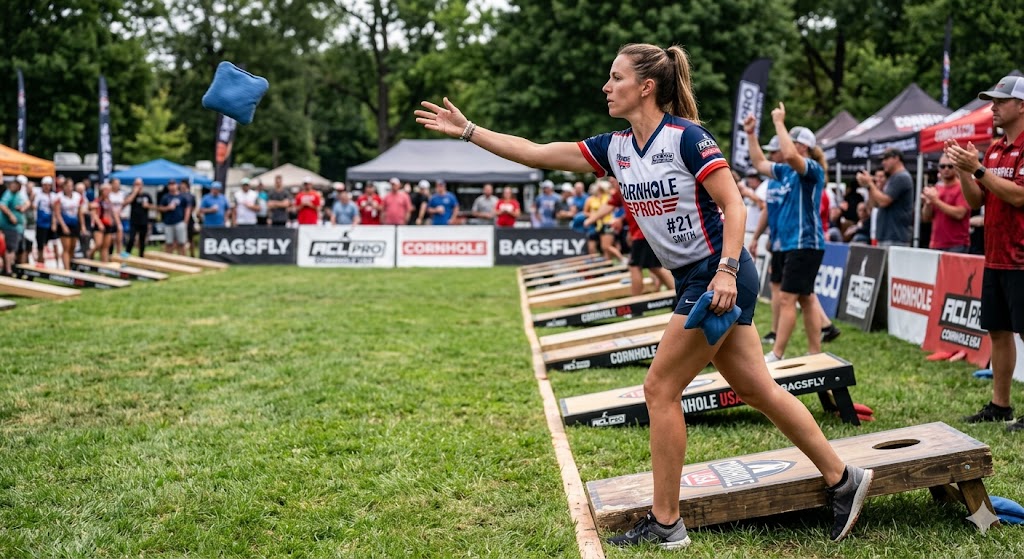
The Cornhole Throwing Motion
The throwing motion should feel smooth and natural.
Most players use an underhand swing, similar to tossing a horseshoe.
The arm moves backward during the backswing and then swings forward toward the board.
As the arm moves forward, the player releases the bag near waist height.
A slight wrist flick creates spin.
This spinning motion stabilizes the bag in the air and improves accuracy.
Avoid forcing the throw.
Instead, focus on a relaxed motion that repeats consistently.
Controlling Bag Spin
Spin helps stabilize the bag during flight.
A spinning bag stays flat in the air instead of wobbling.
This stability improves accuracy and helps the bag land smoothly on the board.
Players create spin by rotating the wrist slightly during the release.
However, the spin should remain gentle.
Too much wrist motion may cause the bag to turn sideways during flight.
A balanced spin produces the best results.
Finding the Right Throwing Arc
The arc refers to how high the bag travels during the throw.
Different players prefer different arcs.
Some players throw with a high arc that drops softly onto the board.
Others use a flatter trajectory that travels faster.
Beginners often benefit from a moderate arc.
This trajectory allows the bag to land softly while still reaching the board easily.
Practicing different arcs helps players discover which style produces the best accuracy.
Practicing the Slide Shot
The slide shot remains one of the most common cornhole throws.
Players aim for the lower half of the board.
When executed correctly, the bag lands and slides toward the hole.
This shot works best on boards with smooth surfaces.
Many players practice landing the bag in the same spot repeatedly.
Once that landing point becomes consistent, the bag will often slide into the hole naturally.
Learning the Airmail Shot
The airmail shot sends the bag directly into the hole without touching the board.
Players usually attempt this shot when the hole becomes blocked by other bags.
Although the shot looks impressive, it requires significant practice.
The throw must travel at the correct height and speed.
Too much power may cause the bag to overshoot the hole.
Too little power may cause the bag to land short.
Professional players practice the airmail shot frequently.
The Push Shot Technique
The push shot uses existing bags on the board.
Players aim their throw at another bag.
When the thrown bag strikes the first bag, both bags may move forward toward the hole.
If executed correctly, both bags may fall into the hole.
This technique can produce large scoring swings during a round.
To understand how this affects scoring strategy, read Winning Cornhole Strategies: Offensive and Defensive Tactics That Work.
Practicing Consistency
Consistency separates casual players from strong competitors.
The goal is to repeat the same throwing motion every time.
Players should practice focusing on three key elements:
Grip
Release point
Arc
Practicing these fundamentals regularly builds muscle memory.
Once the motion becomes automatic, accuracy improves dramatically.
Many experienced players practice several short sessions each week rather than long occasional sessions.
Regular practice keeps the throwing motion sharp.
Common Throwing Mistakes
Most beginners struggle with a few common throwing mistakes.
Recognizing these mistakes helps players correct them quickly.
One mistake involves throwing too hard.
Excessive power often causes bags to bounce off the board.
Another mistake involves inconsistent release points.
Changing the release height or timing can disrupt accuracy.
Players also sometimes rush their throws.
A calm and controlled motion produces better results.
For a full list of beginner errors and solutions, read Common Cornhole Mistakes Beginners Make and How to Fix Them.
Developing a Practice Routine
Improving your throwing technique requires regular practice.
Fortunately, cornhole practice sessions do not need to be long.
Even fifteen to twenty minutes can help.
Players should focus on controlled repetition rather than simply throwing bags randomly.
For example, try practicing specific shots such as:
Landing bags in the center of the board.
Practicing slide shots.
Practicing airmail attempts.
These focused drills build skill much faster than casual tossing.
Adjusting for Different Boards
Not every cornhole board plays the same.
Some boards allow bags to slide easily.
Others create more friction.
Experienced players adjust their throwing style depending on board conditions.
For example:
Faster boards may require softer throws.
Slower boards may require slightly stronger pushes.
Understanding board conditions becomes easier once you understand court layout and equipment standards described in How to Build a Backyard Cornhole Court: Layout, Distance, and Setup.
Practicing on different surfaces also helps players become more adaptable.
How Professional Players Throw
Professional cornhole players emphasize smooth, repeatable mechanics.
Their throws look effortless because they avoid unnecessary movement.
Most professionals release the bag at the same height every time.
Their wrist motion creates controlled spin.
Their stance remains balanced and relaxed.
Watching experienced players can provide valuable insights.
However, beginners should focus on developing their own comfortable technique.
The goal is consistency rather than copying someone else perfectly.
Why Technique Leads to Better Results
Improving your throwing technique affects every part of the game.
Accurate throws make it easier to score points.
They also allow players to execute defensive strategies.
For example, landing a bag directly in front of the hole can block the opponent’s shot.
Strategic throws often determine the outcome of competitive games.
Players who combine strong technique with strategic thinking gain a clear advantage.
If you are interested in competitive play, explore Cornhole Tournaments and Leagues: How Competitive Cornhole Works.
Understanding tournament environments can motivate players to refine their skills further.
Final Thoughts on Cornhole Throwing Technique
Throwing a cornhole bag accurately may look simple, but it requires practice and attention to detail.
Players who focus on grip, stance, arc, and spin quickly improve their consistency.
Developing a smooth and repeatable throwing motion transforms casual tossing into controlled gameplay.
Over time, these skills allow players to experiment with advanced shots such as slides, push shots, and airmail throws.
With practice and patience, anyone can improve their cornhole accuracy.
Once your throwing technique becomes reliable, the game becomes even more enjoyable and competitive.
Continue Learning Cornhole
To improve your understanding of the game, explore the rest of this cornhole learning series:
The Ultimate Beginner’s Guide to Cornhole
Official Cornhole Rules Explained: A Complete Guide for Beginners
Cornhole Scoring Rules: How Points Work and How to Win Games Faster
Cornhole Equipment Guide: Boards, Bags, and Court Setup Explained
Winning Cornhole Strategies: Offensive and Defensive Tactics That Work
Common Cornhole Mistakes Beginners Make and How to Fix Them
How to Build a Backyard Cornhole Court: Layout, Distance, and Setup
Cornhole Tournaments and Leagues: How Competitive Cornhole Works