
Winning Cornhole Strategies: Offensive and Defensive Tactics That Work
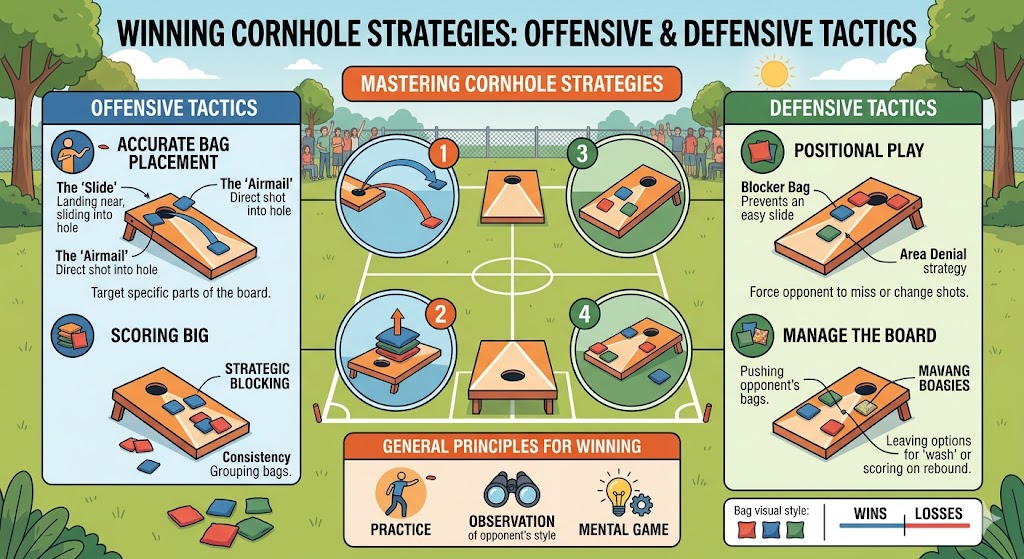
Winning Cornhole Strategies: Offensive and Defensive Tactics That Work
Cornhole may look like a simple backyard game, but winning consistently requires more than just tossing bags toward a board. Skilled players rely on strategy, positioning, and smart decision-making to control the board and limit their opponent’s scoring opportunities.
Beginners often focus only on throwing the bag into the hole. While that approach may produce occasional success, experienced players understand that strategy determines the outcome of many games.
Learning when to play aggressively and when to defend can dramatically improve your results.
If you are new to the sport, start by reviewing The Ultimate Beginner’s Guide to Cornhole to understand the basics of gameplay, equipment, and scoring.
This article focuses specifically on winning strategies, including offensive techniques, defensive positioning, and decision-making tactics that successful players use during matches.
Why Strategy Matters in Cornhole
Many beginners assume that the best player always wins simply by throwing the most bags into the hole.
However, experienced players know the game involves far more than raw accuracy.
Smart players think about every throw.
They ask questions such as:
Should I try to score three points?
Should I block the hole?
Should I push another bag forward?
These decisions shape the entire round.
Strategic thinking becomes even more important once players understand the scoring system. Because cornhole uses cancellation scoring, controlling the board can limit the opponent’s ability to gain points.
To fully understand how this system affects strategy, read Cornhole Scoring Rules: How Points Work and How to Win Games Faster.
Offensive Cornhole Strategies
Offensive strategies focus on maximizing scoring opportunities.
When players have a clear path to the hole, aggressive scoring becomes the best option.
However, offense still requires precision and planning.
Successful offensive players use a combination of accurate throws and smart positioning.
The Hole Run Strategy
One of the most aggressive strategies in cornhole is the hole run.
This approach focuses on throwing every bag directly toward the hole.
Professional players often attempt hole runs when the board remains clear of obstacles.
If all four bags land in the hole, the player scores 12 points in a single round.
However, this strategy carries risk.
Missed throws may slide off the board and produce zero points.
Players must evaluate the situation carefully before committing to a hole run.
The Slide Shot Strategy
The slide shot represents one of the most reliable offensive techniques.
Players aim for the lower portion of the board.
The bag lands and slides upward toward the hole.
This technique works especially well on smooth boards.
Many experienced players practice landing their bags in the same spot repeatedly.
Consistent landing positions often lead to predictable slides toward the hole.
Developing this technique becomes easier after studying How to Throw a Cornhole Bag Like a Pro: Techniques and Form Tips.
Improving throwing mechanics makes offensive strategies far more effective.
The Push Shot Strategy
Push shots allow players to use bags already on the board.
Instead of aiming directly for the hole, players target another bag.
When the thrown bag hits the first bag, both bags may move toward the hole.
If both bags fall through the hole, the player scores six points with a single throw.
Push shots require careful aim and controlled power.
Too much force may push both bags off the board.
Too little force may fail to move the bag at all.
Practicing push shots helps players create scoring opportunities even when the hole appears blocked.
The Airmail Strategy
The airmail shot sends the bag directly into the hole without touching the board.
Players typically attempt this shot when the hole becomes blocked by another bag.
Although difficult, the airmail shot can completely bypass defensive obstacles.
Professional players use this technique frequently during competitive matches.
However, beginners should approach the airmail shot carefully.
Missed attempts often land off the board and score zero points.
Defensive Cornhole Strategies
Defense plays an equally important role in cornhole.
Sometimes preventing the opponent from scoring becomes more valuable than scoring yourself.
Defensive strategies focus on controlling the board and limiting easy shots.
The Block Shot Strategy
Blocking the hole remains one of the most effective defensive tactics.
Players intentionally land a bag directly in front of the hole.
This bag creates an obstacle that prevents opponents from sliding their bags into the hole easily.
Now the opponent must either:
Throw around the block.
Attempt an airmail shot.
Or push the blocking bag forward.
Each option increases the difficulty of the shot.
Blocking often forces opponents to make mistakes.
The Dirty Board Strategy
Another defensive tactic involves filling the board with bags.
Players intentionally land bags in the center area.
This creates congestion on the board.
When the board becomes crowded, opponents struggle to find clear throwing lanes.
Even skilled players may struggle to score consistently under these conditions.
This strategy works particularly well against aggressive players who rely heavily on hole runs.
Strategic Bag Placement
Experienced players think carefully about where each bag lands.
Instead of throwing randomly, they aim for specific locations.
For example:
Landing a bag near the hole may create push-shot opportunities later in the round.
Landing a bag in front of the hole may create a defensive block.
Landing a bag near the center may create board control.
Strategic placement often determines which team controls the round.
Understanding these concepts helps players make smarter decisions during games.
Reading the Board
Successful cornhole players constantly evaluate the board during a round.
They observe factors such as:
Bag positions.
Slide speed.
Open throwing lanes.
Based on these observations, they adjust their strategy.
For example, if the hole becomes blocked, the player may attempt a push shot or airmail.
If the board remains clear, aggressive scoring becomes more attractive.
Reading the board correctly allows players to adapt quickly.
Score-Based Strategy
The score also influences strategic decisions.
For example:
A team leading late in the game may focus on defensive blocking.
A team trailing late may attempt aggressive hole runs.
Understanding when to change strategy becomes easier once players understand the scoring system explained in Cornhole Scoring Rules: How Points Work and How to Win Games Faster.
Score awareness helps players choose the most effective tactics during each round.
Managing Risk
Every throw carries risk.
Aggressive throws may produce large scoring opportunities.
However, they may also lead to missed bags.
Defensive throws may reduce scoring opportunities for both teams.
Successful players learn how to balance risk and reward.
They evaluate each situation carefully before choosing their shot.
Sometimes the safest option produces the best result.
Partner Strategy in Doubles Play
Doubles cornhole introduces another strategic layer.
Teammates must coordinate their throws.
For example:
One player may focus on blocking the hole.
The partner may attempt push shots or scoring opportunities.
Communication helps teams make smarter decisions.
Strong teamwork often defeats teams with better individual throwing skills.
Adjusting Strategy for Board Conditions
Board conditions can affect strategy dramatically.
Fast boards may cause bags to slide farther than expected.
Slow boards may cause bags to stop quickly.
Players must adjust their throws and strategy based on these conditions.
Understanding board behavior becomes easier after reading Cornhole Equipment Guide: Boards, Bags, and Court Setup Explained.
Knowledge of equipment helps players adapt their strategy more effectively.
Avoiding Strategic Mistakes
Many beginners lose games because they ignore strategy.
Common mistakes include:
Always aiming for the hole regardless of board conditions.
Ignoring defensive opportunities.
Failing to consider the score during the round.
Recognizing these mistakes helps players improve faster.
For more detailed advice, see Common Cornhole Mistakes Beginners Make and How to Fix Them.
Correcting these habits can significantly improve performance.
Practicing Strategic Thinking
Strategy improves through experience and observation.
Players should practice thinking about their options before each throw.
Ask yourself:
Where should this bag land?
What will this throw accomplish?
Will it help or hurt my scoring position?
Over time, these decisions become instinctive.
Experienced players often evaluate board conditions within seconds.
Strategy in Competitive Cornhole
Competitive cornhole emphasizes strategy even more strongly.
Professional players rarely waste throws.
Every bag serves a purpose.
They constantly adjust their tactics based on the score, board conditions, and opponent behavior.
Watching professional matches can help beginners understand advanced strategies.
If you want to explore organized competition, read Cornhole Tournaments and Leagues: How Competitive Cornhole Works.
Learning about tournament play can inspire players to refine their strategic thinking.
Final Thoughts on Cornhole Strategy
Cornhole strategy transforms the game from casual entertainment into a thoughtful competition.
Players who understand both offensive and defensive tactics gain a major advantage.
Aggressive scoring, defensive blocking, push shots, and board control all play important roles.
However, the best players know when to switch between offense and defense.
They evaluate the board, consider the score, and choose the smartest option for each throw.
With practice and experience, these strategic decisions become second nature.
Once you combine strong strategy with accurate throwing technique, you begin to see why cornhole has become one of the most competitive backyard sports in the country.
Continue Learning Cornhole
Explore the rest of this cornhole learning series:
The Ultimate Beginner’s Guide to Cornhole
Official Cornhole Rules Explained: A Complete Guide for Beginners
Cornhole Scoring Rules: How Points Work and How to Win Games Faster
Cornhole Equipment Guide: Boards, Bags, and Court Setup Explained
How to Throw a Cornhole Bag Like a Pro: Techniques and Form Tips
Common Cornhole Mistakes Beginners Make and How to Fix Them
How to Build a Backyard Cornhole Court: Layout, Distance, and Setup
Cornhole Tournaments and Leagues: How Competitive Cornhole Works