
Common Cornhole Mistakes Beginners Make and How to Fix Them
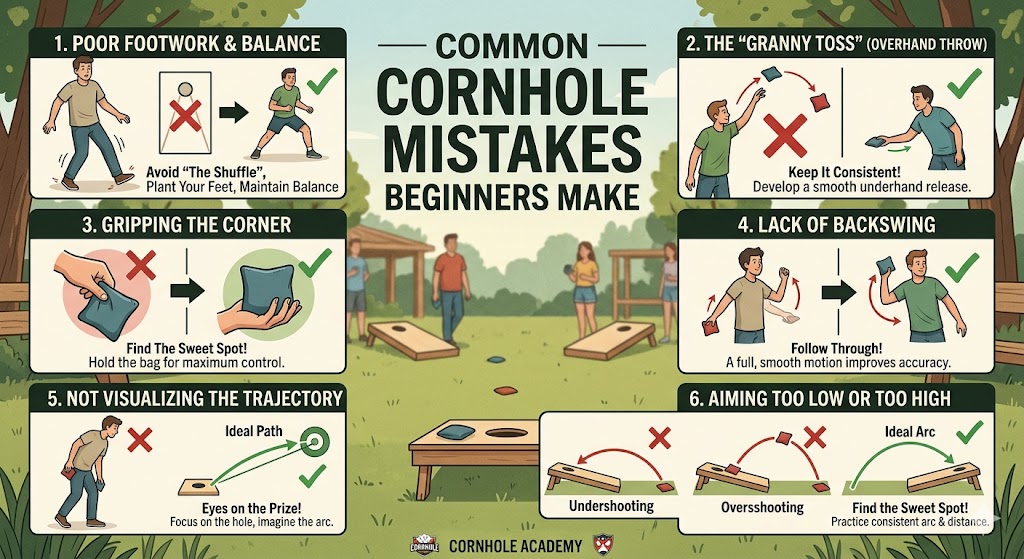
Common Cornhole Mistakes Beginners Make and How to Fix Them
Cornhole looks simple at first glance. Players toss small bags toward a raised board and aim for a hole in the center. Because the rules appear straightforward, many people assume the game requires very little skill.
However, beginners often discover that hitting the hole consistently can be surprisingly difficult. Bags land short, slide off the board, or miss the target completely.
The reason is simple. Most new players make a series of common mistakes that limit their accuracy and consistency.
Fortunately, these mistakes are easy to fix once you recognize them.
If you are new to the game, start by reviewing The Ultimate Beginner’s Guide to Cornhole. That article explains the basic rules, scoring system, and gameplay structure.
In this guide, we will focus on the most common beginner mistakes and provide practical solutions to help you improve faster.
Correcting these habits can dramatically improve your accuracy and confidence on the board.
Why Beginners Struggle With Cornhole
Many beginners approach cornhole casually. They grab a bag and toss it toward the board without thinking much about technique.
Unfortunately, this approach often creates bad habits.
Players develop inconsistent throwing motions. They change their grip from throw to throw. They also rush their shots instead of focusing on control.
Because of these habits, accuracy becomes unpredictable.
Experienced players, on the other hand, rely on repeatable mechanics and consistent strategy.
They treat every throw as part of a larger plan.
Once beginners begin focusing on technique and strategy, their performance usually improves quickly.
Mistake #1: Throwing Too Hard
One of the most common mistakes beginners make is throwing the bag with too much force.
Many players assume that stronger throws increase their chances of reaching the hole. In reality, excessive power usually causes the bag to bounce off the board or slide completely past the hole.
A strong throw also reduces accuracy.
The harder you throw, the more difficult it becomes to control the bag’s trajectory.
How to Fix It
Focus on smooth, controlled throws rather than power.
Most successful players use a relaxed underhand motion that allows the bag to travel in a gentle arc.
The bag should land softly on the board rather than crashing into it.
Practicing this controlled motion helps players improve accuracy dramatically.
If you want to refine your throwing mechanics, read How to Throw a Cornhole Bag Like a Pro: Techniques and Form Tips.
That guide explains proper grip, stance, and release techniques.
Mistake #2: Inconsistent Grip
Another common beginner problem involves grip inconsistency.
Some players hold the bag differently on every throw.
They may grab a corner on one toss and hold the center on the next.
Changing grips constantly disrupts accuracy and spin.
The bag leaves the hand differently each time, which makes it harder to control the flight path.
How to Fix It
Choose a comfortable grip and use it consistently.
Many experienced players use a four-finger grip, placing their fingers underneath the bag and their thumb on top.
This grip helps stabilize the bag during the throw.
Consistency matters more than the exact grip style.
Once your hand position becomes consistent, your throws will become more predictable.
Mistake #3: Ignoring Bag Spin
Spin plays an important role in cornhole accuracy.
A bag with controlled spin flies more smoothly through the air.
Without spin, the bag may wobble or flip unexpectedly.
Many beginners release the bag without any spin at all.
This causes unstable flight and inconsistent landings.
How to Fix It
Add a gentle wrist motion during the release.
This motion should create light spin without forcing the bag to rotate aggressively.
The goal is stability.
A smoothly spinning bag will travel more predictably and land more softly on the board.
Practicing slow, controlled throws helps develop this technique naturally.
Mistake #4: Poor Stance and Balance
Body position affects accuracy more than many beginners realize.
Some players stand awkwardly or shift their weight during the throw.
Others lean too far forward or backward.
These balance issues disrupt the throwing motion and cause inconsistent results.
How to Fix It
Adopt a stable stance before each throw.
Most players prefer either a square stance or an open stance.
Both approaches can work well.
The key is maintaining balance and keeping your body relaxed throughout the motion.
A steady stance supports a smooth and repeatable throw.
Mistake #5: Aiming Only for the Hole
Many beginners believe that every throw should aim directly for the hole.
While scoring three points feels satisfying, constantly aiming for the hole can lead to missed opportunities.
Sometimes the smartest throw involves landing the bag on the board instead.
Strategic placement can block opponents or create scoring opportunities later in the round.
How to Fix It
Think about strategy before each throw.
Ask yourself what outcome will help your team the most.
For example, landing a bag in front of the hole may block your opponent’s slide shot.
Understanding these decisions becomes easier after reading Winning Cornhole Strategies: Offensive and Defensive Tactics That Work.
Strategic thinking improves both offense and defense.
Mistake #6: Ignoring Board Conditions
Not all cornhole boards behave the same way.
Some boards allow bags to slide easily.
Others create more friction and cause bags to stop quickly.
Beginners often fail to notice these differences.
They continue throwing the same way even when conditions change.
How to Fix It
Observe how the bags react on the board.
If the board is fast, use softer throws.
If the board is slow, add slightly more force.
Understanding equipment differences helps players adjust more effectively.
You can learn more about board surfaces and bag materials in Cornhole Equipment Guide: Boards, Bags, and Court Setup Explained.
Mistake #7: Rushing the Throw
Many beginners rush their throws, especially during competitive games.
They grab a bag quickly and toss it without thinking about their motion.
Rushing creates inconsistent mechanics.
Even small timing changes can affect accuracy.
How to Fix It
Slow down before each throw.
Take a moment to focus on your stance and grip.
Then execute your throw smoothly.
Developing a short routine before each throw can improve consistency.
Many experienced players repeat the same routine during every round.
Mistake #8: Poor Shot Selection
Sometimes beginners attempt advanced shots that they have not yet mastered.
For example, they may try a difficult airmail shot when a simple slide shot would be safer.
This approach often leads to missed opportunities.
How to Fix It
Choose the highest percentage shot.
If the hole is open, a slide shot may provide the best chance of scoring.
If the hole is blocked, a push shot may work better.
Careful shot selection improves overall scoring consistency.
Mistake #9: Forgetting the Score
Cornhole strategy changes depending on the score.
However, beginners often ignore this factor.
They continue playing aggressively even when their team holds a large lead.
This approach can allow opponents to catch up quickly.
How to Fix It
Always keep track of the score.
If your team leads late in the game, defensive shots may become more valuable than aggressive scoring attempts.
Understanding the scoring system helps players make smarter decisions.
For a detailed explanation, read Cornhole Scoring Rules: How Points Work and How to Win Games Faster.
Mistake #10: Lack of Practice
Some beginners expect instant improvement without practice.
Unfortunately, cornhole accuracy requires repetition and muscle memory.
Players who practice regularly develop smoother throwing motions and better control.
How to Fix It
Create a simple practice routine.
Spend fifteen to twenty minutes practicing a few times per week.
Focus on specific goals, such as landing bags in the center of the board or practicing slide shots.
Short practice sessions produce steady improvement over time.
How Practice Builds Confidence
Practice does more than improve accuracy.
It also builds confidence.
Players who trust their throwing mechanics feel more relaxed during games.
This relaxed mindset leads to smoother throws and better results.
Confidence also helps players make better strategic decisions.
Instead of guessing, they rely on experience and practice.
Over time, consistent practice transforms beginners into strong competitors.
Learning From Competitive Play
Playing against experienced opponents provides valuable lessons.
You will see how skilled players approach strategy and shot selection.
You may also notice how they control the board with defensive positioning.
These observations can help you refine your own gameplay.
If you want to explore organized competition, read Cornhole Tournaments and Leagues: How Competitive Cornhole Works.
Competitive play introduces new challenges and opportunities to improve.
Final Thoughts on Improving at Cornhole
Every cornhole player starts as a beginner.
Missing shots and making mistakes is part of the learning process.
However, recognizing and correcting common mistakes accelerates improvement dramatically.
Focus on controlled throws, consistent mechanics, and smart strategy.
Pay attention to board conditions and choose the best shot for each situation.
With regular practice and thoughtful gameplay, your accuracy and confidence will continue to grow.
Before long, you may find yourself winning more games and enjoying the sport even more.
Continue Learning Cornhole
Explore the rest of the cornhole learning series:
The Ultimate Beginner’s Guide to Cornhole
Official Cornhole Rules Explained: A Complete Guide for Beginners
Cornhole Scoring Rules: How Points Work and How to Win Games Faster
Cornhole Equipment Guide: Boards, Bags, and Court Setup Explained
How to Throw a Cornhole Bag Like a Pro: Techniques and Form Tips
Winning Cornhole Strategies: Offensive and Defensive Tactics That Work
How to Build a Backyard Cornhole Court: Layout, Distance, and Setup
Cornhole Tournaments and Leagues: How Competitive Cornhole Works